Master the 30-Second Pitch: How to Open Doors Without Sounding Like a Script
Outcome: By the end of this lesson, you will be able to deliver a powerful 30-second pitch using the Hook-Value-Ask framework.
1. The Networking "Appetizer Table" Trap
Picture the scene: You’re at a networking event, coffee in hand, navigating the room. A professional turns to you, the question drops: "So, what do you do?"
Most people answer this question terribly. They recite a job title: "I'm a project manager at a tech company." While factually accurate, it’s not interesting. It doesn’t spark curiosity, and in a competitive job market, it does nothing to differentiate you. It’s an interaction-killer that sends the other person looking for the appetizer table before you’ve even finished your sentence.
As a career strategist, my goal is to help you make people lean in. Your pitch is not a monologue or a verbal resume; it is a conversation opener. Master this, and you transform a standard introduction into a strategic opportunity.
2. The Blueprint: The Hook-Value-Ask Framework
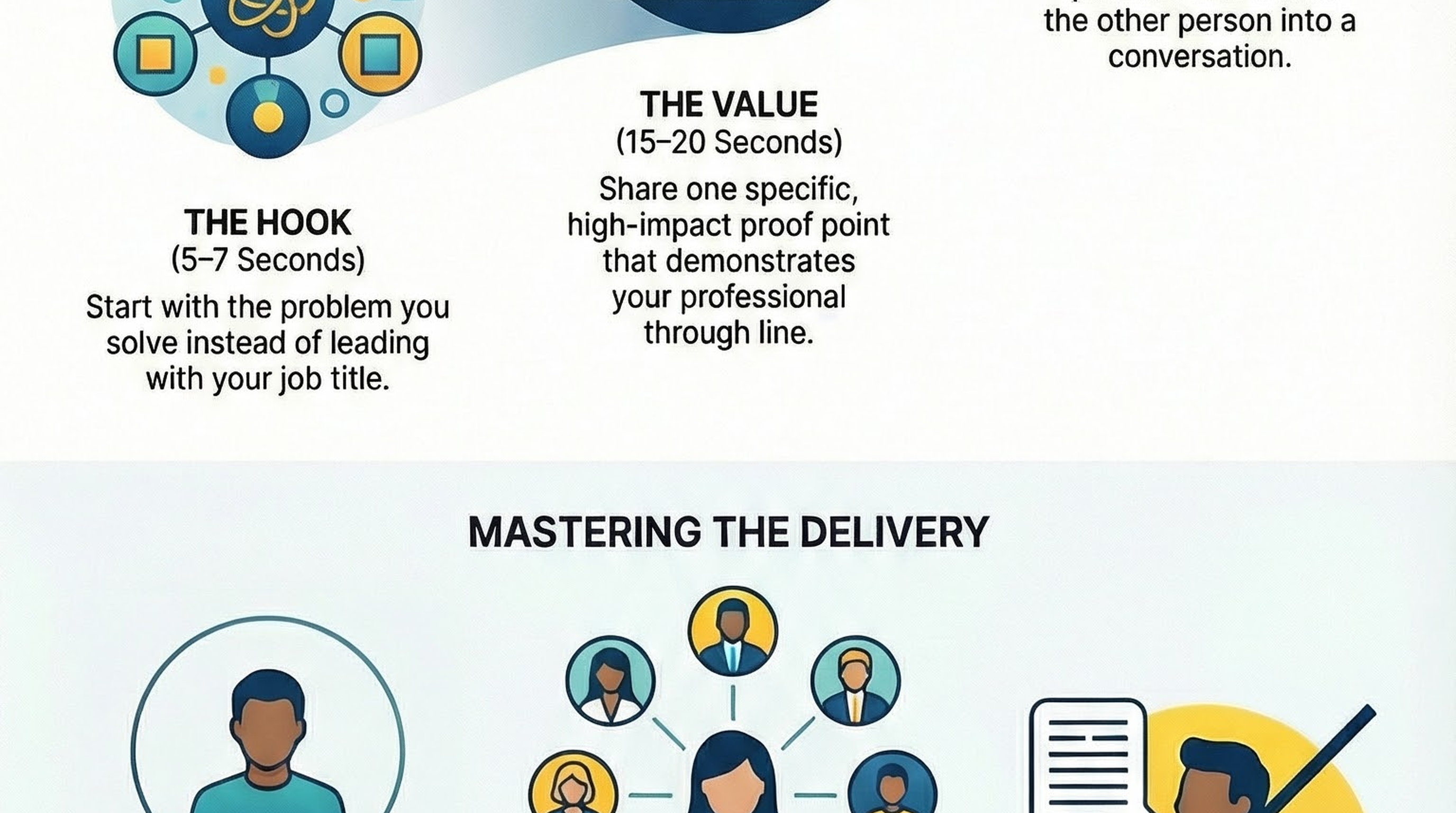
To build a pitch that is both memorable and natural, we use a three-part structure. Central to this is your "Through Line"—the consistent thread of your unique value proposition that connects your past achievements to your future goals.
The Hook (5–7 seconds)
- Purpose: To create immediate curiosity by leading with a problem you solve rather than the role you hold.
- Instead of: "I'm a marketing manager."
- Try This:
"You know how most companies waste half their marketing budget and can't tell you which half? That's the problem I solve."
The Value (15–20 seconds)
- Purpose: To deliver your through line reinforced by exactly one high-impact proof point.
- Instead of: "I have experience in data-driven decision-making and marketing engines."
- Try This:
"I help growth-stage SaaS companies build data-driven marketing engines. At my last company, I redesigned the attribution model and identified $2M in wasted spend within the first quarter."
- Pro-Tip: If you are speaking to a high-level executive, scale your proof point for maximum impact:
"I built a predictive model that identified at-risk customers six months early, saving the company $12M in retention."
The Ask (5–7 seconds)
- Purpose: To start a real conversation. Never ask "Are you hiring?"—it puts people on the defensive.
- Instead of: "Do you know of any openings?"
- Try This:
"I’m exploring opportunities where I can do that at scale. What’s the biggest marketing challenge your team is facing right now?"
3. Know Your Audience: The Art of Adaptation
While your framework remains identical, your language must shift to meet the listener’s level of technical expertise.
| Audience | Emphasis | Language Level (Technicality) |
|---|---|---|
| Recruiter | Role fit + keywords | High (Industry-standard terminology) |
| Peer/Colleague | Shared challenges | Medium (Conversational shop-talk) |
| Executive | Business impact + ROI | Strategic (Outcome-focused) |
| Non-industry | Accessible explanation | Low (Plain language, no jargon) |
Same Message, Different Wrapper: If you’re talking to a marketing peer, your hook might be: "You know how companies struggle with high CAC and messy attribution?" If you’re talking to someone outside your field, you’d wrap that same message differently: "You know how companies spend millions on advertising but can't tell if it's actually working?"
4. Common Pitfalls: Why Most Pitches Fail
Avoid these common traps to ensure your pitch opens doors instead of closing them:
- Starting with your title: Impact: This slots you into a pre-conceived box, making you a commodity rather than a unique problem-solver.
- Listing skills: Impact: People don't remember lists; they remember stories. One proof point is more persuasive than ten claims.
- Being too vague: Impact: Phrasing like "I help companies grow" lacks credibility and fails to stick in the listener’s mind.
- Sounding desperate: Impact: Your pitch should position you as a valuable asset, not a job seeker looking for a favor.
- Making it a monologue: Impact: If you don't end with a question, you've effectively ended the conversation yourself.
5. From Scripted to Natural: The Path to Mastery
The Paradox of the Pitch: You must prepare your pitch meticulously and practice it extensively so that you can deliver it as if you have never rehearsed it at all.
To move from "reciting" to "connecting," follow these coaching steps:
- Practice ideas, not sentences: Memorize the sequence of your Hook, Value, and Ask, but vary the specific words each time. This keeps the delivery fresh and prevents you from sounding like a robot.
- Practice out loud: Speak it in the shower, in the car, or to your dog. Rhythm and pacing matter—what looks good on paper often sounds clunky when spoken.
- Record and review: Use your phone to record your delivery. Listen critically for filler words ("um," "like"), monotone delivery, or rushing.
Repetition Milestones:
- 20 Repetitions: The floor. This is where the pitch starts to feel natural.
- 50 Repetitions: The goal. This is where the delivery becomes effortless and you can focus entirely on the person in front of you.
6. Supercharging Your Prep with AI Tools
AI can be a powerful partner to "stress-test" your pitch in a low-stakes environment before you take it to the real world. Use these applications to refine your delivery:
- Pitch Builder: To draft and iterate on your initial Hook-Value-Ask structure.
- Pitch Coach: To get objective feedback on your tone, clarity, and impact.
- Audience Adapter: To translate your "Value" statement for different stakeholders instantly.
- Pitch Practice Simulator: To roleplay networking scenarios and practice thinking on your feet.
- Follow-Up Question Prep: To anticipate and prepare for the questions your pitch will naturally trigger.
7. The Pitch Quality Checklist
Before you head into your next event, run your pitch through this final review:
- Does it start with a problem/hook, NOT a job title?
- Is my "Through Line" (unique value thread) clearly present?
- Do I have exactly ONE specific, high-impact proof point?
- Does it end with a question that invites a conversation?
- Is it under 30 seconds when spoken at a natural pace?
- Have I eliminated filler words and industry jargon (where appropriate)?
- Does it sound like a confident conversation rather than a performance?
💥 Engagement Zone
- 🎬 Real Story: Priya met a CTO at a casual coffee meetup. She used her "Hook-Value-Ask" pitch. Instead of "I'm looking for a job," she said, "I help fintech startups scale their dev teams without losing culture—do you know anyone facing that hurdle right now?" He hired her as a consultant that afternoon.
- 😂 Humor Touch: A bad pitch is like a bad first date: you talk about yourself for 20 minutes and the other person is looking for the nearest exit. A good pitch makes them want to order dessert.
- 🎮 Gamification: The Voice Memo Test: Record your pitch on your phone. Listen to it. Do you sound like a robot reading a script, or a human solving a problem? If you cringe, record it again! (Repeat until you don't cringe).
- 📊 Self-Assessment: Rate your Pitch Power (1-5 scale):
- I start with a hook that isn't my job title.
- I clearly state the $ or Time value I provide.
- My "Ask" is low-friction and specific. Scoring: 3/3: Door Opener | 1-2: Scripted Seeker | 0: Silence (Time to practice out loud!).
8. Conclusion: Your Most Versatile Tool
Your 30-second pitch is the most versatile tool in your professional toolkit. You will use it in elevators, at high-stakes networking events, during interview "Tell me about yourself" prompts, and in casual encounters that turn into unexpected job leads.
Your 3-Day Master Plan:
- Day 1: Draft your Hook-Value-Ask using the worksheet framework. Define your Through Line.
- Day 2: Create your adapted versions for Recruiters vs. Executives. Practice out loud 20 times.
- Day 3: Record yourself, review against the checklist, and hit the 50-repetition milestone.
Stop reciting your title and start solving problems. Your next great opportunity is just one conversation away.
Accessibility — Image descriptions
| File | Alt text |
|---|---|
GHFE-M03-L05-ENG-the-30-second-pitch-infographic-landscape.png | Infographic for “Master the 30-Second Pitch: How to Open Doors Without Sounding Like a Script”: visual summary of 30 second elevator pitch (landscape layout, GHFE course). |
GHFE-M03-L05-ENG-the-30-second-pitch-infographic-portrait.png | Infographic for “Master the 30-Second Pitch: How to Open Doors Without Sounding Like a Script”: visual summary of 30 second elevator pitch (portrait layout, GHFE course). |
GHFE-M03-L05-ENG-the-30-second-pitch-video-thumbnail-landscape.png | Video thumbnail for “Master the 30-Second Pitch: How to Open Doors Without Sounding Like a Script”: preview image for the lesson video (landscape format). |
GHFE-M03-L05-ENG-the-30-second-pitch-video-thumbnail-portrait.png | Video thumbnail for “Master the 30-Second Pitch: How to Open Doors Without Sounding Like a Script”: preview image for the lesson video (portrait format). |