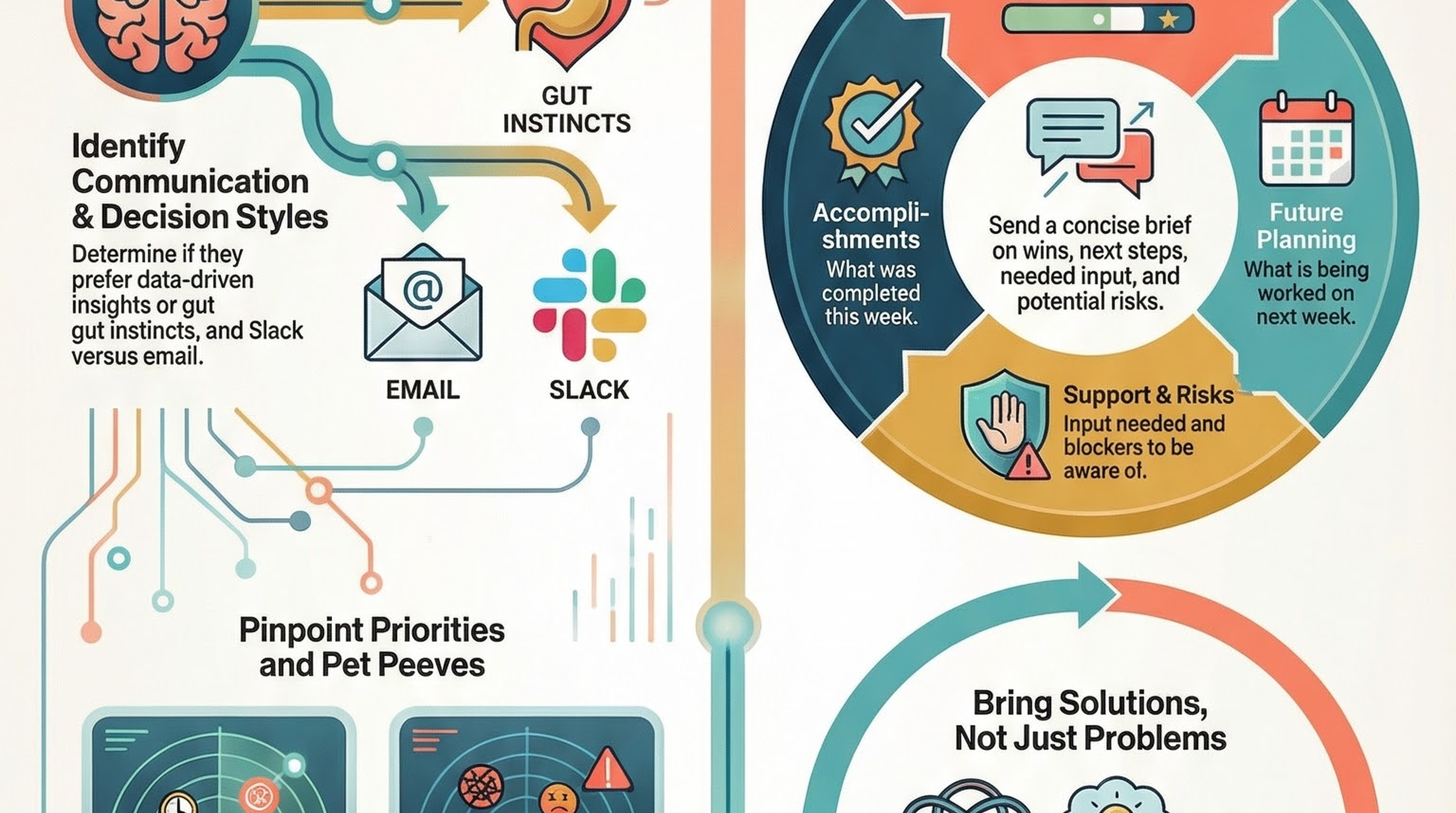
Mastering the Art of Managing Up: Your Strategic Edge in the First 90 Days
Outcome: By the end of this lesson, you will be able to optimize your relationship with your new manager using the Manager OS Decoder.
1. Introduction: Redefining "Managing Up"
"Managing up" is frequently misunderstood as "brown-nosing" or "sucking up" to leadership. In reality, it is a high-stakes partnership and a strategic professional practice. It is the intentional process of understanding your manager's specific needs, communication preferences, and high-level priorities to align your work effectively with their goals.
Make no mistake: mastering this skill is the single biggest factor in determining your trajectory within an organization. By transforming a passive reporting relationship into a proactive alliance, you secure the high-impact projects, the professional autonomy, and the accelerated promotions that define a top-tier career.
2. The Manager Operating System: Decoding Your Boss
Every executive functions with a unique "operating system"—a set of ingrained preferences and requirements for how they process information and execute decisions. To be effective, you must decode this system within your first 14 days.
Use the following assessment table to categorize your observations during your initial weeks:
| Dimension | Key Questions to Observe |
|---|---|
| Communication Preference | Do they prefer Slack, email, or in-person? Do they want long, narrative updates or concise, data-heavy bullet points? |
| Decision-Making Style | Is their process driven by hard data or intuition? Is it collaborative or top-down? |
| Priorities and KPIs | What metrics are they measured on (e.g., revenue, efficiency)? What specific goals keep them up at night? |
| Meeting Preference | How do they like to use their time in 1:1s? Do they want a formal agenda or a casual check-in? |
| Pet Peeves | Do they have a zero-tolerance policy for surprises, lateness, or a lack of detail in reports? |
| What Motivates Them | What are they striving for professionally? What does "winning" look like for them this quarter? |
During your first two weeks, dedicate your focus to observing these patterns. Identifying these nuances allows you to adapt your output to match their expectations perfectly, ensuring you are seen as an asset rather than a liability.
3. Strategic Alignment: Making Their Job Easier
Once you understand your manager's operating system, you must align your work habits to support their success. When your manager succeeds, you succeed.
Incorporate these four actionable strategies into your daily routine:
- Mirroring: Adapt your communication style to match theirs. If they are brief and direct, avoid sending long emails. Do not expect them to adapt to you; the responsibility for alignment lies entirely with you.
- Proactivity: Provide information and status updates before they are requested. This eliminates the need for your manager to "chase" you for data and prevents the professional surprises that erode trust.
- Value-Framing: Frame all requests and updates in the context of your manager’s specific priorities. For example, if your manager is data-driven, bring specific numbers and metrics to every conversation to provide concrete evidence of progress.
- Solution-Orientation: Adopt a "bring solutions, not problems" philosophy. When flagging an issue, always include a recommended course of action: "Here is the challenge we are facing, and here is my recommendation for how we resolve it."
4. The Four-Line Brief: The Weekly Update Framework
The most effective tool for building trust and maintaining a clear paper trail of your accomplishments is the Weekly Update. This five-minute habit positions you as an organized professional and ensures your manager never has to wonder about your progress.
Subject Line: Weekly Update — [Your Name] — Week of [Date]
- Accomplished this week: A concise summary of high-impact wins and completed tasks.
- Working on next week: The primary objectives and strategic priorities on your agenda.
- Need your input on: Specific areas where you require feedback, resources, or a decision from the manager.
- Risks/Blockers: Any potential issues, risks, or blockers that could derail progress.
This brief creates a consistent record of your value, which is indispensable during performance reviews and salary negotiations.
💥 Engagement Zone
🎬 Real Story: The "3-Bullet" Promotion Tom realized his new VP was a "skimmer"—she never read emails longer than three sentences. Tom stopped sending detailed Friday reports and switched to a "3-Bullet Friday" update: one win, one focus, and one blocker. Because he made her life easier, she began trusting him with higher-level strategy. Within 6 months, she promoted him to Chief of Staff, specifically citing his "exceptional communication clarity." Tom didn't work harder; he just "decoded" his boss's brain.
😂 Humor Touch Managing up is like being a professional translator. Your boss speaks "Big Picture/Stress," and you speak "Details/Execution." If you try to give them a 50-page dictionary when they just want to know where the airport is, you’re going to have a bad time. Keep it simple, or they’ll just start hiding in the breakroom when they see you coming.
🎮 Gamification: The "Boss Decoder" Challenge Can you answer these 3 questions about your manager right now?
- The Fear Factor: What is the one metric they are most terrified of missing this quarter? (+10 XP)
- The Channel Check: Do they prefer an informal "heads up" via Slack or a formal calendar invite? (+5 XP)
- The Pet Peeve: What is the one thing (lateness, typos, surprises) that makes them lose trust instantly? (+5 XP)
Target: Score 20 XP for "Alignment Ace" status.
📊 Self-Assessment: The "Value-Framing" Checklist Check off the statements that are true for you over the last 14 days:
- I have framed every project update around their goals, not just my tasks.
- I have never surprised them with bad news in a group meeting (I always do a 1:1 "pre-brief").
- I always bring at least one proposed solution when I flag a problem.
- I have sent a consistent "Weekly Update" (using the Four-Line Brief) every Friday.
Scoring:
- 0-1 Checks: Task Taker. You're doing the work, but you're not yet seen as a partner.
- 2-3 Checks: Reliable Reporter. You're building trust, keep the consistency up.
- 4 Checks: Strategic Partner. You are indispensable and on the fast track for promotion.
5. Leveraging AI to Fast-Track the Relationship
Modern AI tools can be utilized to refine your managing-up strategy and ensure your communication is optimized for maximum impact.
- Manager Style Decoder: Analyze communication patterns and preferences to better understand how to interact with your manager's specific "operating system."
- Weekly Update Optimizer: Refine your four-line brief for maximum clarity, ensuring your accomplishments are framed in a way that resonates with leadership.
- Difficult Conversation Rehearsal: Practice navigating disagreements professionally or requesting additional resources by role-playing the scenario with AI before the actual meeting.
- Progress Documentation: Use AI to maintain a clean, organized record of your wins and milestones throughout your first 90 days.
6. Conclusion: Your 90-Day Success Roadmap
Managing up is not about pleasing a superior; it is about building a strategic framework that allows you to perform your best work with the full support of your leadership. By proactively aligning your work with your manager's needs, you create a productive and mutually beneficial working relationship.
Final Checklist for Your First 90 Days:
- Complete the Manager Style Assessment based on your first two weeks of observation.
- Draft and implement your personalized weekly update template.
- Identify one "early win" to solidify your professional reputation and build trust.
By following this roadmap, you position yourself as a high-performer from day one. In our next lesson, we will dive deeper into how to specifically create those early wins and build a bulletproof professional reputation from the start.
Accessibility — Image descriptions
| File | Alt text |
|---|---|
GHFE-M08-L03-ENG-managing-up-infographic-landscape.png | Infographic for “Mastering the Art of Managing Up: Your Strategic Edge in the First 90 Days”: visual summary of first 90 days new job (landscape layout, GHFE course). |
GHFE-M08-L03-ENG-managing-up-infographic-portrait.png | Infographic for “Mastering the Art of Managing Up: Your Strategic Edge in the First 90 Days”: visual summary of first 90 days new job (portrait layout, GHFE course). |
GHFE-M08-L03-ENG-managing-up-video-thumbnail-landscape.png | Video thumbnail for “Mastering the Art of Managing Up: Your Strategic Edge in the First 90 Days”: preview image for the lesson video (landscape format). |
GHFE-M08-L03-ENG-managing-up-video-thumbnail-portrait.png | Video thumbnail for “Mastering the Art of Managing Up: Your Strategic Edge in the First 90 Days”: preview image for the lesson video (portrait format). |