Master Your Narrative: The Art of Continuous Self-Advocacy
Outcome: By the end of this lesson, you will be able to document and quantify your professional impact using the Wins Journal and Impact Formula.
1. The Uncomfortable Truth About Performance Reviews
The most dangerous myth in corporate life is that your hard work speaks for itself. It does not. The reality is far more clinical: your manager does not—and cannot—remember everything you achieved over the last twelve months. Typically, a manager’s memory is limited to the last eight weeks of performance and perhaps one or two high-visibility outliers. If you are not actively documenting your successes, you are effectively leaving your career progression to chance.
A formal performance review is never a singular annual event; it is merely the summary of a process that occurs every single day. High-performers understand that they must manage their narrative year-round. To ensure your contributions are not just seen but remembered, you must take full ownership of the narrative long before the review meeting begins.
2. The Achievement Documentation System: Your Career Paper Trail
Strategic self-advocacy requires an airtight system of record. Relying on your memory—or your manager’s—is a strategy for failure. You must adopt a disciplined documentation cadence that captures the granular details of your value as they happen.
The cornerstone of this system is the "Five-Minute Friday." This is a non-negotiable ritual for any professional serious about advancement. Every Friday afternoon, you must record your wins. By the time your annual review arrives, you will have fifty-two weeks of bulletproof evidence to draw from, rather than a blank page and a sense of anxiety.
The Documentation Cadence
| Interval | Objective | Action |
|---|---|---|
| Weekly | Wins Journal | Record specific accomplishments, the methods used, and raw Evidence/Metrics. |
| Monthly | Impact Summary | Synthesize weekly entries into high-level contributions to team or departmental goals. |
| Quarterly | Self-Assessment | Draft a formal assessment using the Impact Statement Generator to align wins with KPIs. |
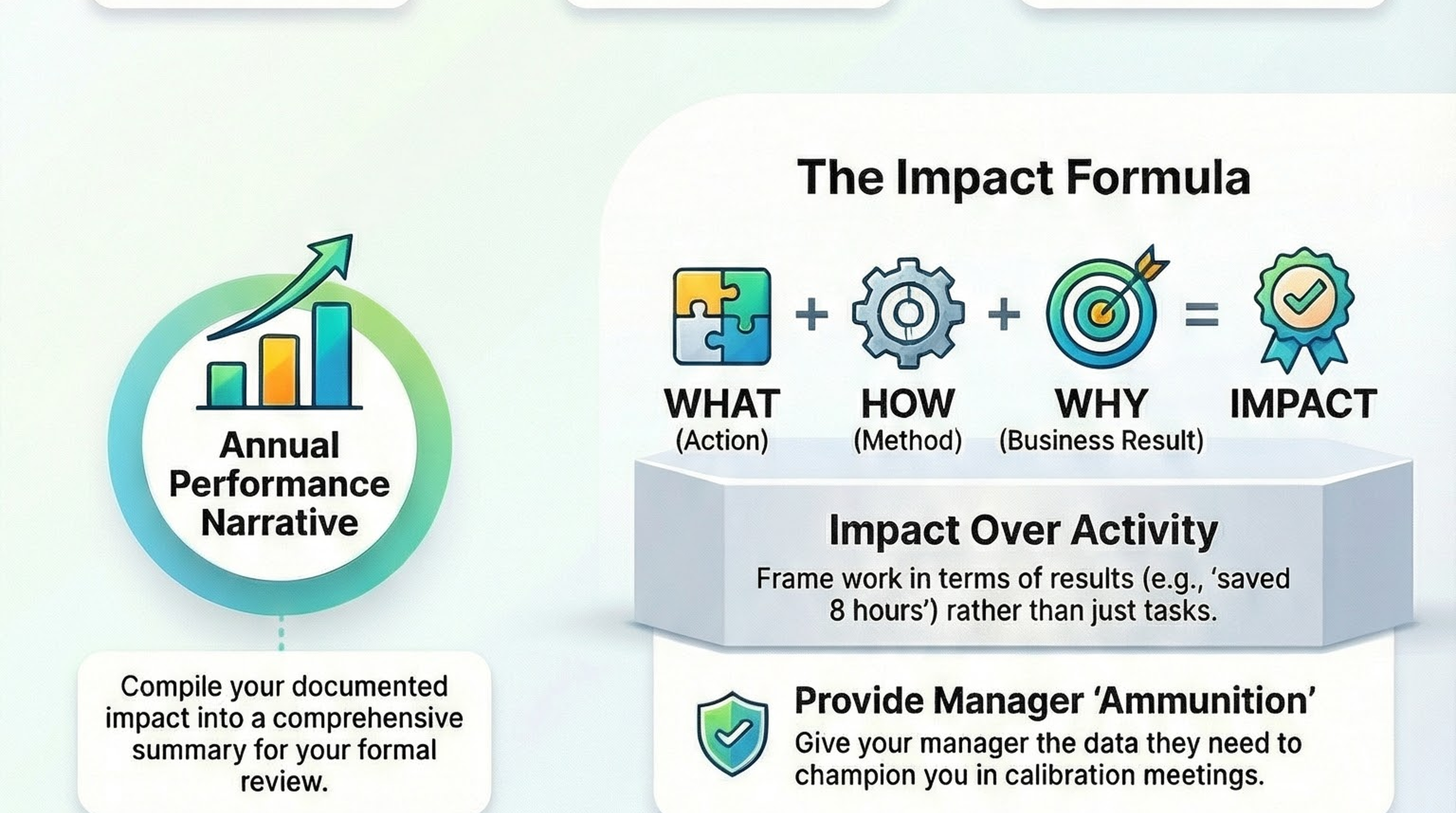
| Annually | Performance Narrative | Compile a comprehensive narrative using your Wins Journal as the primary data source. |
3. Task vs. Impact: Cracking the "Impact Formula"
The most common mistake in self-advocacy is documenting activity instead of results. Your manager does not care that you were busy; they care that you were effective. To elevate your professional standing, you must master the psychological shift from "what I did" to "why it mattered to the business."
Use the following formula to transform your weekly tasks into strategic assets:
The Impact Formula WHAT you did + HOW you did it + WHY it mattered = Impact Statement
Consider the difference between a task-based description and a high-impact narrative:
- Before (Task-focused): "I completed the Q3 report."
- After (Impact-focused): "I redesigned the Q3 reporting process, reducing preparation time by 40% and saving the team eight hours per month, which enabled leadership to make faster, data-driven decisions."
The "After" statement provides a concrete ROI that is impossible to ignore.
4. Reframing Self-Advocacy: Giving Your Manager "Ammunition"
Many professionals struggle with self-promotion due to deeply ingrained cultural values regarding modesty. If you feel that documenting your wins is "boasting," you must reframe your perspective. Strategic self-advocacy is actually a form of service to your manager.
In most organizations, ratings and promotions are finalized in "calibration meetings"—closed-door sessions where managers must justify their team’s ratings to other senior leaders. In these rooms, your manager is your advocate, but they can only be as effective as the data you provide. By delivering clear, metric-driven impact statements, you are providing the "ammunition" they need to champion you in rooms where you are not present. Moving from modesty to clarity isn't about arrogance; it is about providing the necessary data for the organization to function.
5. Leveraging AI: Tools to Streamline Your Narrative
Technology has eliminated the friction of manual documentation. By integrating specific AI tools into your documentation cadence, you can ensure your narrative remains sophisticated and results-oriented without a significant time investment.
- Impact Statement Generator: Use this during your Weekly wins journal entry to instantly transform basic tasks into professional, metric-heavy language.
- Self-Assessment Writer: Deploy this during your Quarterly and Annual reviews to synthesize months of data into a cohesive, persuasive narrative of growth.
- Feedback Preparation: Use this tool to analyze previous reviews and prepare strategic responses for high-stakes performance conversations.
- Career Narrative Builder: Utilize this for long-term planning to ensure your current achievements are building toward your next promotion or role.
💥 Engagement Zone
🎬 Real Story: Marcus, a Senior Developer, worked long hours but stayed quiet. When review season hit, his manager completely forgot that Marcus had personally saved the legacy migration from a catastrophic failure in Q2. Marcus missed out on a $15,000 bonus and the Lead promotion he was eyeing, which went to a much more "vocal" peer who had a simpler, well-documented project.
😂 Humor Touch: Believing your manager will remember your wins is like expecting your cat to remember you fed it ten minutes ago—they both have sudden, selective amnesia when the topic doesn't immediately serve their current focus.
🎮 Gamification: The "Audit-Proof Professional" Challenge: Set a timer for 5 minutes right now. List at least 3 things you did this week that didn't fail. Do this for 4 consecutive weeks to earn the "Career Archivist" badge and never scramble for a review again.
📊 Self-Assessment: Rate your "Narrative Mastery" (1-5):
- I wait for my manager to notice my hard work.
- I try to remember what I did when it's review time.
- I have a folder where I save a few "Good job" emails.
- I update a wins document once a month.
- I have a weekly "Five-Minute Friday" ritual and a metric-backed impact log.
6. Conclusion: Start Your Wins Journal Today
Mastering your career narrative is an ongoing commitment, not a year-end scramble. To secure the recognition and compensation you deserve, internalize these four pillars:
- Document everything: Memory is a sieve; documentation is a fortress.
- Impact > Activity: Frame every contribution in terms of business results and ROI.
- Self-advocacy is service: Provide your manager with the ammunition they need to be your champion.
- Manage the narrative year-round: Your reputation is built in the 364 days leading up to your review.
Call to Action: Start your wins journal today. Do not wait for the next quarter or the next "perfect" project. Your career documentation begins with your very next entry.
Documentation is the essential foundation of your professional brand. In our next session, we will leverage this foundation to build your long-term Career Development Plan.
Accessibility — Image descriptions
| File | Alt text |
|---|---|
GHFE-M09-L01-ENG-wins-journal-infographic-landscape.png | Infographic for “Master Your Narrative: The Art of Continuous Self-Advocacy”: visual summary of narrative continuous self advocacy (landscape layout, GHFE course). |
GHFE-M09-L01-ENG-wins-journal-infographic-portrait.png | Infographic for “Master Your Narrative: The Art of Continuous Self-Advocacy”: visual summary of narrative continuous self advocacy (portrait layout, GHFE course). |
GHFE-M09-L01-ENG-wins-journal-video-thumbnail-landscape.png | Video thumbnail for “Master Your Narrative: The Art of Continuous Self-Advocacy”: preview image for the lesson video (landscape format). |
GHFE-M09-L01-ENG-wins-journal-video-thumbnail-portrait.png | Video thumbnail for “Master Your Narrative: The Art of Continuous Self-Advocacy”: preview image for the lesson video (portrait format). |