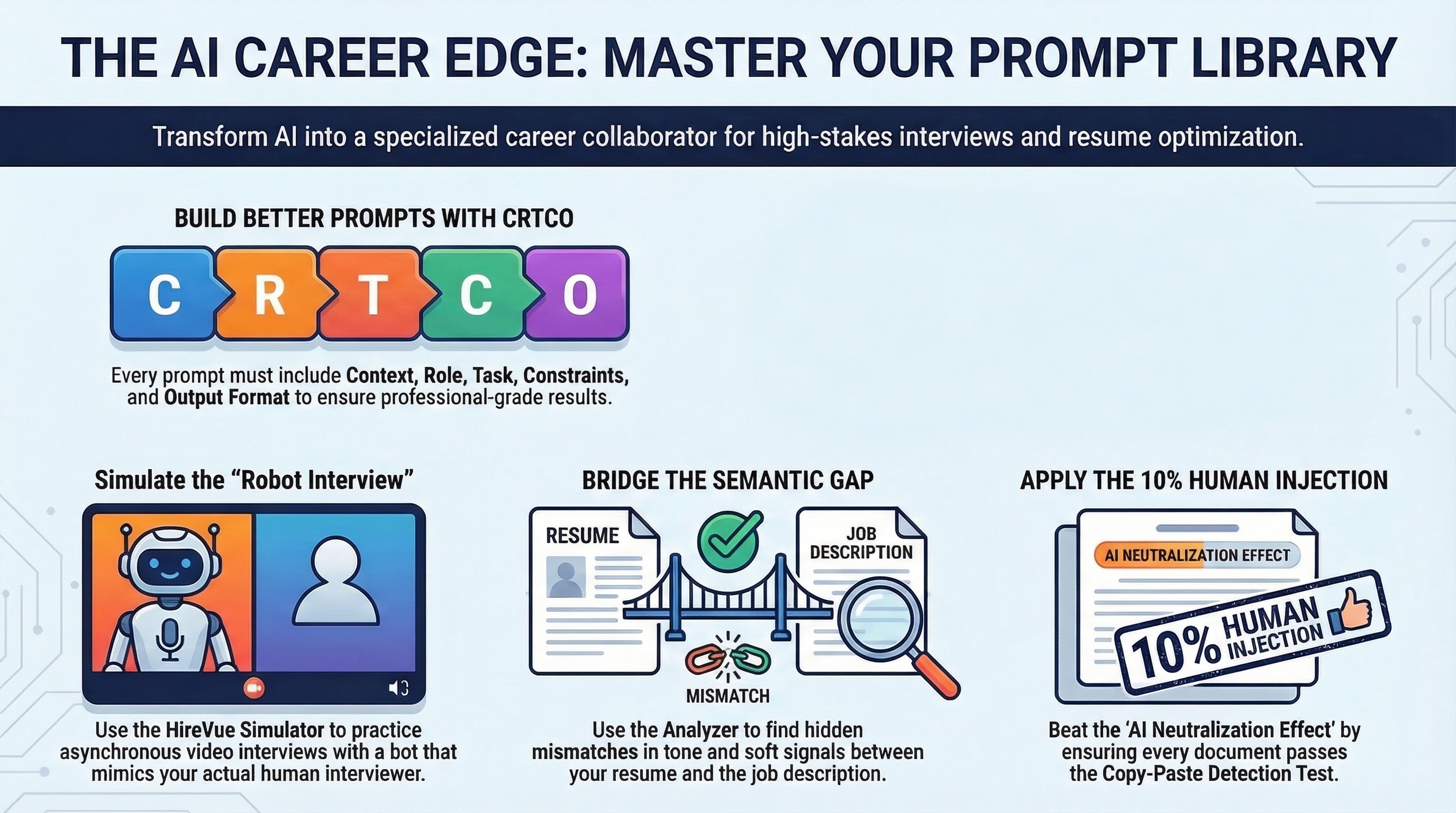
The AI Prompt Library: Engineered Prompts for Job Seekers
Outcome: By the end of this lesson, you will run at least one HireVue Simulator session and one Semantic Gap Analyzer pass on your real resume and target job description using fill-in-the-blank prompts from the AI Prompt Library.
Everyone has access to the same models. The edge is how you engineer the conversation—the same way a developer ships code with tests, not vibes.
1. The Prompt Engineering Mindset
Most job seekers use AI like a search box: vague question → vague answer. Strategists use AI like a collaborator with a spec.
Every prompt in this library follows CRTCO:
| Letter | Meaning | Your job |
|---|---|---|
| C | Context | Your level, industry, target company type |
| R | Role | Who the AI should pretend to be (VP Eng, recruiter, HireVue bot) |
| T | Task | Exactly what to produce (5 behavioral Qs, gap list, rewrite) |
| C | Constraints | Tone, length, what it must not invent |
| O | Output format | Table, score 1–10, bullet list, JSON |
Bad: “Help me prepare for my interview.”
Good: “You are a VP of Engineering at a Series-B fintech. You’re interviewing a Senior Backend Developer. You value systems thinking and ownership. Ask me 5 behavioral questions. After each answer, rate 1–10 and say what was missing.”
The library gives you fill-in-the-blank versions so you do not rebuild this from scratch every time.
2. The HireVue Simulator Prompt
Async video interviews (HireVue, Spark Hire, etc.) reward pace, structure, and calm—not the same skills as a live panel.
Workflow:
- Paste the job description into the simulator prompt.
- Add 3 LinkedIn profiles of likely interviewers (titles + seniority).
- Run three rounds: Screening → Technical/Role → Leadership/Values.
- After each answer, demand: score, gap, and a 9/10 example answer.
- Repeat until your scores stabilize (usually 8–10 runs).
Rule: The simulator is for reps, not truth. It will not know your company’s secret rubric—but it will break your “um” habit and force STAR structure under time pressure.
Use the prompt in sources/template.md and log scores in your GHFE workspace.
3. The Semantic Gap Analyzer Prompt
Keyword matchers miss implied requirements: “strategic partner,” “builder mindset,” “comfort with ambiguity.”
The Semantic Gap Analyzer compares your resume to a target JD and returns:
- Explicit keyword gaps
- Tonal misalignment (IC language vs. director scope)
- Implicit seniority signals
- Suggested reframes—not “add this buzzword,” but “rewrite this bullet to show scope → action → number”
Privacy: Use [COMPANY], [PROJECT], [METRIC] placeholders. Never paste unreleased financials or customer names.
4. The Seven Prompt Categories
| # | Category | Top use |
|---|---|---|
| 1 | Resume Optimization | Achievement Miner — turn duties into metrics |
| 2 | Cover Letter | Problem → Solution → Proof for one role |
| 3 | Profile Optimizer for Interest Graph | |
| 4 | Company Research | Intelligence briefing before networking |
| 5 | Interview Prep | HireVue Simulator (this lesson) |
| 6 | Networking | Outreach Composer (specific, short, flattering) |
| 7 | Negotiation | Market Rate Triangulator (3+ sources) |
Download the full worksheet in sources/worksheet.md and copy prompts into your dedicated GHFE AI thread.
5. Exercise: One Simulator + One Gap Pass (30 minutes)
- Pick one active target role with a posted JD.
- Run the Semantic Gap Analyzer; save the top 3 gaps.
- Fix one bullet on your resume using scope → action → number.
- Run Round 1 of the HireVue Simulator; record your score and one improvement.
- Check off items in
sources/checklist.md.
Success criteria: You have a dated log entry with gap list + simulator score—not just “I read about AI.”
6. Consultant’s Rules (Mirror, Not Oracle)
- Cross-check salary and market claims with two human sources.
- Never let AI invent employers, titles, or metrics you did not provide.
- You own Stay/Go, apply/no-apply, and accept/decline—the model reflects; it does not decide.
Key Takeaways
- CRTCO turns generic AI into a spec-driven collaborator.
- Simulation lets you fail in private before the real interview platform records you.
- Gap analysis finds implied requirements ATS and humans both use.
Glossary
| Term | Definition |
|---|---|
| CRTCO | Context, Role, Task, Constraints, Output — prompt architecture |
| AI Prompt Library | GHFE fill-in-the-blank prompts for job-search tasks |
| HireVue Simulator Prompt | Multi-round async interview practice |
| Semantic Gap Analyzer | Resume vs. JD inferred gap finder |
| Inferred skill gap | Requirement implied but not stated in the posting |