Stop Chasing Postings: How to Build a Strategic Target Company List
Outcome: By the end of this lesson, you will be able to identify high-potential target companies using Bleeding Neck Analysis.
The best jobs are filled before they are ever posted. They go to the candidates who were already on the organization’s radar—professionals who built relationships, demonstrated relevance, and established a presence long before a vacancy hit a job board. This isn't "networking magic"; it is a predictable, systemic approach to the modern market.
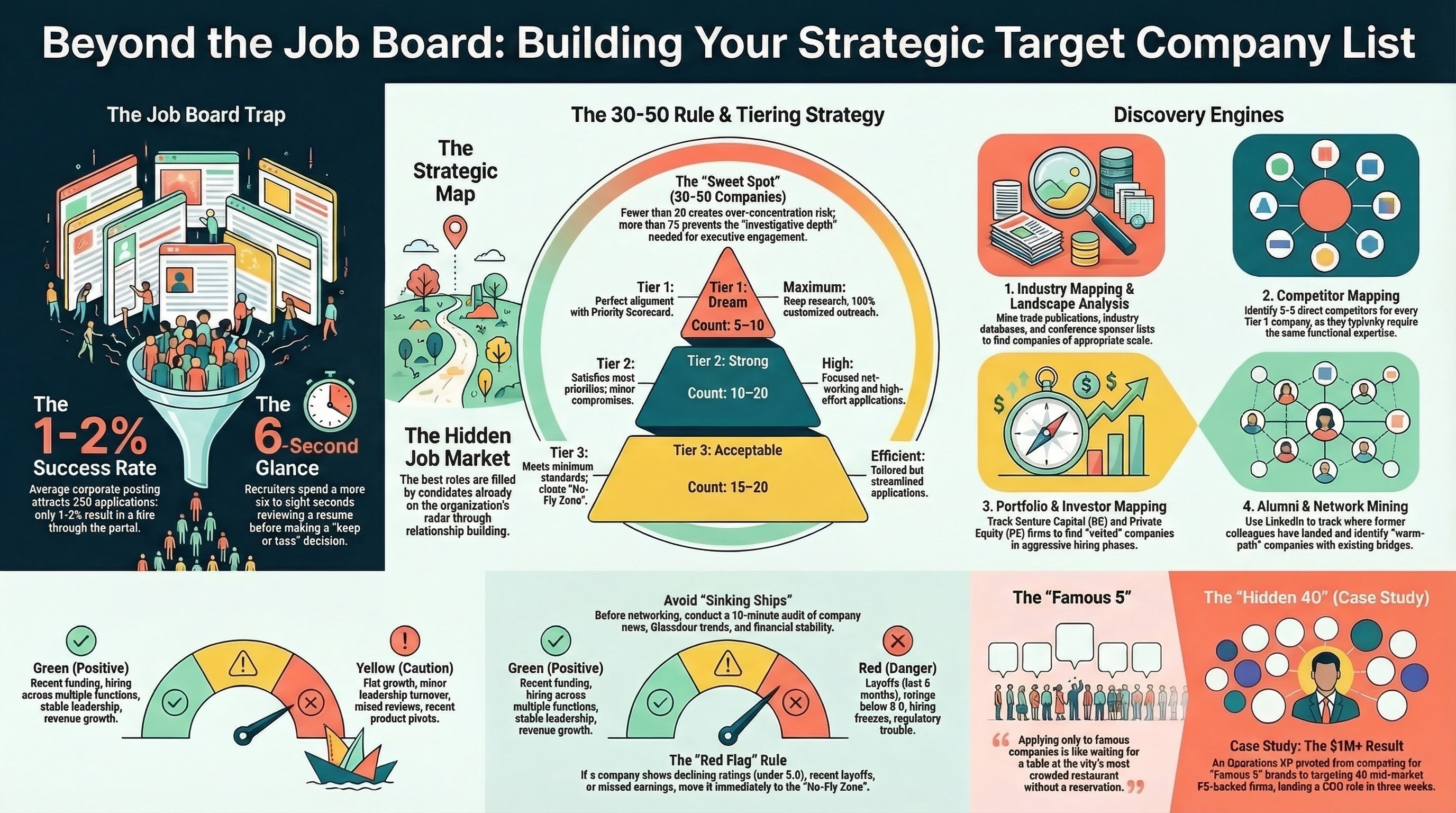
To win, you must abandon the "Job Board Trap." In that reactive cycle, a single corporate posting can attract hundreds of applications, recruiters skim each resume in seconds, and success rates sit in the low single digits. To move straight to a conversation, you must shift your mindset from "look and apply" to "construct a market map." This intelligence dossier—your Target Company List—will become the strategic backbone of your entire executive search.
The Power of the 30-50 Rule
A high-level search requires a precise volume of targets. If your list contains fewer than 20 organizations, you are over-concentrated; a single sector downturn could wipe out half your prospects. If you exceed 75, you will lack the "investigative depth" required to maintain meaningful engagement.
The "sweet spot" is 30 to 50 organizations, segmented via a tiering system to ensure your energy is deployed where the ROI is highest.
| Tier Level | Name | Company Count | Investment Strategy | Criteria |
|---|---|---|---|---|
| Tier 1 | Dream | 5–10 | Maximum Investment: Deep research, extensive networking, and 100% customized outreach. | Perfect alignment with your Priority Scorecard. |
| Tier 2 | Strong | 10–20 | High Effort: Focused networking and standard high-effort applications. | Satisfies most priorities with minor compromises. |
| Tier 3 | Acceptable | 15–20 | Efficient Effort: Tailored but streamlined applications. | Meets minimum standards; clears the No-Fly Zone. |
Four Strategic Methods for Organization Discovery
Building a robust dossier requires mining data beyond household names. Use these four research engines to identify your 30 to 50 vetted prospects, integrating AI to accelerate your market mapping.
- Industry Mapping & Landscape Analysis: Start with the "Target Role Profiles" identified in your strategy. Mine trade publications, industry databases, and conference sponsor lists to find every company of appropriate scale.
- AI Integration: Use AI Tool Applications 1 & 5 to generate comprehensive lists of companies within specific sectors and map out the broader industry landscape.
- Competitor Mapping: For every Tier 1 company, identify their top three to five competitors. These organizations typically require the same functional expertise and leadership talent.
- AI Integration: Deploy AI Tool Application 2 to instantly surface direct and indirect competitors for your top-tier targets.
- Portfolio and Investor Mapping: If targeting growth-stage or mid-market companies, identify the Venture Capital (VC) and Private Equity (PE) firms investing in your space. These portfolio companies are often "vetted" by investors and entering aggressive hiring phases.
- AI Integration: Use AI Tool Application 4 to extract lists of companies from specific VC/PE portfolios relevant to your target function.
- Alumni and Network Mining: Use LinkedIn to track where professionals with your "Target Title" actually work. Analyze where former colleagues have landed; these are "warm-path" companies where you likely possess an existing internal bridge.
The Health Check: Checking Vital Signs
Before investing weeks of networking energy, you must ensure you aren't boarding a sinking ship. A ten-minute "vital signs" check per company can save you months of wasted effort. Use AI Tool Application 3 (Company Health Analyzer) to assist in this forensic review.
| Signal Level | Indicators |
|---|---|
| Green (Positive) | Recent funding rounds; consistent revenue growth; hiring across multiple functions; stable leadership; positive product momentum. |
| Yellow (Caution) | Flat growth; minor leadership turnover; mixed Glassdoor reviews; recent pivot in product strategy. |
| Red (Danger) | Layoffs within the last 6 months; declining revenue/missed earnings; Glassdoor ratings below 3.0 or a declining trend; hiring freeze rumors; regulatory trouble. |
Executive Note: If a company fails the health check, it immediately enters your "No-Fly Zone" and is removed from the list.
Conclusion: Your Living Intelligence Dossier
Your Target Company List is not a static document; it is a living intelligence dossier. As you engage with the market, you will learn more about internal cultures, financial stability, and leadership gaps. Add, remove, and re-tier companies based on this ongoing intelligence.
By operating from a vetted list rather than a job board, you move with the precision of a strategist. This proactive approach places you ahead of the vast majority of job seekers who are still waiting for a posting to tell them where to look. Your search is no longer a matter of luck—it is a matter of targeting.
💥 Engagement Zone
🎬 Real Story: Javier, a 50-year-old Operations VP, was only applying to "Fortune 500" brands because they were the only ones he knew. He was competing against 500+ people for every role. After using Portfolio Mapping, he identified 40 mid-market companies backed by a specific Private Equity firm that specialized in his industry. He realized these companies were all scaling and needed his exact experience. By targeting the "Hidden 40" instead of the "Famous 5," he landed three interviews in three weeks and accepted a COO role with equity that could be worth $1M+ at exit.
😂 Humor Touch: Applying only to companies everyone has heard of is like trying to get a table at the most famous restaurant in town on a Saturday night without a reservation. You're going to be waiting outside in the cold forever. Meanwhile, there’s a spectacular "local gem" around the corner that has better food, a table waiting for you, and actually wants your business. Let’s find the gems.
🎮 Gamification: The "Deep-Dive" Sprint. Pick ONE company on your list. Set a timer for 10 minutes. Can you find the names of three people who work there in your target department? If yes, you've just moved from "random applicant" to "strategic researcher."
📊 Self-Assessment: The Market Map Maturity. How robust is your target list right now?
- "I have 5-10 big names I've always known."
- "I have about 20 companies, but they're all in the same industry."
- "I have a list of 30, but I haven't done health checks on any of them."
- "I have 40+ companies tiered into 3 levels with health-check data."
- "I have a living dossier of 50 vetted companies with internal bridges identified for my Tier 1s." Current Score: [ ]
Key Takeaways
Once your research is compiled, shift from investigation to execution. Use this checklist to formalize your campaign:
- Construct the Master List: Identify 30–50 organizations using the four discovery methods.
- Tier the Portfolio: Categorize every organization into Tier 1, 2, or 3 based on your Priority Scorecard.
- Conduct 10-Minute Health Checks: Perform a "vital signs" deep-dive on all Tier 1 and Tier 2 companies.
- Leverage AI Research: Use the AI Tools Guide to identify hidden competitors and map investor portfolios for your top targets.
- Map Internal Gateways: Identify existing LinkedIn connections or current open roles within your Tier 1 and Tier 2 targets.
Accessibility — Image descriptions
| File | Alt text |
|---|---|
GHFE-M02-L02-ENG-target-company-list-infographic-landscape.png | Infographic for “Stop Chasing Postings: How to Build a Strategic Target Company List”: visual summary of target company list (landscape layout, GHFE course). |
GHFE-M02-L02-ENG-target-company-list-infographic-portrait.png | Infographic for “Stop Chasing Postings: How to Build a Strategic Target Company List”: visual summary of target company list (portrait layout, GHFE course). |
GHFE-M02-L02-ENG-target-company-list-video-thumbnail-landscape.png | Video thumbnail for “Stop Chasing Postings: How to Build a Strategic Target Company List”: preview image for the lesson video (landscape format). |
GHFE-M02-L02-ENG-target-company-list-video-thumbnail-portrait.png | Video thumbnail for “Stop Chasing Postings: How to Build a Strategic Target Company List”: preview image for the lesson video (portrait format). |