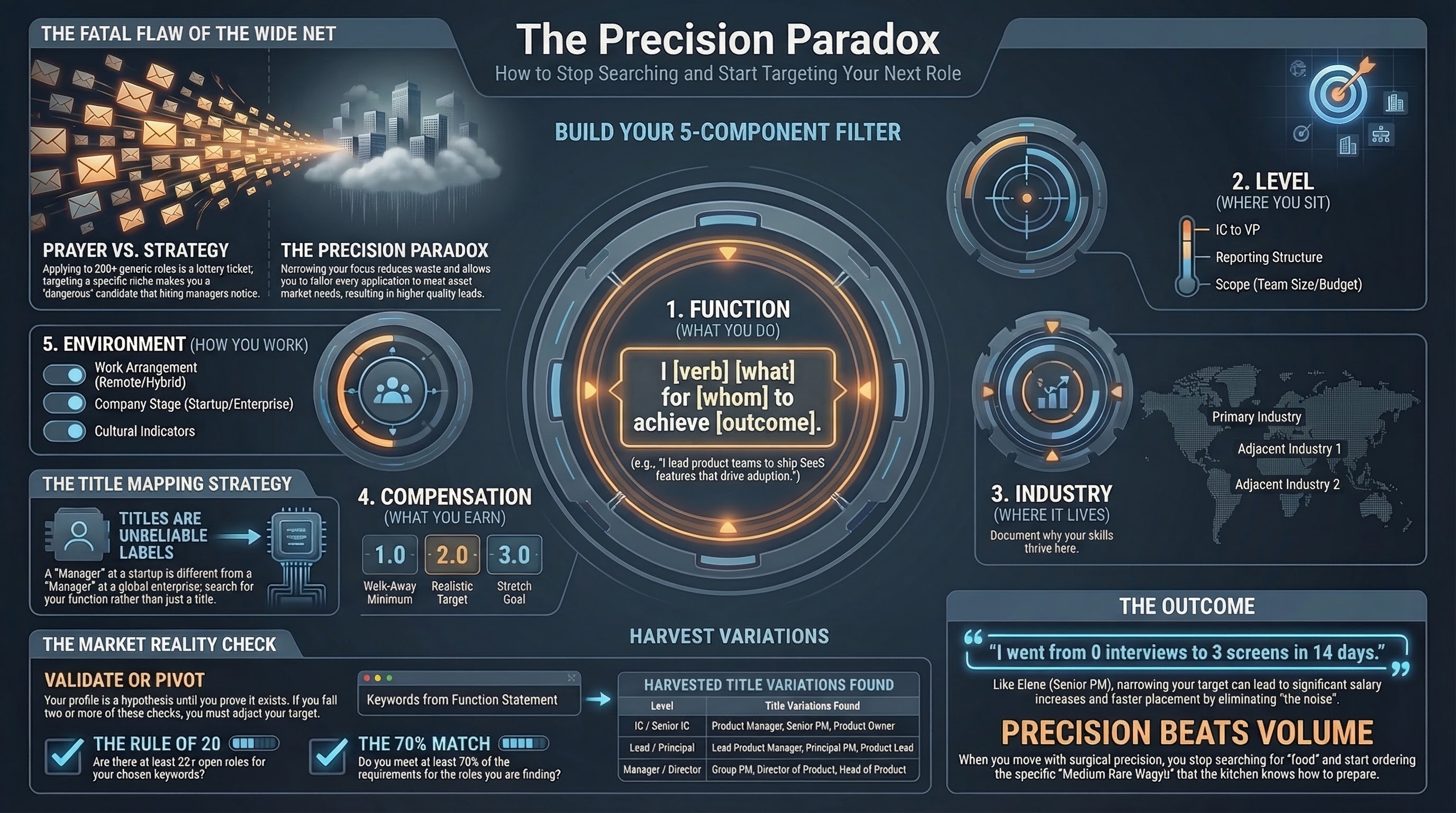
Stop Searching, Start Targeting: How the Precision Paradox Accelerates Your Career Move
Outcome: By the end of this lesson, you will be able to define your ideal next role using the 5-Component Filter.
1. Introduction: The Fatal Flaw of the "Wide Net" Strategy
The most common mistake job seekers make is casting a "wide net." They apply to 200+ generic roles across dozens of categories, hoping for a bite. In reality, this approach is a lottery ticket, not a strategy. You must understand one thing: "Looking for a role in my field" is not a plan—it is a prayer. And prayers do not get callbacks.
To succeed in a competitive market, you must embrace the Precision Paradox. This principle states that narrowing your target actually increases your results. By reducing waste and focusing on a specific scope, you can tailor every application, networking outreach, and interview response to meet exact market needs. Hiring managers respond to specificity; they can smell generic, low-effort applications from a mile away. Precision makes you a "dangerous" candidate because you can demonstrate that you have done the homework your competitors ignored.
2. The Blueprint: Building Your Target Role Profile
A strategic job search requires a Target Role Profile. Think of this as a five-component filter. If an opportunity does not pass through these five criteria, it is not worth your time.
Component 1: Function (What You DO)
Your function is the constant that transfers across companies. Titles are often meaningless labels that vary by organization; your function is the actual work you perform and the problems you solve.
- The Negative Example: Don't say: "I'm a product manager." That is a title, and it is too vague to be actionable.
- The Function Statement: Define your work using the formula: "I [verb] [what] for [whom] to achieve [outcome]."
- The Standard: "I lead cross-functional product teams to ship B2B SaaS features that drive user adoption."
Component 2: Level (Where You SIT)
Searching at the wrong level wastes time on both sides. You must define your seniority, scope of authority, and the specific reporting structure you are targeting.
- Seniority: Choose one: IC, Senior IC, Lead, Manager, Senior Manager, Director, or VP.
- Reporting Structure: Who do you report to? (Options: Founder, C-Suite, VP, Director, or Manager).
- Scope: Define your target team size (e.g., 5–10 people) and your budget responsibility range (e.g., $500k–$2M).
Component 3: Industry (Where it LIVES)
To maintain strategic focus, you cannot look everywhere at once.
- Primary Industry: Your main target.
- Adjacent Industries: No more than two sectors where your skills translate.
- The "Why" Rationale: For each industry selected, you must document the specific rationale. Why does your function thrive here? (e.g., "High growth in Fintech requires my experience in regulatory compliance tools.")
Component 4: Compensation (What You EARN)
Your expectations must be data-driven. You require three specific numbers:
- The Target: Your ideal base and total compensation.
- The Walk-Away Minimum: The floor below which you will not engage.
- The Stretch Goal: A realistic upper-bound for the role based on market highs.
Component 5: Environment (How You WORK)
Define the logistical and cultural factors that align with your priority scorecard:
- Work Arrangement: Fully remote, hybrid, or on-site.
- Company Stage: Startup (Seed/Series A), growth-stage, or public enterprise.
- Company Size: Define the headcount (e.g., 50–200, 1000–5000, etc.).
- Team Culture: Specify the indicators that matter (e.g., high autonomy, structured mentorship).
3. The Title Mapping Strategy: Navigating the "Label" Problem
Job titles are unreliable. A "Marketing Manager" at a global enterprise performs entirely different tasks than one at a 20-person startup. To find all relevant opportunities, you must "map the territory" by searching for your function rather than a single label.
The Intensity Warning: This is not a fifteen-minute exercise. Spend at least one hour on this. This time investment pays for itself a hundred times over because it uncovers the opportunities that most job seekers miss.
How to Map Titles:
- Start with your Function Statement.
- Search job boards using keywords from that statement rather than a title.
- Collect every title variation and group them by level to create your search keyword list.
| Level | Title Variations (Example: Product) |
|---|---|
| IC / Senior IC | Product Manager, Senior Product Manager, Product Owner |
| Lead / Principal | Lead Product Manager, Senior Product Owner, Product Lead |
| Manager | Product Manager (People Lead), Program Manager, Product |
| Director / VP | Director of Product, Head of Product, VP Product, VP Product Management |
4. The AI Power-User’s Guide to Role Definition
Artificial Intelligence can transform your research from generic to surgical. Use these five specific applications to refine your target profile.
- Role Definition Advisor: Articulates your function statement and identifies the correct seniority level.
- Title Mapper: Generates a comprehensive list of title variations across different industries.
- Compensation Researcher: Provides data-driven salary ranges based on role, level, and geography.
- Market Demand Validator: Assesses if there is sufficient hiring volume to support a search.
- Target Refinement Coach: Iterates on your profile based on real-world market feedback and gaps.
Pro-Tip: Precision Over Generics
- Specific Prompting: A prompt for "Product Manager" returns useless, generic results. Use high-specificity prompts like "Senior Product Manager for B2B SaaS infrastructure tools" for actionable intelligence.
- Account for Data Lag: AI salary data is often 6–12 months old. Always cross-reference AI findings with live job postings or sites like Levels.fyi and Glassdoor.
5. The Reality Check: Validating Your Target
Your Target Role Profile is a hypothesis until it is validated against market reality. Use the following checklist to ensure your target is viable:
- Volume Check: Are there 20+ open roles currently available for your chosen keywords?
- Qualification Check: Do you meet at least 70% of the requirements for the roles you are finding?
- Compensation Alignment: Is your target salary within the ranges posted in recent listings?
- Geographic/Remote Fit: Do the roles match your specific environment and size preferences?
The Strategic Pivot: If you answer "No" to two or more of these points, your target is likely misaligned with the current market. Do not force a failing strategy. Immediately return to your AI Target Refinement Coach to adjust your parameters.
6. Conclusion: Turning Strategy into Action
In a job search, precision beats volume every time. By defining exactly what you do, where you sit, and what you are worth, you eliminate the noise and focus your energy on the opportunities where you have the highest probability of success.
When you move with surgical precision, you stop being a seeker and start being a strategist. This clarity makes you a "dangerous" candidate because you can tailor every interaction to the exact needs of the employer.
💥 Engagement Zone
🎬 Real Story: Elena, a Senior Project Manager, spent six months applying to every "Manager" role she found. She got zero interviews and was ready to give up. After doing this lesson, she narrowed her target to "Implementation Manager for Fintech Scale-ups ($150k-$180k range)." She updated her LinkedIn and resume with this exact language. Within 14 days, she had three recruiter screens and landed a role with a $40k increase. Her "wide net" had cost her half a year of salary—roughly $75,000 in lost earnings.
😂 Humor Touch: A generic job search is like walking into a restaurant and telling the server, "I'll have the food, please." You're going to get a very confused look, and you're probably not going to like what they bring you. Be the person who orders the "Medium-Rare Wagyu with Truffle Fries"—the kitchen (the hiring manager) knows exactly what to do with that.
🎮 Gamification: The "Power Statement" Challenge. Write your function statement using the formula: "I [verb] [what] for [whom] to achieve [outcome]." Set a timer for 2 minutes. Can you say it out loud without stumbling? If not, it's too complicated. Simplify until it's punchy.
📊 Self-Assessment: The Precision Meter. How specific is your target role right now?
- "I'm looking for anything that pays well in my general field."
- "I know my title, but I haven't defined the industry or environment yet."
- "I have a target profile, but I'm still tempted to apply to 'backup' roles."
- "My target is clear, and I can articulate my unique value for it."
- "I have surgical focus; I only apply to roles that hit 100% of my Target Profile." Current Score: [ ]
Key Takeaways
- Complete the Target Role Profile: Define all five components (Function, Level, Industry, Compensation, Environment) in the worksheet.
- Map 5–10 Title Variations: Ensure you aren't missing roles like "Program Manager, Product" due to naming conventions.
- Validate your Target: Use AI tools and job board data to confirm that your target role exists in sufficient volume.
Accessibility — Image descriptions
| File | Alt text |
|---|---|
GHFE-M02-L01-ENG-target-role-profile-infographic-landscape.png | Infographic for “Stop Searching, Start Targeting: How the Precision Paradox Accelerates Your Career Move”: visual summary of searching start targeting precision (landscape layout, GHFE course). |
GHFE-M02-L01-ENG-target-role-profile-infographic-portrait.png | Infographic for “Stop Searching, Start Targeting: How the Precision Paradox Accelerates Your Career Move”: visual summary of searching start targeting precision (portrait layout, GHFE course). |
GHFE-M02-L01-ENG-target-role-profile-video-thumbnail-landscape.png | Video thumbnail for “Stop Searching, Start Targeting: How the Precision Paradox Accelerates Your Career Move”: preview image for the lesson video (landscape format). |
GHFE-M02-L01-ENG-target-role-profile-video-thumbnail-portrait.png | Video thumbnail for “Stop Searching, Start Targeting: How the Precision Paradox Accelerates Your Career Move”: preview image for the lesson video (portrait format). |