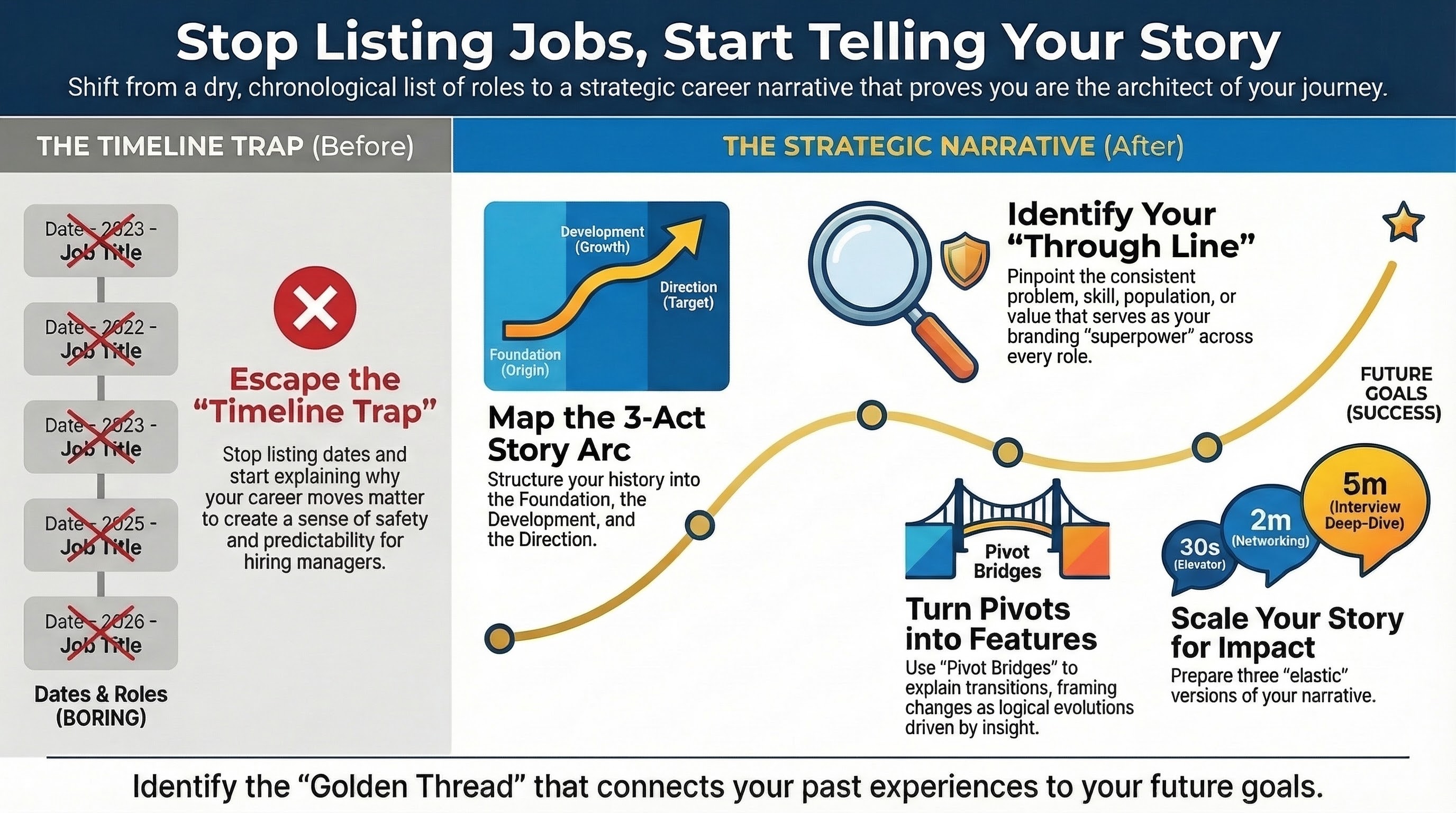
Stop Listing Jobs, Start Telling Your Story: How to Build a Career Narrative That Wins
Outcome: By the end of this lesson, you will be able to construct a compelling career narrative using the 3-Act Story Arc.
Most professionals approach their career history as a dry, chronological timeline: "I worked at Company A for three years, then I moved to Company B for two years, and then I went to Company C." While factually accurate, this is what I call the "Timeline Trap." It tells a recruiter what happened, but it fails to explain why any of it matters.
As humans, we are biologically wired for stories, not bullet points. When a hiring manager reviews your background, they are looking for a cohesive narrative that makes sense of your trajectory. If your career path looks random on paper, they will assume it is random in practice—and in the high-stakes world of hiring, uncertainty is a silent deal-killer. By shifting from a list of jobs to an intentional narrative, you create a sense of safety and predictability. You prove that you aren't just a passenger in your career; you are the strategic architect of it.
The Core Framework: The Three-Act Story Arc
To transform your history into a compelling brand, we use the Three-Act Story Arc. This isn't just a writing exercise; it’s a way to help you see your own journey with the clarity and pride it deserves.
Act 1: The Foundation
This act is about your "Origin Story." What was the initial spark? What drew you to this field, and what early experiences shaped your professional identity? This doesn't have to be your first entry-level job; it could be a specific challenge you faced in university, a core passion, or a defining moment where you realized you had a unique knack for a certain type of work.
Act 2: The Development
This is the "meat" of your story—the place where your professional character is forged in the fire of real-world challenges. It’s where you showcase how you grew, the obstacles you overcame, and the skills you built.
The Recruiter’s Perspective: This is also where most people lose the narrative. They treat career changes as disjointed breaks. I want you to view them differently.
"Many people treat a career pivot as a break in their story. In reality, a pivot is a plot twist. Plot twists are the most interesting part of any story—if you set them up correctly with a logical bridge."
Act 3: The Direction
The final act connects your past to the future. Why does your next move make absolute sense given everything that came before? This is where you demonstrate how your unique perspective makes you the only logical choice for the specific role you are targeting.
Finding Your "Through Line": The Golden Thread
The Through Line is your branding superpower. It is the single thread that connects every chapter of your career, serving as a "North Star" for your resume, LinkedIn, and every interview answer you give. When you identify this theme, your background stops looking like a collection of random jobs and start looking like a mission.
A through line typically falls into one of four categories:
- A Problem: A consistent challenge you are "wired" to solve.
- A Population: A specific group of people you are passionate about serving.
- A Skill: A core competency (like "translating data into strategy") you have continuously deepened.
- A Value: A fundamental belief (like "transparency" or "efficiency") that drives your decisions.
The Pattern Finder
To find your thread, look back at your career timeline and answer these questions:
| Question | Your Reflection |
|---|---|
| The Problem | What specific problem do I keep solving, regardless of my job title? |
| The Skill | What one skill has appeared in every single position I’ve held? |
| The People | What type of team or customer do I always gravitate toward? |
| The Drive | What do people consistently thank me for or recognize me for? |
| The Value | What fundamental belief has driven my biggest career decisions? |
The Pivot Bridge: Turning Gaps into Features
If your Through Line is the "what," the Pivot Bridge is the "why." A bridge statement connects where you were to where you went next, showing that your transitions were driven by insight rather than whim.
The Pivot Bridge Template: "I realized that [Insight/Trigger connected to your Through Line], which led me to [New Direction]."
Consider this example from an operations professional moving into product management. Instead of just listing the change, they use their through line of "fixing broken systems" to bridge the gap:
"I started in operations because I loved fixing broken systems. That led me to process improvement, where I realized the tools we were using were the biggest bottleneck. I wanted to be the one building the tools rather than just using them, which led me to transition into Product Management so I could build internal platforms that solve those problems at scale."
By providing the "why," you make the pivot look like a logical evolution—a feature of your adaptability, not a bug in your focus.
Scaling Your Story: The Three Versions Every Pro Needs
Your story must be "elastic." You need to be able to tell it in different lengths while maintaining the same core through line.
- The 30-Second Pitch (The Elevator Version): This is purely your Through Line + Your Current Direction. Use this for quick introductions where you need to establish your brand immediately.
- The 2-Minute Version (The Networking Version): This is the standard for most conversations. It follows the Three-Act Arc but adds one or two key development moments from Act 2 to provide depth and invite follow-up questions.
- The 5-Minute Version (The Interview Version): Use this for the "Tell me about yourself" prompt. This is the full narrative arc, including specific examples of challenges met and results achieved.
Leveraging AI to Stress-Test Your Narrative
Artificial Intelligence is an incredible tool for refining your narrative—not to write it for you, but to act as a mirror. Use these five "Stress-Test" applications from the AI Tools Guide to ensure your story is bulletproof:
- The Through Line Finder: Feed AI your work history and ask it to identify recurring themes you might be too close to see.
- The Pivot Bridge Builder: Use AI to help draft logical transitions between seemingly unrelated roles by finding the common skills.
- The Career Story Editor: Paste your draft and ask the AI to "edit for narrative clarity," ensuring the "why" is as strong as the "what."
- The Interview Story Prep: Have AI generate practice questions based on your specific story arc to see where the narrative might feel thin.
- The Gap Explainer: Use AI to help frame a career break or a period of unemployment as a period of intentional growth or strategic reflection.
💥 Engagement Zone
- 🎬 Real Story: Javier had 15 years in logistics but his resume looked like a random list of warehouses. We found his "Golden Thread": Simplifying Chaos. Once he framed himself as the "Chaos Specialist" who saves companies $200k/year in shipping errors, he landed a Director role in 3 weeks.
- 😂 Humor Touch: A chronological resume is like a 400-page IKEA manual without the pictures. Technically accurate, but nobody wants to read it, and you'll definitely have leftover screws at the end.
- 🎮 Gamification: The "So What?" Drill: Read your last three resume bullets. After each one, say "So what?" out loud. If you can't answer with a dollar amount, a time saving, or a "the company didn't die" result, rewrite it!
- 📊 Self-Assessment: Rate your Narrative Strength (1-5 scale):
- My "Through Line" is clear in 2 sentences or less.
- I have a logical "Bridge" for every career pivot.
- My 30-second pitch feels like a story, not a script. Scoring: 12-15: Storytelling Master | 8-11: Plotting the Course | <8: Still in the "Timeline Trap" (Re-read Section 1!).
Conclusion: Key Takeaways and Next Steps
Building a career narrative is the foundational act of professional branding. When you own your story, you own the room. Remember these five core principles:
- Story before resume. Your narrative must exist before you ever touch a bullet point.
- Every move needs a "why." If you don't explain your logic, the audience will invent their own (usually negative) reasons.
- Pivots are features. Frame them to show breadth, intentionality, and growth.
- The through line is your superpower. It is the North Star that makes your brand click.
- Practice out loud. A story that looks good on a screen might not feel natural in conversation. Rehearse until it flows.
Your Action Plan
- Complete the Story Arc Workshop: Map your timeline and the "why" behind every move.
- Identify your Through Line: Define the golden thread that connects your past to your future.
- Draft your three story versions: Write out your 30-second, 2-minute, and 5-minute narratives.
- Practice out loud: Record yourself or speak to a mentor until your 2-minute version feels like a natural conversation.
By replacing a dry list of dates with a coherent, intentional story, you kill uncertainty and give hiring managers a clear, compelling reason to say "yes."
Accessibility — Image descriptions
| File | Alt text |
|---|---|
GHFE-M03-L01-ENG-career-storytelling-infographic-landscape.png | Infographic for “Stop Listing Jobs, Start Telling Your Story: How to Build a Career Narrative That Wins”: visual summary of listing jobs start telling (landscape layout, GHFE course). |
GHFE-M03-L01-ENG-career-storytelling-infographic-portrait.png | Infographic for “Stop Listing Jobs, Start Telling Your Story: How to Build a Career Narrative That Wins”: visual summary of listing jobs start telling (portrait layout, GHFE course). |
GHFE-M03-L01-ENG-career-storytelling-video-thumbnail-landscape.png | Video thumbnail for “Stop Listing Jobs, Start Telling Your Story: How to Build a Career Narrative That Wins”: preview image for the lesson video (landscape format). |
GHFE-M03-L01-ENG-career-storytelling-video-thumbnail-portrait.png | Video thumbnail for “Stop Listing Jobs, Start Telling Your Story: How to Build a Career Narrative That Wins”: preview image for the lesson video (portrait format). |