Mastering the Informational Interview: Your Job Search Superpower
Outcome: By the end of this lesson, you will be able to extract high-value insights from professional connections using the 15-Minute Rule.
If I could hand you a single superpower for your career, it would be this: the ability to have genuine, high-stakes conversations with the people who are already where you want to be. Most job seekers are stuck in the "apply and hope" cycle—tossing resumes into the digital void and praying for a human response. But the pros? They use a different playbook.
The informational interview is your unfair advantage. It allows you to build relationships with decision-makers, gather intelligence on what a role is really like, and find people who can advocate for you from the inside—all before a job is ever posted. Today, I’m going to show you exactly how to master this process.
Phase 1 & 2: Landing the Meeting (The Art of the Ask)
Before you send a single message, you need to do your homework. A "Senior Career Strategist" knows that a cold outreach is only as good as the research behind it. Start by identifying individuals whose career paths or current roles align with your goals. Scour their LinkedIn profiles, read the publications they’ve contributed to, or watch their recent conference talks. You are looking for a genuine connection point—a reason why you are reaching out to them specifically, and not just anyone with a fancy title.
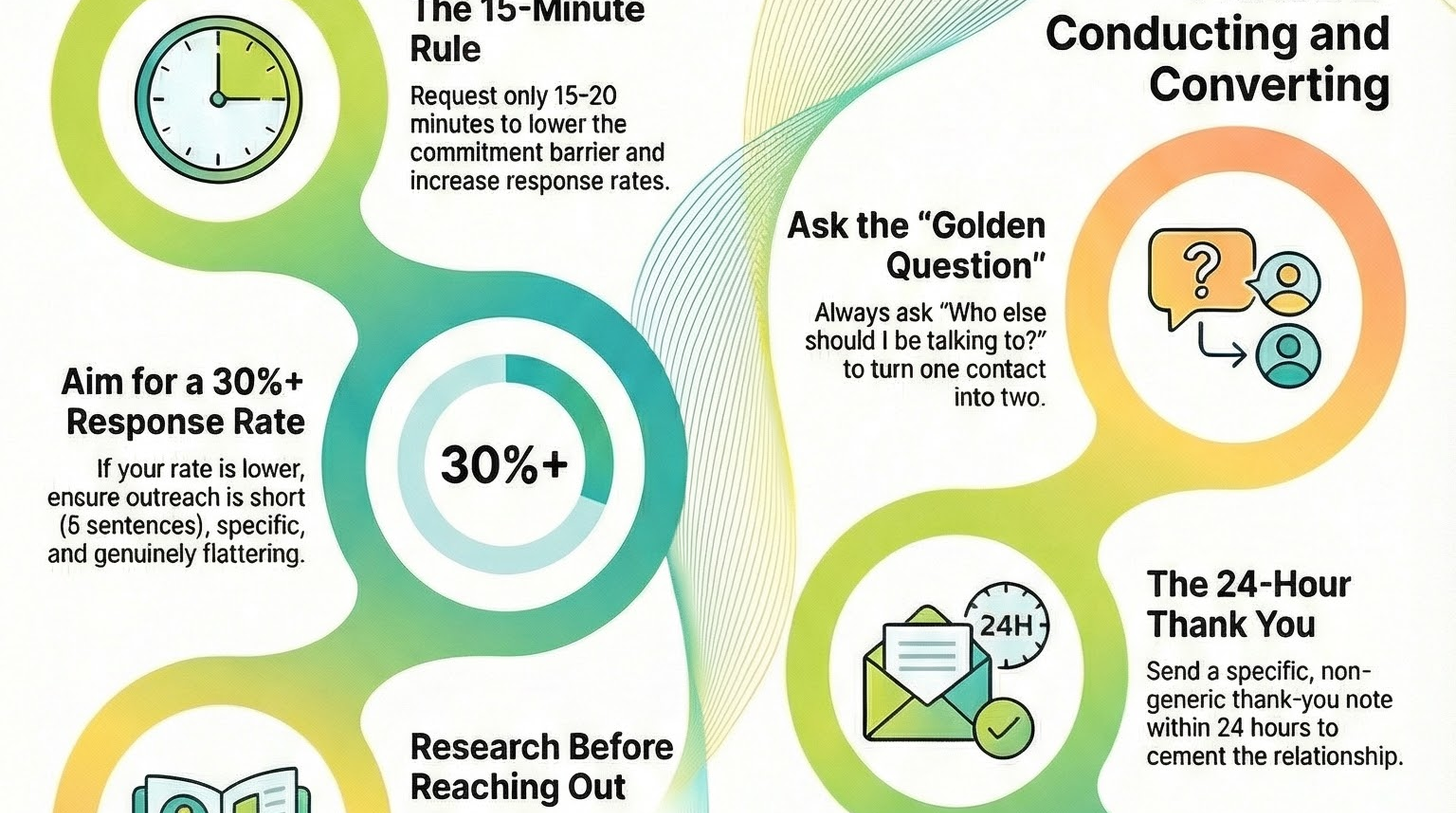
Once you’ve found your target, it’s time to craft the message. Here is the hard truth: if your response rate is low, fix the message, not the volume. If you aren't hitting a 30% response rate, your outreach is likely too long, too vague, or too self-serving.
Follow the "Short, Specific, Flattering" framework:
- Short: Keep it to five sentences or fewer. Professional people do not read essays from strangers.
- Specific: Tell them exactly why they caught your eye. "I noticed you transitioned from traditional finance to decentralized tech" is better than "I want to learn about your industry."
- Flattering: Express genuine respect for their work without being sycophantic. Mention a specific article or project that resonated with you.
The 15-Minute Rule
When requesting a meeting, always ask for 15-20 minutes. Asking for 30 or 60 minutes is a high-friction request that usually ends up in the trash. A 15-minute window represents a much lower commitment, making it significantly easier for a busy professional to say "yes." This small shift is often the difference between being ignored and getting scheduled.
Phase 3 & 4: Conducting a Memorable Conversation
Showing up unprepared is worse than not showing up at all. To make this conversation feel like a professional dialogue rather than an interrogation, you need two things: a 30-second pitch and a list of 8–10 strategic questions.
The Flow of the Interview:
- Gratitude: Open by thanking them specifically for their time.
- The Pitch: Deliver a quick version of your 30-second summary to provide context on who you are and why you value their perspective.
- The Questions: Move into your prepared list, but be ready to follow interesting threads. The best interviews feel like a natural conversation.
- Watch the Clock: If you asked for 15 minutes, wrap up at 15 minutes. Respecting their time builds immediate trust. If they choose to keep talking, let that be their decision.
The Golden Questions Table
Use these questions to extract "insider intelligence" that you simply cannot find on a company website.
| The Question | The Strategic Intent (Intelligence Provided) |
|---|---|
| "What do you wish you knew before starting this role?" | Insider intelligence on the reality of the position vs. expectations. |
| "What’s the biggest challenge your team is facing right now?" | Identifies pain points where you can eventually provide value. |
| "How is this industry/function evolving?" | Demonstrates and builds high-level industry awareness. |
| "What skills separate good performers from great ones?" | Helps you understand how to position yourself as a top-tier candidate. |
| "If you were job searching for a role like mine, what would you do differently?" | Provides customized strategic advice for your specific search. |
| "Who else should I be talking to?" | The most valuable tool for expansion and warm introductions. |
The final "Golden Question" transforms one connection into three. When you reach out to the next person, you’re no longer a stranger; you’re a referral: "Sarah Chen suggested I reach out to you."
Phase 5: The Follow-Up (Where the Magic Happens)
The conversation is just the beginning. To turn a chat into a lasting career asset, you must master the follow-up.
- The 24-Hour Rule: Send a thank-you note within 24 hours. No exceptions.
- Specific Evidence: Avoid generic "thanks for your time" messages. Mention a specific recommendation they made. “I read that HBR article you mentioned—particularly the section on distributed teams. It really changed how I’m thinking about my next role.”
- Close the Loop: If they recommended a book, a certification, or a person, tell them when you’ve acted on it. This proves you weren't just "picking their brain," but were actually listening. This transforms a transaction into a relationship.
Leveraging Technology: Your AI Interview Toolkit
You can use AI to streamline the entire informational interview lifecycle. Use these five specialized applications to ensure your execution is flawless:
- Outreach Message Crafter: Ensures your initial contact stays within the 5-sentence limit and adheres to the "Short, Specific, Flattering" rule to maximize response rates.
- Pre-Interview Researcher: Synthesizes LinkedIn profiles, publications, and company news to help you find that "genuine connection point" in seconds.
- Thank-You Note Writer: Drafts personalized follow-ups that incorporate specific insights or resources (like that HBR article) discussed during the meeting.
- Follow-Up Strategist: Helps you plan long-term touchpoints so the relationship stays active without being a nuisance.
- Referral Request Script: Assists in drafting professional "warm introduction" messages to the new contacts suggested during the "Who else should I be talking to?" phase.
💥 Engagement Zone
🎬 Real Story: Julie, a software engineer, used the "Short, Specific, Flattering" framework to land a 15-minute call with a Senior VP at her dream fintech firm. During the call, she asked the Golden Question: "Who else should I be talking to?" The VP introduced her to the Hiring Manager, bypassing the ATS entirely. Julie was hired 14 days later. The total time spent? Less than 3 hours of effort for a $45k salary bump.
😂 Humor Touch: Cold outreach is like dating. If your first message is "Will you hire me?" you're going to get blocked. Start with a "coffee date" (the informational interview) first. Nobody wants to commit to a career-long relationship on the first "Hello."
🎮 Gamification: The "Flattery" Test. Find a target contact on LinkedIn. Read their latest post or article. Draft a two-sentence message that actually shows you read it and aren't just copying a template. If you can’t find anything interesting about them to mention, you haven't researched them enough.
📊 Self-Assessment: The Interview Ready Meter. How ready are you to conduct your first informational interview?
- "I'm terrified of bothering people and haven't sent a single message."
- "I've sent messages, but my response rate is under 10%."
- "I have a few calls scheduled, but I'm still 'winging it' with my questions."
- "I use the 'Short, Specific, Flattering' framework and have my Golden Question ready."
- "I consistently turn 15-minute chats into warm referrals." Current Score: [ ]
Conclusion & Immediate Action Plan
Success in the modern job market is driven by relationships, not algorithms. By focusing on the relationship rather than the job request, you plant seeds that will grow throughout your entire career.
Your 7-Day Challenge
Don't just read this—execute it. Here is your checklist for the week:
- Identify 10 target contacts whose career paths align with your goals.
- Send your first 3 outreach messages using the "Short, Specific, Flattering" framework and the 15-minute rule.
- Prepare your customized question list, ensuring you’ve bookmarked the Golden Question for the end of the call.
Start planting these seeds today. Your future self will thank you for building the network that accelerates your career for years to come.
Accessibility — Image descriptions
| File | Alt text |
|---|---|
GHFE-M04-L02-ENG-informational-interviews-infographic-landscape.png | Infographic for “Mastering the Informational Interview: Your Job Search Superpower”: visual summary of informational interview (landscape layout, GHFE course). |
GHFE-M04-L02-ENG-informational-interviews-infographic-portrait.png | Infographic for “Mastering the Informational Interview: Your Job Search Superpower”: visual summary of informational interview (portrait layout, GHFE course). |
GHFE-M04-L02-ENG-informational-interviews-video-thumbnail-landscape.png | Video thumbnail for “Mastering the Informational Interview: Your Job Search Superpower”: preview image for the lesson video (landscape format). |
GHFE-M04-L02-ENG-informational-interviews-video-thumbnail-portrait.png | Video thumbnail for “Mastering the Informational Interview: Your Job Search Superpower”: preview image for the lesson video (portrait format). |