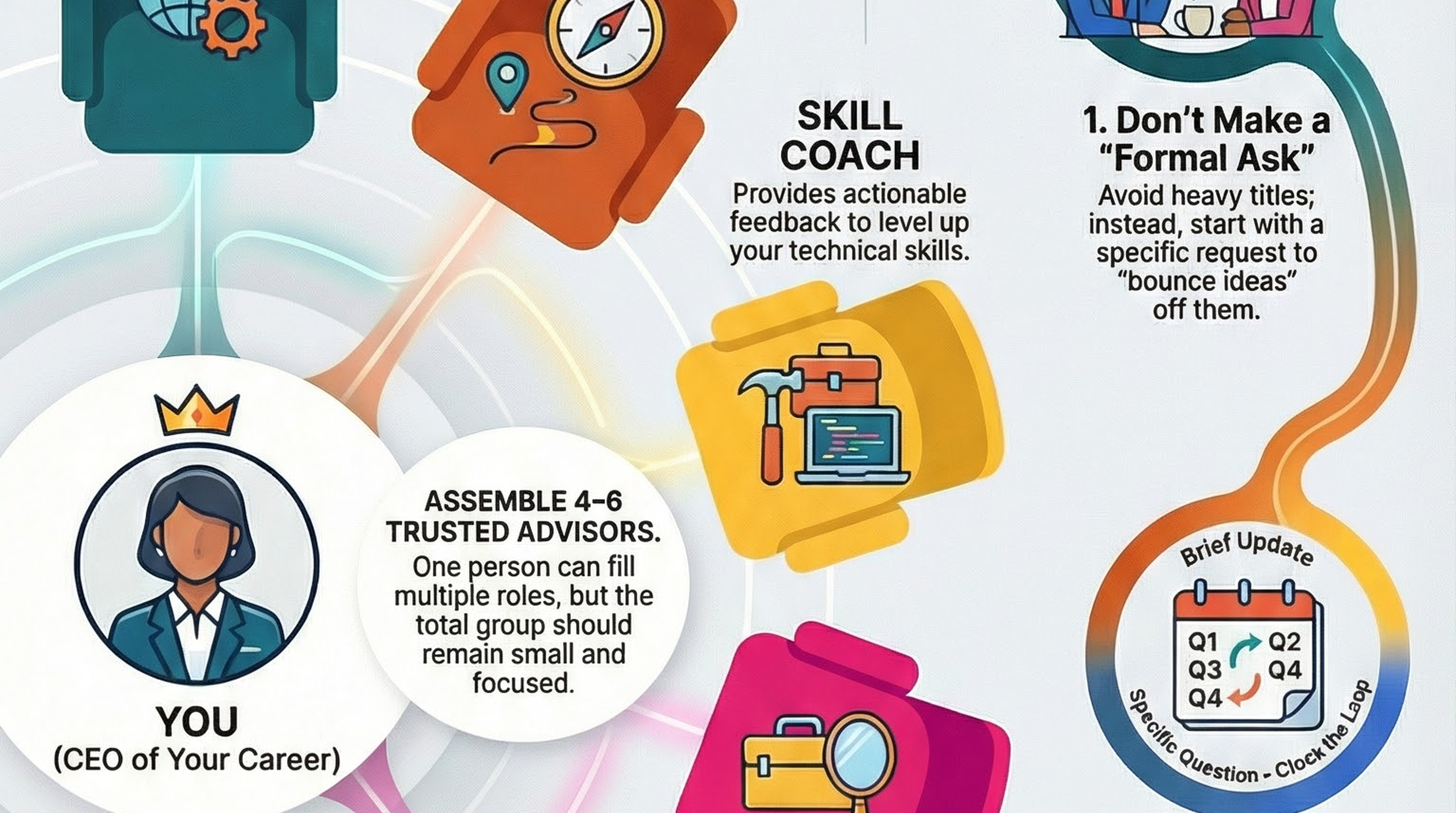
Stop Navigating Solo: Why You Need a Personal Board of Advisors (and How to Build One)
Outcome: By the end of this lesson, you will be able to assemble your personal Board of Advisors using the 5-Seat Advisor Model.
The CEO Secrets of Career Success
Every Fortune 500 CEO has a board of directors. Every high-growth startup relies on a circle of advisors. Every Olympic athlete is backed by a dedicated coaching team. These elite performers understand a fundamental truth: the most successful people in the world do not navigate alone. They surround themselves with individuals who see what they cannot, know what they do not, and push them further than they could ever go on their own.
Yet, most professionals remain "solopreneurs" by accident, navigating high-stakes transitions and complex career landscapes without a sounding board. To change your trajectory, you must treat your career with the same strategic rigor as a CEO treats a company. You need a Personal Board of Advisors. This is not a vague network of mentors, but a structured, intentional group of four to six people who provide guidance, accountability, and access to opportunities you cannot reach on your own.
The Five Essential Seats on Your Board
A complete board requires five distinct roles to cover the full spectrum of professional growth. While one individual may fill multiple seats, the ideal board consists of four to six people total to maintain a manageable yet diverse breadth of perspective.
- The Industry Insider: This person is deeply embedded in your target field. They know the key players, the emerging trends, and where the industry is heading. They provide critical market intelligence and immediate industry credibility.
- The Skill Coach: An expert in your core professional skill. They provide specific, actionable feedback on your actual work. Their value is in the details: "Not 'great job,' but 'your analysis is solid, but your recommendations section needs to be more prescriptive.'"
- The Career Strategist: Typically 5–10 years ahead of you on a similar path. They have already made the decisions you are currently facing. They see around corners, helping you avoid common pitfalls and mistakes they’ve witnessed or made themselves.
- The Connector: This individual possesses an extraordinarily wide network and enjoys making introductions. They multiply your reach exponentially; as the saying goes, "one good connector is worth a hundred LinkedIn connections."
- The Truth Teller: Perhaps the most vital seat. This person cares enough to provide the uncomfortable, brutally honest feedback that others avoid. They are the ones who will tell you, "Your resume is weak," "your interview skills need work," or "you’re aiming too low."
Pro Tip: You do not need a different person for every role. Look for "multi-hyphenate" advisors who can fill two seats—such as a Career Strategist who is also your Truth Teller—to keep your total board count between 4 and 6 people.
How to Recruit Your Board (The First Outreach Framework)
The most effective advisory relationships are built organically, not through formal contracts. Never ask the question: "Will you be on my Board of Advisors?" This language is too heavy, too corporate, and inherently awkward. It creates a sense of obligation that causes high-value people to pull away.
Instead, follow the First Outreach Plan logic to build the relationship naturally:
- The Target: Identify a candidate and categorize them by relationship status (Strong, Developing, or New).
- The Specific "Why": Define exactly why you value their perspective. (e.g., "I really respect how you navigated the transition from engineering to product leadership.")
- The Low-Friction Ask: Never start with a vague request. Ask to "bounce ideas" off them regarding a specific topic where they have expertise.
- The Format: Propose a brief coffee chat, a short phone call, or a targeted message exchange to keep the "cost" of the interaction low for them.
The Quarterly Rhythm: Infinite ROI in Five Hours a Year
The secret to maintaining high-level advisory relationships is consistency without being a burden. Avoid "just checking in"—it is networking’s most meaningless phrase and offers zero value. Instead, use a purposeful Quarterly Rhythm. This system takes approximately 15 minutes per person per quarter—just five hours a year—to manage a world-class support system.
Maintain these relationships using this three-part Markdown template:
- The Update: A brief, 2–3 sentence summary of what you have been working on since your last contact.
- The Specific Question: A clear, concise area where you currently need their perspective or guidance.
- Closing the Loop: A report on how their previous advice specifically impacted your decisions or results. Everyone likes to feel heard; showing that you actually implemented their guidance is the secret to advisor retention.
Leveraging AI to Power Your Board Interactions
Strategic relationship management can be streamlined using AI. Use these tools to organize your thoughts and maximize the time your advisors give you:
- Board Seat Identifier: Strategically categorizes your current network into the five essential seats to reveal where your "board" has gaps.
- Advisory Outreach Drafter: Generates natural, non-awkward outreach messages that focus on specific asks rather than heavy titles.
- Quarterly Update Generator: Structures your recent achievements into a concise format, ensuring you respect your advisor's time.
- Board Discussion Prep: Organizes your thoughts and refines your questions before a high-stakes call, ensuring you extract maximum value from every minute.
Reciprocity: The Give-Back Plan
A Personal Board of Advisors is a long-term career asset, not a one-way extraction of value. Even if the power dynamic feels unbalanced, you must offer value in return to keep the relationship healthy.
- Share Wins: Let them know when their guidance leads to a success; your growth is their "return on investment."
- Credit Their Advice: Publicly or privately acknowledge their specific contribution to your progress.
- Offer Unique Value: Share relevant articles, offer your own technical skills, or provide unique tools you’ve discovered that might solve a problem they are facing.
💥 Engagement Zone
🎬 Real Story: David, a newly promoted Marketing Director, was struggling with a complex stakeholder conflict. He nearly made a move that would have damaged his reputation permanently. One 15-minute call to his "Strategic Sage" (a mentor from 3 years ago on his board) gave him the exact script he needed. The conflict was resolved in 24 hours. The cost of not having that advisor? Potential career stagnation and months of political fallout.
😂 Humor Touch: Being your own career advisor is like being your own lawyer. You have a fool for a client, and you're way too close to the case to see the judge (the hiring manager) is already rolling their eyes. Get some external perspective before you "object" to your own success.
🎮 Gamification: The "Empty Seat" Audit. Draw a circle. Divide it into four. Label them: "The Truth Teller," "The Strategic Sage," "The Connector," and "The Industry Expert." Which seat is currently empty in your career? Write down the name of one person you could ask to fill that seat. Do it now.
📊 Self-Assessment: The Board Health Meter. How well-rounded is your career support system?
- "I'm a lone wolf. I make every decision in a vacuum."
- "I have a few work friends, but they mostly just agree with everything I say."
- "I have mentors, but I only call them when there's an emergency."
- "I have at least two distinct advisors I check in with quarterly."
- "I have a formal Personal Board of Advisors that covers all four key roles." Current Score: [ ]
Conclusion & Key Takeaways
Building a Personal Board of Advisors is the difference between navigating your career with a clear compass versus doing so blindfolded. By formalizing these relationships, you move from accidental "solopreneurship" to a supported, strategic career path.
Quick Start Checklist:
- Identify candidates for each of the five board seats. Rank them by relationship status (Strong, Developing, or New) to prioritize your approach.
- Reach out to one person this week using the First Outreach Plan logic (Target, Why, Ask, Format).
- Set a quarterly schedule in your calendar to ensure you "close the loop" with every advisor.
Stop navigating solo. Build your board, and start treating your career with the strategic rigor it deserves.
Accessibility — Image descriptions
| File | Alt text |
|---|---|
GHFE-M04-L03-ENG-board-of-advisors-infographic-landscape.png | Infographic for “Stop Navigating Solo: Why You Need a Personal Board of Advisors (and How to Build One)”: visual summary of personal board of advisors (landscape layout, GHFE course). |
GHFE-M04-L03-ENG-board-of-advisors-infographic-portrait.png | Infographic for “Stop Navigating Solo: Why You Need a Personal Board of Advisors (and How to Build One)”: visual summary of personal board of advisors (portrait layout, GHFE course). |
GHFE-M04-L03-ENG-board-of-advisors-video-thumbnail-landscape.png | Video thumbnail for “Stop Navigating Solo: Why You Need a Personal Board of Advisors (and How to Build One)”: preview image for the lesson video (landscape format). |
GHFE-M04-L03-ENG-board-of-advisors-video-thumbnail-portrait.png | Video thumbnail for “Stop Navigating Solo: Why You Need a Personal Board of Advisors (and How to Build One)”: preview image for the lesson video (portrait format). |