Stop Repeating Your Resume: How to Write the Cover Letter That Actually Gets Read
Outcome: By the end of this lesson, you will be able to write high-conversion cover letters using the Problem-Solution-Proof framework.
1. Introduction: The "Secret Weapon" Mindset
Let me say something controversial: Most cover letters are a waste of time—for you and the hiring manager. They are usually boring recaps of the resume that is already attached. Phrases like "I am a highly motivated professional seeking to leverage my extensive experience" ensure that nobody reads past the first line.
To stand out, you must stop treating this as a formality and start treating it as your secret weapon. While your resume lists your history, the cover letter is a persuasion document. Its core premise is simple: it must tell the story of why you want this specific role and how you are the specific solution to their problem. It creates emotion and makes the hiring manager want to meet you.
2. The "Problem-Solution-Proof" Framework
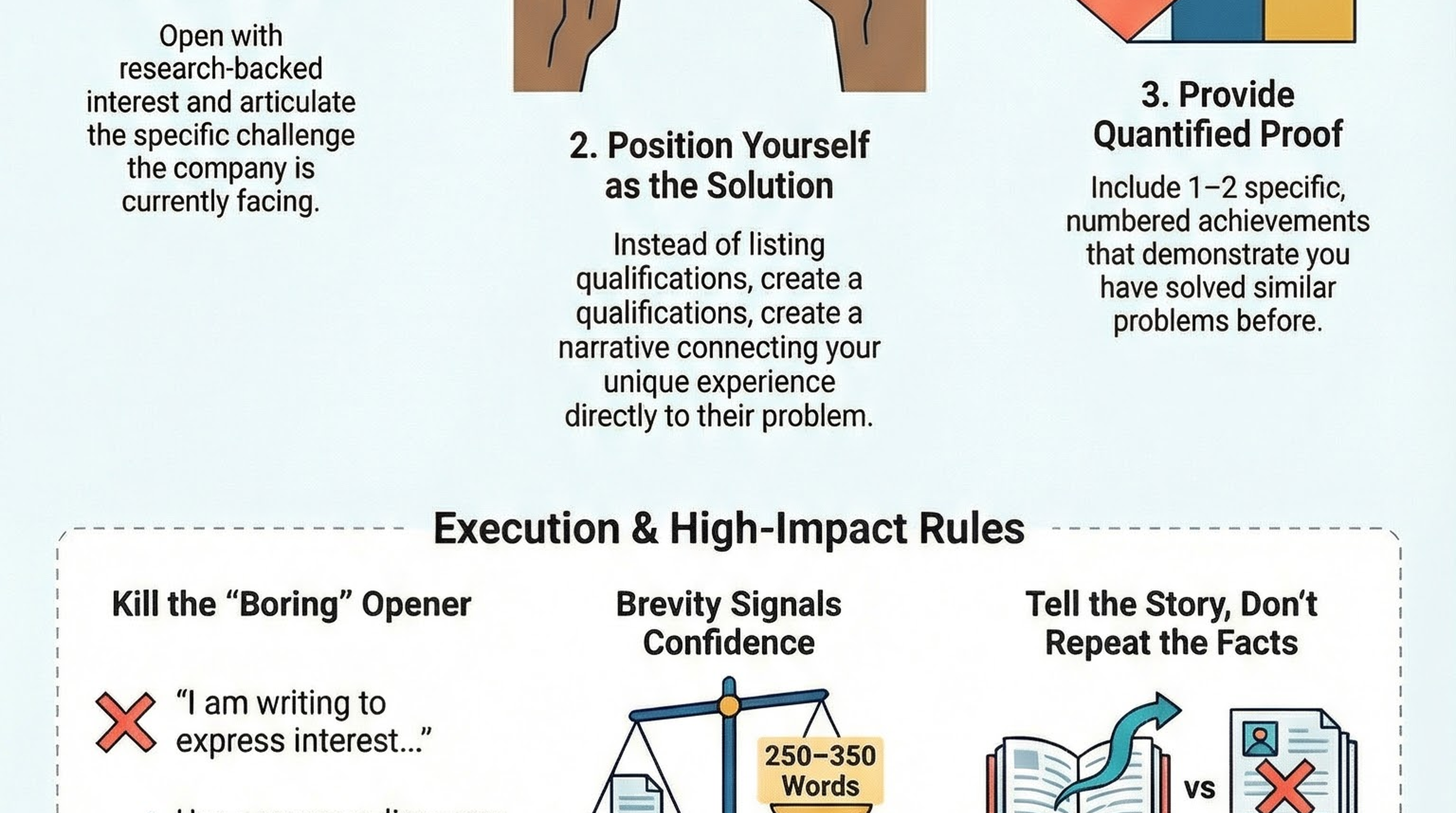
Follow this four-paragraph blueprint to transform your letter from a boring recap into a high-impact narrative.
- Paragraph 1: The Hook + The Problem. Do your homework. Demonstrate research by mentioning a specific discovery, such as a "new logistics automation initiative." Articulate the challenge behind the role so they know you understand their world.
- Paragraph 2: The Solution. Position yourself as the answer. Create a "narrative of relevance" rather than a list of qualifications. For example, instead of saying you have management experience, describe how you have "built and scaled technology teams" to directly address their growth needs.
- Paragraph 3: The Proof. Quantify your impact. Provide one or two concrete accomplishments that parallel their current challenge. Use numbers and outcomes (e.g., "reducing operational costs by 30%") to prove you have solved similar problems before.
- Paragraph 4: The Close. Suggest next steps. End with a confident, not arrogant, call to action. State your availability for a conversation and make it easy for them to reach you.
3. Mastering the Opening Hook
The opening line determines whether a hiring manager keeps reading or moves on. Never start with "I am writing to express my interest"—that sentence has never excited anyone. Use the table below to pivot to high-impact openings.
| Hook Type | ❌ The Boring Recap | ✅ The High-Impact Hook |
|---|---|---|
| Company Discovery | "I am writing to express my interest in the Data Analyst role..." | "When I read that [Company] is expanding its data analytics capability, I recognized exactly the challenge I solved at [Previous Company]." |
| Lead with a Result | "I am a highly motivated professional with supply chain experience..." | "Three years ago, I inherited a supply chain that was losing $2M annually to inefficiency. I turned it into a competitive advantage." |
| Mutual Connection | "I am applying because I heard your team is growing..." | "After speaking with Sarah Chen about your team's growth plans, I’m excited about the possibility of contributing to your automation goals." |
4. The Golden Rules of Impact and Brevity
In professional communications, brevity signals confidence. Follow these non-negotiables to maintain authority:
- Strictly adhere to a 250–350 word limit. If your draft is longer, "cut until it fits."
- Ensure the Role Title matches the posting exactly. Precision prevents your application from looking like a generic template.
- Fact-check the company name. Avoid the "copy-paste" kiss of death by verifying the name and culture before hitting send.
- Match the tone. Research the company culture—is it formal and corporate or fast-paced and casual? Your writing style must reflect their environment.
5. Supercharging the Process with AI Tools
Use these four AI applications to streamline your writing process without losing the human narrative:
- Cover Letter Generator: Use this for your initial draft to map your resume against the job description.
- Opening Hook Generator: Use this specifically to brainstorm attention-grabbing first sentences based on the three patterns mentioned above.
- Cover Letter Critic: Use this to get objective feedback and identify where you are slipping into "resume repeat" territory.
- Tone Matcher: Use this to ensure your style aligns with the company culture, preventing a "cultural mismatch" before you even interview.
💥 Engagement Zone
🎬 Real Story: Maria was a great candidate on paper, but she was a "career pivoter" moving from Education to Tech. Her resume alone didn't explain why she was making the move. She used the "Problem/Solution" framework in this lesson for her cover letter. Instead of listing her duties, she wrote: "Your company is currently scaling its customer onboarding—I've spent 10 years mastering the art of taking complex information and making it simple for new learners." She got the call-back because she solved their pain point before they even met her.
😂 Humor Touch: A cover letter that just repeats your resume is like a movie trailer that is just the entire movie played at 2x speed. Nobody wants to see it, and it spoils the experience. Your cover letter should be the "director's commentary"—explaining the why and the how behind the scenes.
🎮 Gamification: The "Blandness" Audit. Look at the first sentence of your last cover letter. Does it start with "I am writing to express my interest in..."? If yes, you've just failed the audit. Your challenge: Rewrite that first line to focus on a company problem you can solve. "I saw your recent expansion into [Region] and I have three ideas on how to..." Much better. Ready? Audit!
📊 Self-Assessment: The Cover Letter Impact Score. How would a hiring manager feel after reading your letter?
- "They'd probably fall asleep before the second paragraph."
- "They'd know I'm qualified, but they wouldn't know why I'm interested in them."
- "They'd see I've done my research on the company."
- "They'd understand exactly how my past experience solves their current problem."
- "They'd be reaching for the phone to call me before they even finish the page." Current Score: [ ]
6. Conclusion: Your Final Checklist
Before you submit, verify your work against this Success Checklist:
- Opens with a specific, compelling hook (Discovery, Result, or Connection).
- Identifies their problem, not just my qualifications.
- Connects my experience directly to their specific need.
- Includes 1–2 quantified, concrete achievements.
- Ends with a confident call to action and clear next steps.
- Total word count is between 250–350 words.
- No "I am writing to express..." or other fluff.
- Company name is correct and Role Title matches the posting exactly.
- Tone matches the specific company culture.
7. Call to Action
Stop treating the cover letter as a mandatory chore. When you shift your mindset from "reporting for duty" to "solving a problem," you change the power dynamic of the hiring process. Once you have mastered this persuasive narrative, you are ready for the next challenge: navigating the Applicant Tracking Systems (ATS) to ensure your story reaches a human being.
Accessibility — Image descriptions
| File | Alt text |
|---|---|
GHFE-M05-L02-ENG-cover-letter-strategy-infographic-landscape.png | Infographic for “Stop Repeating Your Resume: How to Write the Cover Letter That Actually Gets Read”: visual summary of repeating resume write cover (landscape layout, GHFE course). |
GHFE-M05-L02-ENG-cover-letter-strategy-infographic-portrait.png | Infographic for “Stop Repeating Your Resume: How to Write the Cover Letter That Actually Gets Read”: visual summary of repeating resume write cover (portrait layout, GHFE course). |
GHFE-M05-L02-ENG-cover-letter-strategy-video-thumbnail-landscape.png | Video thumbnail for “Stop Repeating Your Resume: How to Write the Cover Letter That Actually Gets Read”: preview image for the lesson video (landscape format). |
GHFE-M05-L02-ENG-cover-letter-strategy-video-thumbnail-portrait.png | Video thumbnail for “Stop Repeating Your Resume: How to Write the Cover Letter That Actually Gets Read”: preview image for the lesson video (portrait format). |