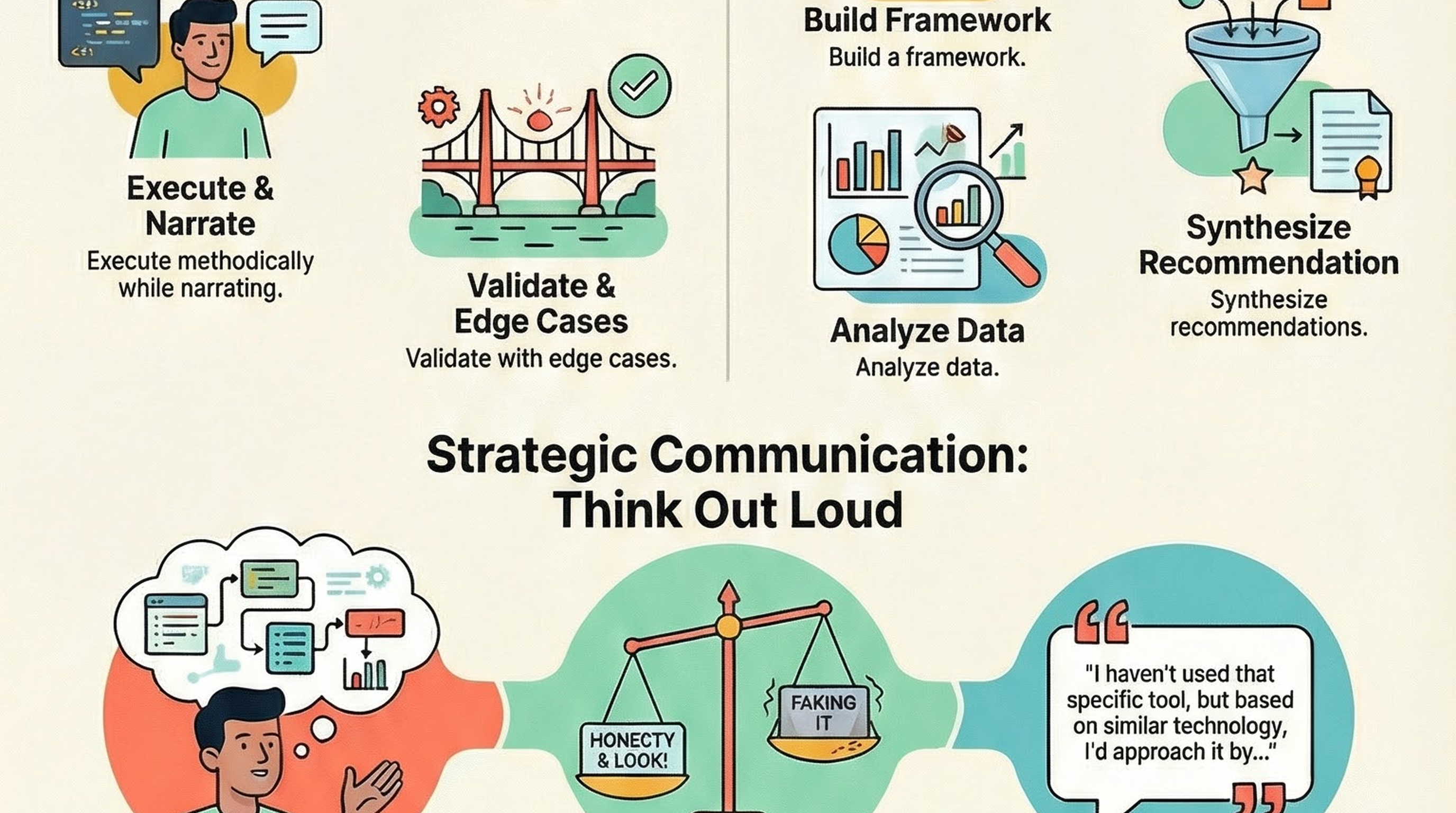
Master the Thinking Process: A Guide to Crushing Technical and Case Interviews
Outcome: By the end of this lesson, you will be able to navigate technical and case interviews using the 4-Step Case Framework.
The "Liberating Truth" of Modern Interviews
In high-stakes technical and case interviews, most candidates fail before they even finish their first sentence. They fall into the trap of believing the interview is a knowledge test where the only goal is to find the "right" answer.
As a career strategist, I am here to share a liberating truth that changes the entire power dynamic of the room: The interviewer cares significantly more about your problem-solving process than your final solution.
I have seen brilliant candidates provide the perfect technical answer and get rejected because they were a "black box" who couldn't explain their methodology. Conversely, I’ve seen candidates arrive at a sub-optimal or even incorrect answer and still receive an offer because their reasoning was structured, transparent, and resilient. These interviews are assessments of how you think under pressure. To succeed, you must stop acting like a calculator and start acting like a consultant.
The Four-Step Framework for Technical Interviews
To command the room and project "senior-level" authority, you must follow a methodical framework that telegraphs your logic to the interviewer.
- Step 1: Clarify (The Senior Signal). Before you touch a whiteboard or a keyboard, you must ask questions. Clarify the scope, define the constraints, and list your assumptions. Ask the pivotal question: "What does success look like for this specific problem?" Jumping straight into a solution is a "junior signal"—it suggests you are a liability in a production environment who might build the wrong thing. Clarifying shows you are a strategic asset who understands the "why" before the "how."
- Step 2: Structure (The Safety Net). Never solve in a vacuum. Outline your approach first to provide the interviewer with a "roadmap." By stating, "I’m going to approach this in three parts: first X, then Y, then finally Z," you give the interviewer a chance to course-correct you before you waste time. More importantly, this roadmap serves as your personal safety net; if you get lost in the weeds of execution, you have a high-level plan to return to.
- Step 3: Execute (Narration). Work through your plan methodically while thinking out loud. You must narrate your reasoning—why you are choosing a specific library, or how a specific variable affects the outcome. Remember: The interviewer cannot evaluate what they cannot hear. If you are silent, they cannot help you, and they certainly cannot hire you.
- Step 4: Validate (The Active Stance). Once you have a solution, don't just stop. Check your work against the constraints you identified in Step 1. Adopt an active stance: "This solution handles the primary case, but I’d want to test it against these specific edge cases..." This demonstrates that you understand technical trade-offs and take pride in the robustness of your work.
The Case Interview: Hypothesis-Driven Problem Solving
Case interviews test your ability to navigate ambiguity. To demonstrate executive-level thinking, you must be solution-oriented from minute one by being hypothesis-driven.
- Listen and Restate: Repeat the problem back to confirm understanding. This ensures you aren't solving the wrong business problem.
- Form a Hypothesis: State an initial hypothesis immediately (e.g., "My initial hypothesis is that the revenue drop is driven by new market entrants..."). This is a key indicator of structured thinking; it shows you are looking for a solution, not just wandering through data.
- Build a Framework: Create a simple structure with two to four categories to analyze the problem. This framework is the backbone of your entire analysis. It keeps you organized and ensures your thinking is MECE (Mutually Exclusive, Collectively Exhaustive).
- Analyze: Work through each branch of your framework. Use the data provided, but when data is missing, make and state reasonable assumptions to keep the momentum.
- Synthesize: Bring your findings together into a clear, actionable recommendation. End with a "bottom-line" conclusion supported by the logic you just built.
How to Gracefully Handle "I Don't Know"
At some point, an interviewer will push you to the edge of your knowledge. This is by design. They want to see if you crumble, bluff, or reason.
Mantra: Honesty + reasoning > bluffing every time.
Bluffing is a fireable offense in a real-world technical role; it destroys trust. Instead, demonstrate intellectual honesty and transferable thinking using these templates:
- Approaching an unknown technology: "I haven’t worked with that specific tool yet, but here’s how I’d approach learning it based on my experience with [Related Tool]..."
- Hypothesizing based on similar problems: "I’m not certain of the exact internal mechanism here, but based on how similar systems handle load balancing, I’d hypothesize that..."
- Extending experience to a new area: "That specific industry context is new to me, but I can apply the logic I used when solving [Similar Problem] to this scenario..."
Putting it into Practice: AI Tools and Action Items
Don't just read this guide—drill it. Use AI tools to simulate the pressure of the interview room:
- Mock Technical Interviewer: Use this to practice the full 4-step framework from clarification to validation.
- Case Interview Coach: Use this to drill your "Hypothesis" and "Framework" steps until they are second nature.
- Technical Concept Explainer: Use this to practice Step 3 (Execute). Feed it a complex concept and practice narrating the explanation clearly.
- "I Don't Know" Response Generator: Use this to generate difficult, "left-field" questions to practice your honesty + reasoning drills.
Action Plan
- Narrate the Logic: Practice narrating your code or case logic out loud with a partner until you can do it fluently without breaking your flow or losing your train of thought.
- The "Rule of Three": Work through at least three complex case problems using the five-step hypothesis-driven framework.
- AI Pressure Test: Conduct at least two full-length mock interviews using AI tools to simulate the transition between "Clarifying" and "Executing" under a timer.
💥 Engagement Zone
🎬 Real Story: "Logic" Liam. Liam was a Software Engineer who was asked a complex architectural question he didn't know the answer to. Instead of guessing or staying silent, he "narrated his logic." He talked through his assumptions, his trade-offs, and his troubleshooting steps. The interviewer said, "Your answer wasn't perfect, but your process was exactly what we need on our team." He was hired.
😂 Humor Touch: Thinking out loud is like being a sports commentator for your own brain. "And here comes Liam, bravely entering the 'I don't know' zone! He’s making a bold play on the trade-offs! Will he stick the landing on the final recommendation? Let's watch his logic in slow-motion!" It feels silly at first, but it's pure gold to an interviewer.
🎮 Gamification: The Logic Leap Challenge. Take a random, "impossible" question (e.g., "How many piano tuners are there in New York City?") and narrate your solving process out loud for exactly 3 minutes. Don't worry about the final number—just focus on demonstrating your logical steps!
📊 Self-Assessment: Rate your "Process Over Product" on a scale of 1-5:
- I stay silent when I'm stuck (The Panic Zone).
- I guess the answer and hope it's right.
- I mention some of my thinking, but only when prompted.
- I consistently narrate my logic and ask clarifying questions.
- I am a logic leader. I can walk an interviewer through my most complex problem-solving steps with clarity and confidence.
Conclusion: Top 5 Takeaways for Success
- Process over answers. Your logic is the product you are selling, not the code or the conclusion.
- Clarify before solving. Jumping in without questions is a "junior liability" signal. Always ask: "What does success look like?"
- Think out loud. Make your internal reasoning visible. If you are silent, you are failing.
- Structure everything. Use roadmaps and frameworks to provide a safety net for yourself and a guide for your interviewer.
- Don’t fake it. Transparent reasoning and intellectual honesty are more valuable than memorized knowledge.
Technical and case interviews are not "gotcha" games; they are thinking exercises. If you can demonstrate a robust, structured, and communicative process, you will be the candidate the team trusts to solve the problems they haven't even encountered yet.
Accessibility — Image descriptions
| File | Alt text |
|---|---|
GHFE-M06-L03-ENG-thinking-interviews-infographic-landscape.png | Infographic for “Master the Thinking Process: A Guide to Crushing Technical and Case Interviews”: visual summary of thinking process crushing technical (landscape layout, GHFE course). |
GHFE-M06-L03-ENG-thinking-interviews-infographic-portrait.png | Infographic for “Master the Thinking Process: A Guide to Crushing Technical and Case Interviews”: visual summary of thinking process crushing technical (portrait layout, GHFE course). |
GHFE-M06-L03-ENG-thinking-interviews-video-thumbnail-landscape.png | Video thumbnail for “Master the Thinking Process: A Guide to Crushing Technical and Case Interviews”: preview image for the lesson video (landscape format). |
GHFE-M06-L03-ENG-thinking-interviews-video-thumbnail-portrait.png | Video thumbnail for “Master the Thinking Process: A Guide to Crushing Technical and Case Interviews”: preview image for the lesson video (portrait format). |