Mastering the STAR Method: How to Ace Your Behavioral Interview
Outcome: By the end of this lesson, you will be able to master behavioral interviews using the STAR Method and the 10/10/60/20 Rule.
1. Introduction: The High-Stakes Opening
"Tell me about a time when..." If you have sat for a professional interview in the last decade, you have heard this phrase. These are behavioral questions, and they are not asked by accident. Research proves that past behavior is the single best predictor of future performance. To navigate these, the industry-standard framework is the STAR method.
Here is the problem: everyone knows STAR, but almost nobody uses it well. Most candidates drown the interviewer in irrelevant context and skip the very details that lead to a job offer. If you want to outperform the competition, you cannot just use STAR—you must master it. This guide will show you how to execute the framework like a top-tier candidate.
2. The STAR Framework: A Blueprint for Success
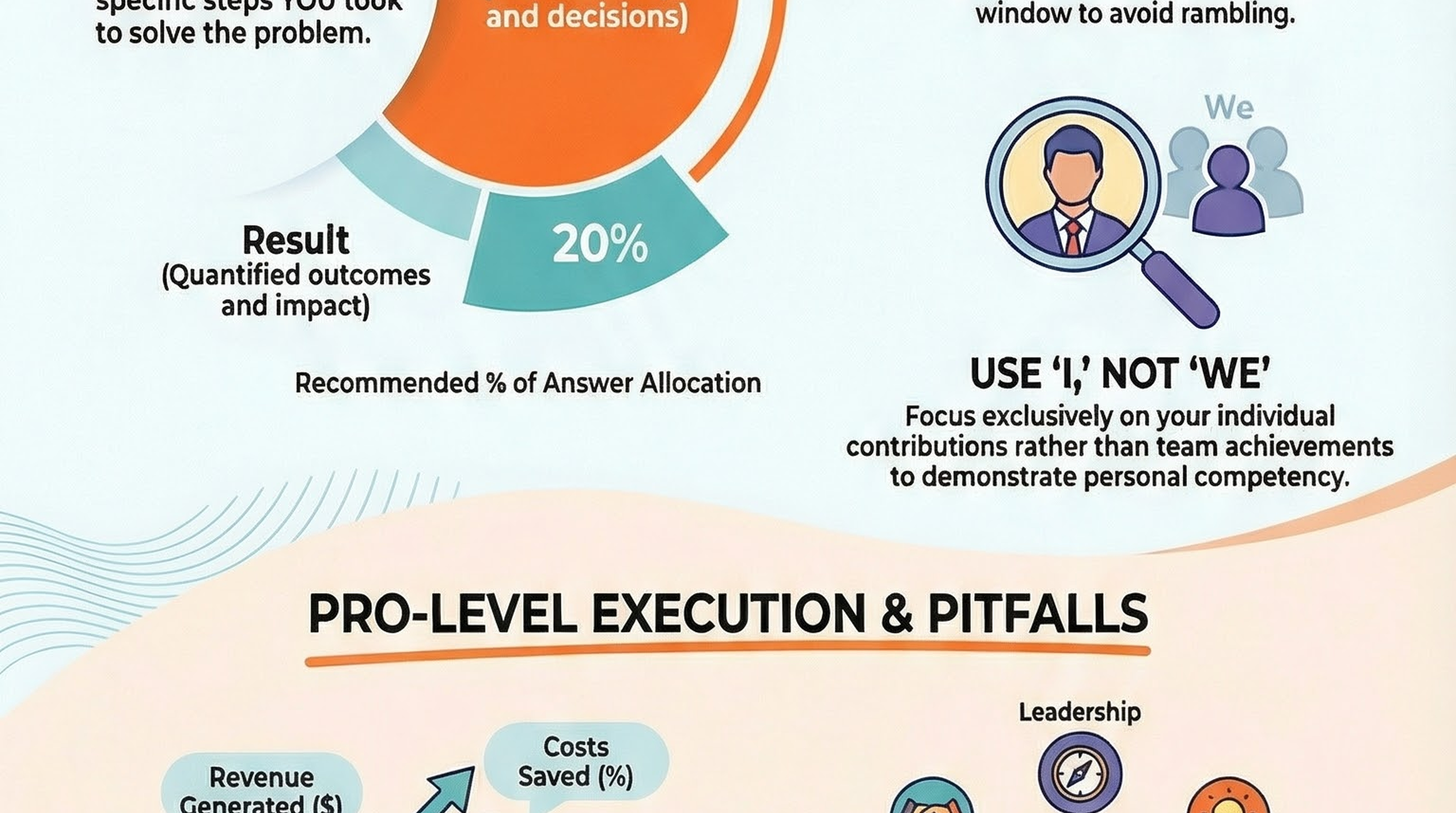
A winning interview answer is a matter of precision and balance. Most candidates fail because they spend three minutes setting the scene and only thirty seconds describing what they actually did. To win the room, you must adhere to a strict time distribution.
| Component | Allocation | Strategic Instruction |
|---|---|---|
| Situation | 10% | Set the scene briefly in one to two sentences maximum. |
| Task | 10% | State your specific individual responsibility—what was expected of you? |
| Action | 60% | Walk through the specific, detailed steps you took to solve the problem. |
| Result | 20% | Quantify the outcome to provide a credible, memorable conclusion. |
3. The Secret Sauce: Why the 'Action' Section is King
The "Action" section is the heart of your answer. This is what hiring managers are actually evaluating. If you summarize here, you lose.
60% of your answer must focus on the specific steps you took. This is your time to shine.
To execute this section like a senior leader, you must follow these rules:
- Stop using "We": The interviewer is hiring you, not your former team. If you don't own the action, you don't get the credit. Use "I" exclusively when describing the work.
- Show your logic: Do not just list what you did; explain why you chose that specific approach. Include one "Why" for every "What" to demonstrate senior-level thinking.
- Navigate obstacles: Be detailed about the hurdles you encountered and the specific decisions you made to bypass them.
4. Quantifying Your Impact: The Power of the 'Result'
A story without a quantified result is just an anecdote. Numbers provide the evidence required to make your claims credible and memorable.
You must aim for data-driven results, such as:
- "Revenue increased by 32%."
- "Customer satisfaction (CSAT) scores improved from 3.2 to 4.7."
- "Delivery time decreased from 14 days to 6."
What if you cannot quantify the result? If a specific metric is unavailable, do not settle for "it went well." You must describe the concrete impact in specific terms. Detail the exact change that occurred because of your intervention and why it mattered to the business.
5. The 5 Fatal STAR Mistakes to Avoid
Avoiding these common errors will immediately place you in the top tier of candidates:
- Too much Situation, not enough Action: Don’t spend three minutes painting a picture. The interviewer wants to know what you did, not the full history of the project.
- Using "We" instead of "I": Own your contributions. Team accomplishments don't get you hired.
- Vague actions: "I worked hard" is meaningless. Detail your specific methods and steps.
- No quantified results: "They were happy" is an opinion, not a result. Provide data.
- Rambling: Your answer must land between 90 seconds and 2 minutes. Two minutes is the absolute maximum. If you cannot tell the story that concisely, you haven't practiced enough.
6. Building Your Story Library
You cannot "wing" a behavioral interview. You need a library of 8 to 10 stories prepared in advance. Because many stories are versatile, you will use a Story-to-Competency Mapper to ensure your library covers these five core competencies:
- Leadership
- Overcoming Challenge/Failure
- Teamwork/Collaboration
- Initiative/Innovation
- Conflict Resolution
To polish these narratives, leverage professional AI tools: use the STAR Story Refiner to fix your structure, the Behavioral Question Predictor to anticipate prompts, and a Mock Behavioral Interview tool to practice your delivery under pressure.
💥 Engagement Zone
🎬 Real Story: "Rambling" Rita. Rita was a talented Project Manager who spent 4 minutes explaining the "Situation" of her most complex project, but only 30 seconds on the "Action." The interviewer missed her contribution and thought she was a passive observer. After using the 60% Action rule, Rita landed a Senior PM role at a Tier 1 tech firm. She didn't have more experience; she just became a better narrator.
😂 Humor Touch: A STAR story without an "Action" is like a movie trailer that shows the setup but cuts to black before the explosion. It leaves everyone feeling confused and unsatisfied. You’re the hero of this story—don’t let the context be the main character!
🎮 Gamification: The STAR Timer Challenge. Set a timer for 2 minutes. Record yourself telling one of your core stories. If it's over the limit, or if you spend more than 20 seconds on the "Situation," you're "disqualified"—start over! It's time to build your precision.
📊 Self-Assessment: Rate your "STAR Mastery" on a scale of 1-5:
- I "wing it" and hope for the best (The Ramble Zone).
- I know the components, but I spend too much time on the context.
- I use "we" instead of "I" in my Action section.
- I consistently hit the 60% Action target and quantify my Results.
- I am a STAR athlete. My stories are crisp, quantified, and high-impact.
7. Conclusion & Action Plan
To master the STAR method, remember the big three: Focus on the Action (60%), use "I" instead of "we," and quantify every result. If you do this, you turn a standard conversation into a powerful demonstration of your professional value.
Final Preparation Checklist:
- Write 5 STAR stories using the framework (refer to your Worksheet).
- Ensure every story includes the "Why" behind your actions.
- Practice each story out loud until it is consistently under 2 minutes.
- Map your 8-10 stories to the five core competencies.
- Use AI tools to refine and mock-interview your stories.
Once you have mastered these behavioral stories, you are ready for the next stage of preparation: Technical and Case Study interviews. These require a different strategy, but the discipline you've built here will be your foundation.
Accessibility — Image descriptions
| File | Alt text |
|---|---|
GHFE-M06-L02-ENG-star-method-mastery-infographic-landscape.png | Infographic for “Mastering the STAR Method: How to Ace Your Behavioral Interview”: visual summary of STAR method interview (landscape layout, GHFE course). |
GHFE-M06-L02-ENG-star-method-mastery-infographic-portrait.png | Infographic for “Mastering the STAR Method: How to Ace Your Behavioral Interview”: visual summary of STAR method interview (portrait layout, GHFE course). |
GHFE-M06-L02-ENG-star-method-mastery-video-thumbnail-landscape.png | Video thumbnail for “Mastering the STAR Method: How to Ace Your Behavioral Interview”: preview image for the lesson video (landscape format). |
GHFE-M06-L02-ENG-star-method-mastery-video-thumbnail-portrait.png | Video thumbnail for “Mastering the STAR Method: How to Ace Your Behavioral Interview”: preview image for the lesson video (portrait format). |