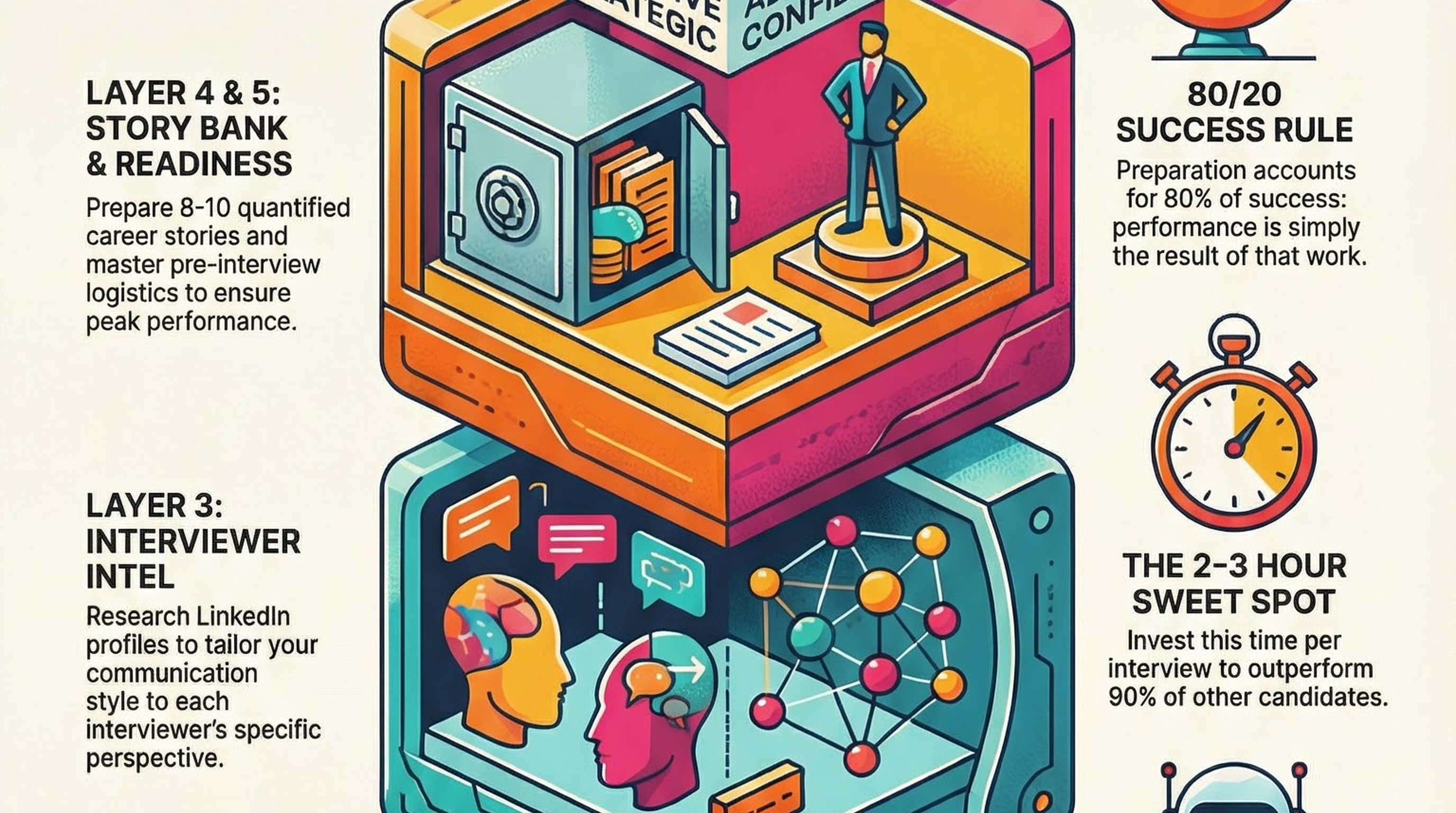
The Unfair Advantage: Mastering the 5-Layer Interview Preparation System
Outcome: By the end of this lesson, you will be able to perform deep role and interviewer research using the 5-Layer Prep System.
1. Introduction: The 80/20 Rule of Interview Success
In the high-stakes world of career advancement, a dangerous myth persists: that the "most qualified" candidate gets the job. This is a fallacy. Technical brilliance and an impressive resume are merely the price of admission. The offer doesn't go to the person with the best past; it goes to the person who can best articulate their future value.
Interview success is governed by the 80/20 rule: 80% of your victory is won through preparation, while only 20% is determined by the performance itself. If you walk into a room relying on "talent" alone, you are leaving your career to chance. This guide provides a systematic framework designed to transform nervous candidates into strategic winners who walk into the room with an unfair advantage.
2. The Foundation: Why Preparation is Your Competitive Advantage
Under-preparation is the silent killer of high-potential careers. Most candidates treat an interview as a passive, defensive conversation where they hope to survive the questions. A strategist views the interview as an offensive demonstration of value and tactical intelligence.
The most prepared candidate wins—almost every time.
By the time you sit down, you should already have the intelligence needed to solve the company’s problems. This level of preparation eliminates the anxiety of the unknown and replaces it with the confidence of an expert.
3. Deep Dive: The 5-Layer Prep System
To achieve peak performance, you must execute a targeted intelligence-gathering mission across five distinct layers.
Layer 1: Company Deep Dive
Surface-level knowledge is an insult to the interviewer. You must investigate the "Key Findings" that reveal the company's true state:
- Mission, Values, and Culture: Look beyond the website; check LinkedIn posts and employee reviews for the "genuine" culture.
- Financial Health & Growth Trajectory: Review the last three months of news and financial reports to understand if they are expanding or contracting.
- Competitive Landscape: Identify who they are fighting against in the market.
- Strategic Challenges: Pinpoint the obstacles the company currently faces.
- The Genuine "Why": Based on this research, synthesize a "Genuine 'Why'" statement. This bridges the gap between raw data and your personal motivation, answering the "Why do you want to work here?" question before it is even asked.
Layer 2: Role Intelligence (The 3-Tier System)
You must decode the job posting to understand the actual problem the company is hiring you to solve. Do not take the bullet points at face value. Use this 3-tier system:
- Tier 1: Core Skills. What are the non-negotiable technical requirements?
- Tier 2: Success Metrics. How will they measure your performance in the first 90 days?
- Tier 3: Cultural Nuance. What soft skills are required to navigate this specific team's politics or pace?
Layer 3: Interviewer Intel (The Secret Weapon)
This is the most overlooked and highest-impact layer. You must pivot your language based on who is across the table:
- The HR Recruiter: Evaluates you for culture fit, baseline competency, and "risk." Use language focused on alignment and reliability.
- The Technical Lead/VP: Focuses on execution and strategic impact. They want to know if you can do the work and if you will make their life easier. Use LinkedIn to find their tenure, background, and shared interests to build rapid rapport.
Layer 4: The Story Bank
Never "wing" a behavioral question. Build a bank of 8–10 career stories. Every story in your bank must include:
- A "Working Title": Give it a sticky name like "The Q3 Revenue Save" or "The Migration Turnaround" to make it memorable.
- Competency Mapping: Specifically note which skill the story proves (e.g., leadership, crisis management).
- Hard Metrics: Quantify every achievement. "Improved efficiency" is weak; "Reduced processing time by 22% resulting in $40k monthly savings" is tactical.
Layer 5: Logistics & Mindset
Professionalism is found in the details. Confirm the format, test your camera and microphone, and curate a distraction-free environment. Once the logistics are locked, shift to mental anchors. Use visualization and controlled breathing to transition from a state of "scrambling" to a state of calm authority.
4. The Investment: How to Spend Your Time
The "sweet spot" for interview preparation is a focused 2–3 hour window. A strategist knows that spending 10 hours in unguided research leads to diminishing returns. You need targeted intelligence, not a history degree in the company.
The 3-Hour Preparation Breakdown
| Duration | Task | Focus |
|---|---|---|
| 1 Hour | Company & Role Research | Decoding the 3-Tier System and findings. |
| 30 Minutes | Interviewer Research | Reviewing LinkedIn for backgrounds and "Focus Areas." |
| 30 Minutes | Rehearsing Stories | Refining Working Titles and quantifying metrics. |
| 30 Minutes | Logistics & Mindset | Tech tests, environment prep, and mental anchoring. |
5. Modernizing the Search: AI Tool Applications
Leverage technology to accelerate your intelligence gathering. Use these four AI applications as your "pro-tips" for execution:
- Company Research Accelerator: Use AI to synthesize annual reports and news into a 5-minute executive summary.
- Story Bank Builder: Feed AI your raw career wins and ask it to refine the "Working Titles" and structure them for maximum impact.
- Interviewer Intel: Use AI to summarize an interviewer's public profile and suggest likely areas of focus based on their career path.
- Mock Stress Interview Partner: Instead of a standard mock interview, prompt the AI to act as a "skeptical VP" to stress-test your responses and refine your delivery under pressure.
6. The Final Checklist: Ready for Peak Performance
Before you join the call or enter the room, ensure these boxes are checked:
- Company Deep Dive Complete: I can articulate their growth trajectory and strategic challenges.
- Genuine "Why" Statement Ready: I have a non-generic reason for wanting this specific role.
- Role Decoded (3-Tier): I know the core skills, success metrics, and cultural nuances.
- Interviewer Intel Gathered: I know who I’m talking to and how to pivot my language for them.
- 8+ Stories Quantified: Every story has a "Working Title," metrics, and a competency map.
- Questions for the Interviewer Prepared: I have 3–5 high-level questions ready.
- Tech/Logistics Tested: Camera, mic, and internet are stable; environment is quiet.
- Mental Preparation Done: Visualization and breathing complete; I am in a state of confidence.
💥 Engagement Zone
🎬 Real Story: "Deep Dive" David. David was applying for a Senior Operations role. During the interview, he mentioned a specific operational bottleneck discussed in the company's Q3 investor call. The Hiring Manager’s jaw dropped. "Wait, you actually read the earnings report?" David replied, "I wanted to understand how this role directly impacts your Q4 targets." He got an offer the next day. The research wasn't just homework; it was his secret weapon.
😂 Humor Touch: Walking into an interview without deep-dive research is like going on a first date and asking, "So, what's your name again?" It's not just awkward; it’s a total dealbreaker. Preparation is the difference between a high-value candidate and a random person who wandered in off the street.
🎮 Gamification: The 5-Minute Recon Challenge. Set a timer for 5 minutes. Go to Google News and your target company's LinkedIn page. Find one piece of "non-obvious" news (e.g., a recent award, a new partnership, or a quote from an executive). Mention this in your mock interview today!
📊 Self-Assessment: Rate your "Preparation Power" on a scale of 1-5:
- I check the website for 2 minutes before the call (The Amateur Zone).
- I know the basic products and mission, but nothing about the financials.
- I have researched the company and my interviewer's LinkedIn profile.
- I understand the company's current challenges and have a "Why Us" statement ready.
- I am a strategy ninja. I know their Q3 targets better than some of their own employees.
7. Conclusion: From Scrambling to Strategic
Mastering these five layers—Company, Role, Interviewer, Stories, and Logistics—is the difference between being a nervous participant and a strategic winner. Mental preparation is not an optional "extra"; it is the foundation of authority.
By applying this systematic approach, you gain an unfair advantage over the majority of candidates who under-prepare. You are no longer hoping for a job; you are demonstrating why you are the only logical choice for the role.
Now that your foundation is built and your stories are banked, you are ready for the next phase of execution. In the next lesson, we will master the STAR Method to deliver your behavioral answers with surgical precision.
Accessibility — Image descriptions
| File | Alt text |
|---|---|
GHFE-M06-L01-ENG-5-layer-prep-system-infographic-landscape.png | Infographic for “The Unfair Advantage: Mastering the 5-Layer Interview Preparation System”: visual summary of 5 layer interview prep (landscape layout, GHFE course). |
GHFE-M06-L01-ENG-5-layer-prep-system-infographic-portrait.png | Infographic for “The Unfair Advantage: Mastering the 5-Layer Interview Preparation System”: visual summary of 5 layer interview prep (portrait layout, GHFE course). |
GHFE-M06-L01-ENG-5-layer-prep-system-video-thumbnail-landscape.png | Video thumbnail for “The Unfair Advantage: Mastering the 5-Layer Interview Preparation System”: preview image for the lesson video (landscape format). |
GHFE-M06-L01-ENG-5-layer-prep-system-video-thumbnail-portrait.png | Video thumbnail for “The Unfair Advantage: Mastering the 5-Layer Interview Preparation System”: preview image for the lesson video (portrait format). |