Know Your Worth: How to Use Data as Leverage in Your Next Negotiation
Outcome: By the end of this lesson, you will be able to perform a Total Comp Triangulation to determine your true market value.
The High Cost of Silence: Your First Offer is Your Foundation
In the world of high-stakes career moves, silence is an expensive mistake. Failing to negotiate your very first offer doesn't just impact your immediate paycheck; it creates a financial deficit that follows you for decades. Industry studies reveal that professionals who fail to negotiate their initial compensation can lose over $500,000 across the span of their careers due to the compounding effect of annual raises and percentage-based bonuses.
Your leverage is built entirely on the strength of your data. You cannot negotiate what you do not understand. Approaching a negotiation based on what you want or feel is a recipe for failure. To command the room, you must move beyond desire and master evidence. Data is the ultimate leverage that transforms a request into a requirement.
The Digital Paper Trail: Triangulating Market Compensation
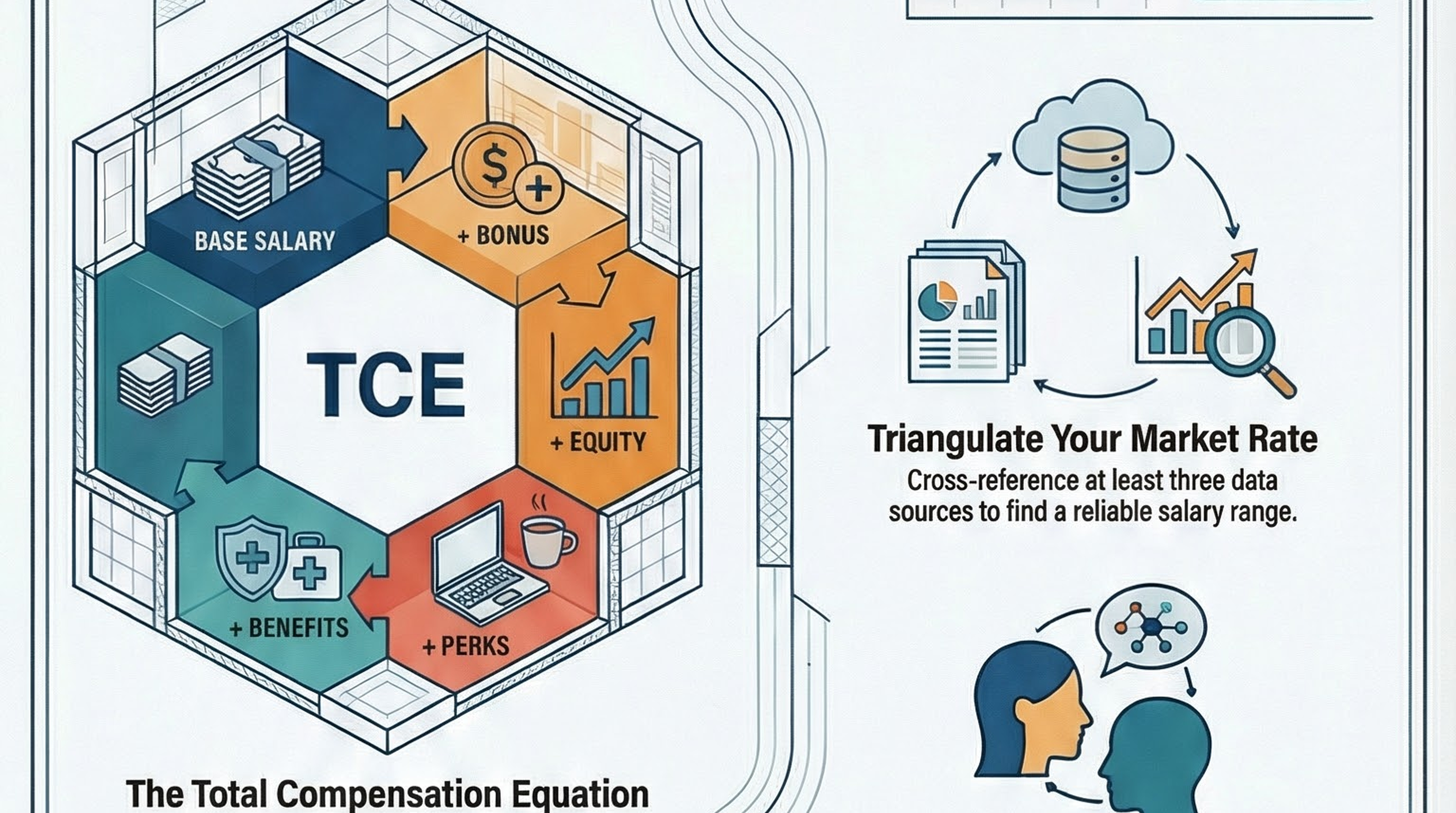
Strategic negotiation requires "triangulation." Because no single platform provides a perfect snapshot of the market, you must cross-reference at least three distinct sources to establish a credible range. Your goal is to identify the intersection of role, experience level, and location.
Use the following table to evaluate your data sources. Note that while digital tools provide a baseline, human intelligence remains the gold standard for accuracy.
| Source | Information Provided | Reliability Level |
|---|---|---|
| Recruiters/Network | Real-time market intel and internal ranges | Very High |
| Levels.fyi | Detailed, verified compensation for tech roles | High (Tech-specific) |
| Industry Reports | Deep-dive data on specific sectors and trends | High |
| BLS.gov | Federal labor statistics and broad averages | High (Averages) |
| Glassdoor | Salary ranges by company and specific role | Medium |
| Payscale | Role-based salary data and market trends | Medium |
| LinkedIn Salary | Crowd-sourced data from professional networks | Medium |
The Human Advantage: Real-Time Intelligence (HUMINT)
While digital databases are a vital starting point, your network provides "Human Intelligence" that static websites cannot match. Recruiters and industry peers offer the nuance required to understand why a number is what it is.
Human sources provide critical context that reveals the "hidden" market:
- Industry-Specific Talent Shortages: A network contact can reveal if a specific sector—like healthcare or AI—is currently paying 20% above national averages due to a localized talent scarcity.
- Company-Specific Comp Structures: Real-time intel can clarify that a firm pays lower cash because they offer aggressive equity, or that they have reached their "internal ceiling" for a specific grade level.
- The "Why" Behind the Number: Humans can explain if a high salary on Glassdoor was a one-time signing bonus or a standard base.
Beyond the Paycheck: Solving the Total Compensation Equation
Sophisticated negotiators do not fixate on the headline number. They optimize the Total Compensation Equation, factoring in the Company Stage (e.g., an early-stage startup offering high equity versus a Fortune 500 company offering high base salary and stability).
Total Compensation = Base Salary + Bonus + Equity + Benefits + Perks
To see the power of this equation, consider two competing offers. A $70,000 base salary may seem inferior to an $85,000 offer at first glance. However, the math often tells a different story:
- Offer A: $70,000 Base + 20% Annual Bonus ($14,000) = $84,000 Total Cash.
- Once you add stock options, 401k matching, and premium health benefits, the $70k offer easily eclipses the $85k "dry" offer that includes no bonus or equity.
Defining Your Boundaries: Floor, Target, and Stretch
Before you enter any room, you must have your "Tactical Range" documented. A number without a Rationale is just a guess; a position backed by market data is a professional stance.
- The Floor (Walk-away): This is your absolute minimum based on your financial needs and market value.
- Strategist’s Tip: Your floor is your psychological safety net. Defining it clearly in advance prevents you from making fear-based concessions or "desperation hires" during the heat of the conversation.
- The Target (Realistic): This is the number that your triangulated market data suggests is fair and achievable for someone with your specific expertise.
- The Stretch (Aspirational): This is the high end of the market range—the best-case scenario that remains justifiable by data.
AI-Powered Negotiation: Strategic Research Methodology
Modern professionals use AI not just to find data, but to synthesize it into a competitive advantage. Integrate AI into your workflow through these four strategic applications:
- Compensation Synthesis: Use AI to aggregate data from multiple disparate sources (Glassdoor, Payscale, BLS) into a single, cohesive market analysis.
- Total Comp Calculator: Automate the complex math required to compare offers with different equity structures and bonus tiers.
- Cost of Living (COL) Adjuster: Instantly translate what a $150k salary in New York City means in terms of purchasing power in Austin or Denver.
- Negotiation Data Summary: Use AI to condense all your research into a one-page "cheat sheet." This summary should include your data points and the rationales for your Floor, Target, and Stretch numbers, serving as your primary reference during the live discussion.
💥 Engagement Zone
🎬 Real Story: The $80,000 Silence Tax Sarah, a Senior Marketing Manager, accepted a $110k offer without negotiating, fearing she’d look "difficult." Two years later, she discovered a male peer with less experience was hired at $135k. That $25k gap, compounded with 5% annual raises, cost her over $80,000 in four years—the price of a luxury SUV or a significant down payment—simply because she didn't spend 15 minutes citing market data.
😂 Humor Touch Negotiating without data is like playing poker where everyone else can see your cards, and you’re betting with Monopoly money. You might feel bold, but the house (HR) already knows exactly what the pot is worth, and they aren’t impressed by your "gut feeling" or your desire for a nicer espresso machine.
🎮 Gamification: The 60-Second Data Sprint Set a timer for 60 seconds. Go to Levels.fyi or Glassdoor and find the median salary for your target role in your specific city. Results:
- Found it? +10 Leverage Points. You're already ahead of most candidates.
- Still searching? Your "Silence Tax" is accruing. Keep digging until you have a hard number!
📊 Self-Assessment: The Negotiation Readiness Audit Rate yourself on a scale of 1-5 for each statement:
- I have at least 3 verified data sources for my target role. [ ]
- I know my absolute "Walk-away Floor" and the logic behind it. [ ]
- I can state my "Rationale" for my target salary in one clear sentence. [ ]
- I have calculated the value of equity, bonuses, and benefits, not just base pay. [ ]
Scoring:
- 4-10: Danger Zone. You're walking into a knife fight with a wet noodle.
- 11-15: Solid Foundation. You have the facts to back up your ask.
- 16-20: Compensation Commando. You are ready to command the room.
Key Takeaways and Action Plan
Key Takeaways
- Data is Your Leverage: Entering a negotiation without market research is like going to court without evidence.
- Optimize the Full Equation: Focus on total compensation (bonuses, equity, benefits), not just the base salary.
- Know Your Floor: A predefined walk-away number is your best defense against desperation and poor decision-making.
- Triangulation is Mandatory: Cross-reference at least three sources to ensure your data isn't skewed by a single platform's limitations.
- Prioritize Human Intel: Real-world context from recruiters and your network beats static database entries every time.
Action Plan
- Gather Intel: Collect salary data from at least three digital sources and two network contacts.
- Establish Your Range: Define your Floor, Target, and Stretch numbers, and write down a one-sentence Rationale for each based on your research.
- Factor the Stage: Identify whether the company stage (Startup vs. Corporate) favors equity or cash, and adjust your expectations accordingly.
- Prepare Your Cheat Sheet: Use an AI tool to generate a "Total Compensation Comparison" and a "1-page Negotiation Data Summary" to bring to your meeting.
By walking into the room with verified data and a calculated range, you transition from a candidate asking for a favor to a professional negotiating a high-value business partnership. Market data provides the confidence; your strategy provides the results.
Accessibility — Image descriptions
| File | Alt text |
|---|---|
GHFE-M07-L01-ENG-market-value-data-infographic-landscape.png | Infographic for “Know Your Worth: How to Use Data as Leverage in Your Next Negotiation”: visual summary of salary negotiation (landscape layout, GHFE course). |
GHFE-M07-L01-ENG-market-value-data-infographic-portrait.png | Infographic for “Know Your Worth: How to Use Data as Leverage in Your Next Negotiation”: visual summary of salary negotiation (portrait layout, GHFE course). |
GHFE-M07-L01-ENG-market-value-data-video-thumbnail-landscape.png | Video thumbnail for “Know Your Worth: How to Use Data as Leverage in Your Next Negotiation”: preview image for the lesson video (landscape format). |
GHFE-M07-L01-ENG-market-value-data-video-thumbnail-portrait.png | Video thumbnail for “Know Your Worth: How to Use Data as Leverage in Your Next Negotiation”: preview image for the lesson video (portrait format). |