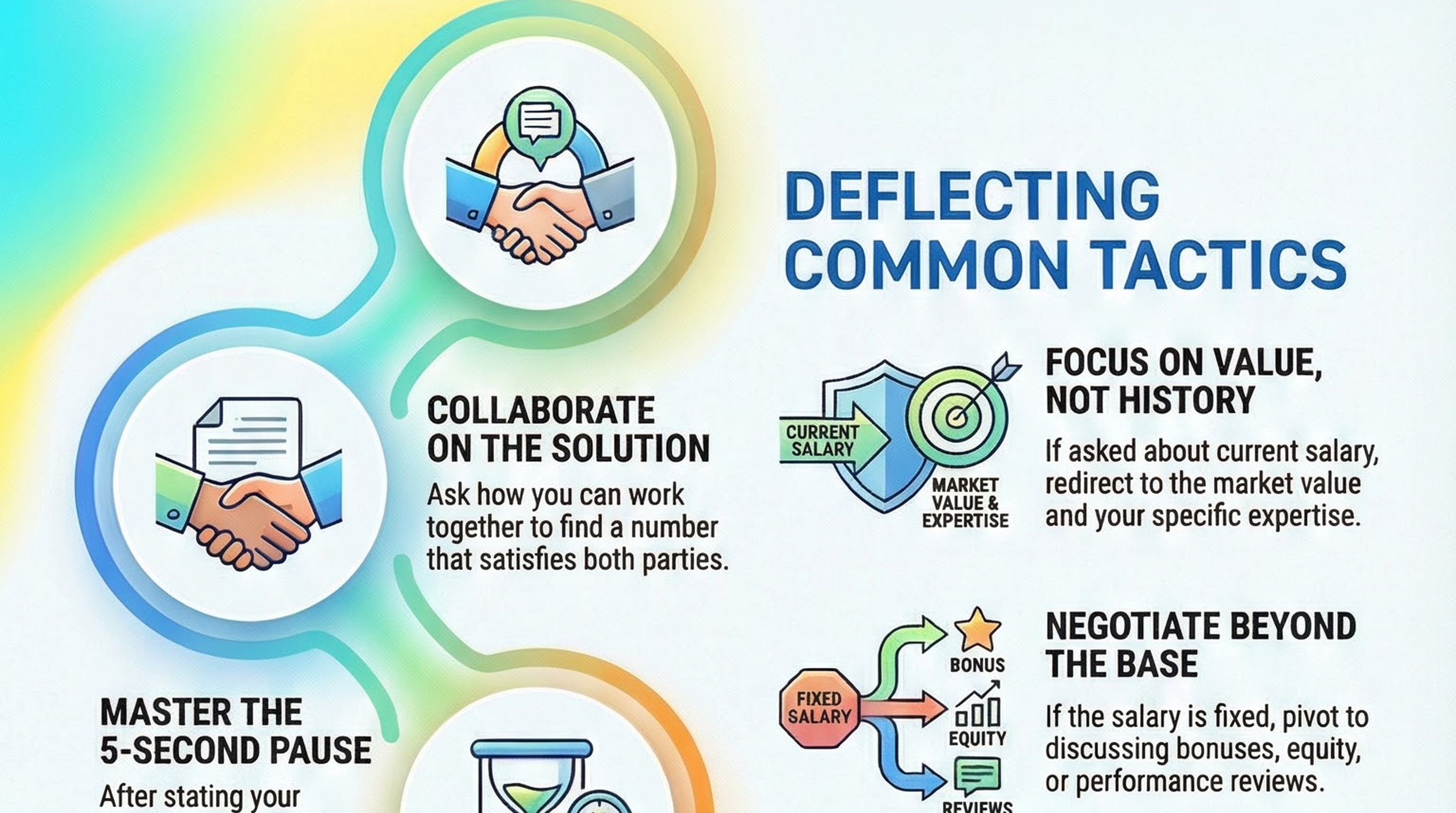
Master the Ask: A Collaborative Framework for Successful Salary Negotiation
Outcome: By the end of this lesson, you will be able to execute a successful salary negotiation using the Enthusiasm-Data-Pause-Collab framework.
Redefining the Negotiation Mindset
Most professionals dread negotiation because they view it as an impending conflict or a high-stakes battle. Shift your perspective: negotiation is not a confrontation; it is a collaborative, problem-solving conversation.
The psychology of the situation is heavily in your favor. The employer has already chosen you—they have identified you as the solution to their problem. You have already demonstrated that you want to work there. Because both sides are already aligned on the ultimate goal of reaching a deal, the negotiation is simply the process of finding the right terms. By adopting this mindset and utilizing a structured framework, you keep strategy in and emotions out.
The 4-Step Negotiation Framework
To maintain professional leverage, you must treat the negotiation as a structured conversation rather than an improvised chat. Follow these four steps to ensure you remain in control of the narrative.
Step 1: Express Enthusiasm
The first ten seconds of your response set the entire tone. You must establish yourself as a collaborative partner rather than a combatant. Never skip this opening, and never lead with financial demands.
- The Script: "I'm really excited about this opportunity. I believe this role is a great fit, and I can make a significant impact."
Step 2: Present Your Counter with Data
When you present your counter-offer, you must "anchor" the conversation at the higher end of your research-backed range. This provides the necessary space for the employer to move toward you while keeping the justification objective.
The Anatomy of the Counter: Enthusiasm + Data Citation + Specific Value + High-Anchored Range
"Based on my research of market rates for this role and considering my specific experience in [X and Y], I was hoping we could discuss a base salary in the range of $X to $Y."
By structuring your ask this way, you aren't just naming a number; you are providing a logical roadmap that explains why that number is the fair market value for your specific expertise.
Step 3: The Power of the Pause
This is the hardest part of the framework, but it is the most critical for maintaining leverage. After you state your range, stop talking. Apply the 5-second rule in the live conversation, but as your coach, I mandate that you practice a full 10-second silence during your preparation.
The inclination to fill the silence is overwhelming, but you must resist it. In negotiation psychology, the first person to speak after a number is presented often loses leverage. Silence creates the necessary pressure and space for the employer to process your anchor and move toward your position.
Step 4: Collaborate on Solutions
If the employer cannot meet your number immediately, shift from a "yes/no" dynamic to a partnership. This positions you as someone who is ready to solve the company's budget problems alongside them.
- The Script: "I understand the budget constraints. How can we work together to get to a number that works for both of us?"
Deflecting Common Employer Tactics
Employers often use scripted pushback to limit their financial exposure. To handle these with confidence, you must have your own scripts ready so that your professional "muscle memory" can take over.
Tactical Response Guide
| The Tactic | Your Response |
|---|---|
| "This is our final offer." | "I understand. Can we explore other components like a bonus, equity, a signing bonus, or start date flexibility?" |
| "We don't negotiate." | "I appreciate that. Would you be open to a performance review after 6 months with a guaranteed salary bump?" |
| "What are you currently making?" | "I'd prefer to focus on the value I bring and market rates for this role rather than my previous salary." |
| Silence or pressure tactics. | Match their silence. Stay calm, maintain eye contact (if in person), and wait for them to continue. |
| "We need an answer today." | "I want to make a thoughtful decision. Can I have 48 hours to review the full offer?" |
Leveraging AI for Negotiation Prep
Technology is the ultimate tool for building the discipline required for high-stakes conversations. Using AI allows you to simulate the stress of a real negotiation, ensuring that when a tactic is deployed against you, you don't freeze—you react.
Utilize these four AI applications to build your muscle memory:
- Negotiation Role-Play: Use a bot to simulate the back-and-forth of a live conversation.
- Negotiation Script Writer: Generate personalized scripts that weave your specific data and experience into the 4-step framework.
- Counter-Tactic Prep: Challenge the AI to throw "final offer" or "budget constraint" excuses at you to practice your redirects.
- Email Negotiation Drafter: Convert your verbal strategy into professional, high-impact written correspondence.
💥 Engagement Zone
🎬 Real Story: The $2,250-Per-Second Silence James was offered $95k for a Product Owner role. He used the 4-Step Framework: he expressed enthusiasm, cited market data for a $105k-$115k range, and then... he went silent. The silence lasted a grueling 8 seconds. Finally, the recruiter blinked: "We can't do $115k, but we can do $108k plus a $5k signing bonus." By staying silent for 8 seconds, James earned an extra $18k in year one—roughly $2,250 per second of "awkward" silence.
😂 Humor Touch The "Power of the Pause" feels like an eternity. Your brain will scream, "Say something! Tell them a joke! Offer to wash their car!" Ignore your brain. Treat that silence like a staring contest with a very expensive prize. If you speak first, you’re basically handing them your wallet and saying, "Keep the change."
🎮 Gamification: The Staring Contest Challenge Set a timer for 10 seconds. Look at a fixed point (or your reflection) and deliver your counter-offer script aloud. Now, wait for the full 10 seconds without making a sound or breaking eye contact. Results:
- Cracked before 5s? You're a "Chatty Negotiator." Practice again until you can hold the line!
- Made it to 10s? You're a "Silent Strategist." +20 Leverage Points.
📊 Self-Assessment: The "Master the Ask" Readiness Check Check off each item you have fully prepared:
- I have my "Enthusiasm Script" written and practiced.
- I have a high-anchored range ($X to $Y) backed by 3 data points.
- I am mentally prepared to sit in silence for at least 5-10 seconds.
- I have at least 3 "Redirect Scripts" ready for common pushback (e.g., "This is our final offer").
Scoring:
- 0-1 Checks: You're "Winging It"—and likely leaving $10k+ on the table.
- 2-3 Checks: Getting warmer, but a skilled recruiter might still outmaneuver you.
- 4 Checks: You're a Negotiation Ninja. Proceed with total confidence.
Conclusion: Your Pre-Flight Checklist
Preparation is the difference between leaving money on the table and securing the compensation you deserve. Use these key takeaways as your final check before the conversation:
- Always negotiate. The initial offer almost always expects a counter. Do not leave value on the table by accepting the first number.
- Enthusiasm first. A positive opening is your greatest shield; it prevents the conversation from becoming confrontational.
- Data justifies your ask. "Because the market shows..." is an argument that is very difficult for an employer to dismiss.
- The pause is your best tool. Discipline in silence creates the space for the employer to move toward your number.
- Script it in advance. This is your most important financial conversation. Never "wing" it; having a written plan keeps your strategy on track.
Final Action Item: Write out your personalized 4-step script right now. Stand in front of a mirror or use an AI tool and practice it aloud at least three times. Your goal is to make the delivery feel natural and your responses to tactics automatic.
Accessibility — Image descriptions
| File | Alt text |
|---|---|
GHFE-M07-L02-ENG-4-step-framework-infographic-landscape.png | Infographic for “Master the Ask: A Collaborative Framework for Successful Salary Negotiation”: visual summary of salary negotiation (landscape layout, GHFE course). |
GHFE-M07-L02-ENG-4-step-framework-infographic-portrait.png | Infographic for “Master the Ask: A Collaborative Framework for Successful Salary Negotiation”: visual summary of salary negotiation (portrait layout, GHFE course). |
GHFE-M07-L02-ENG-4-step-framework-video-thumbnail-landscape.png | Video thumbnail for “Master the Ask: A Collaborative Framework for Successful Salary Negotiation”: preview image for the lesson video (landscape format). |
GHFE-M07-L02-ENG-4-step-framework-video-thumbnail-portrait.png | Video thumbnail for “Master the Ask: A Collaborative Framework for Successful Salary Negotiation”: preview image for the lesson video (portrait format). |