Navigating the Final Play: How to Master Multiple Offers and Avoid the Counteroffer Trap
Outcome: By the end of this lesson, you will be able to manage multiple job offers and make the right decision using the Offer Decision Matrix.
The phone rings. It’s the second offer you’ve been waiting for. Suddenly, the stress of the job search transforms into a high-stakes power play. You have gone from seeker to selected, and for a brief window, you hold all the cards. This is where most candidates lose their nerve—and their leverage.
In the final stage of your job search, you will likely face two defining scenarios: the massive leverage of holding multiple competing offers or the seductive, but often fatal, temptation of a counteroffer from your current employer. To come out on top, you must trade emotional reactions for a data-driven framework. As your coach, my goal is to ensure you don’t just land a job, but secure the best possible trajectory for your career.
Multiple Offers: The Ultimate Leverage Play
Holding two or more offers simultaneously is the strongest negotiation position you will ever occupy. It creates a natural "fear of missing out" (FOMO) for the hiring manager, but you must handle this power with surgical precision. If you are struggling to manage the logistics of these conversations, the Competing Offer Script tool can help you draft the exact language needed for your specific situation.
The Dos of Strategic Leverage
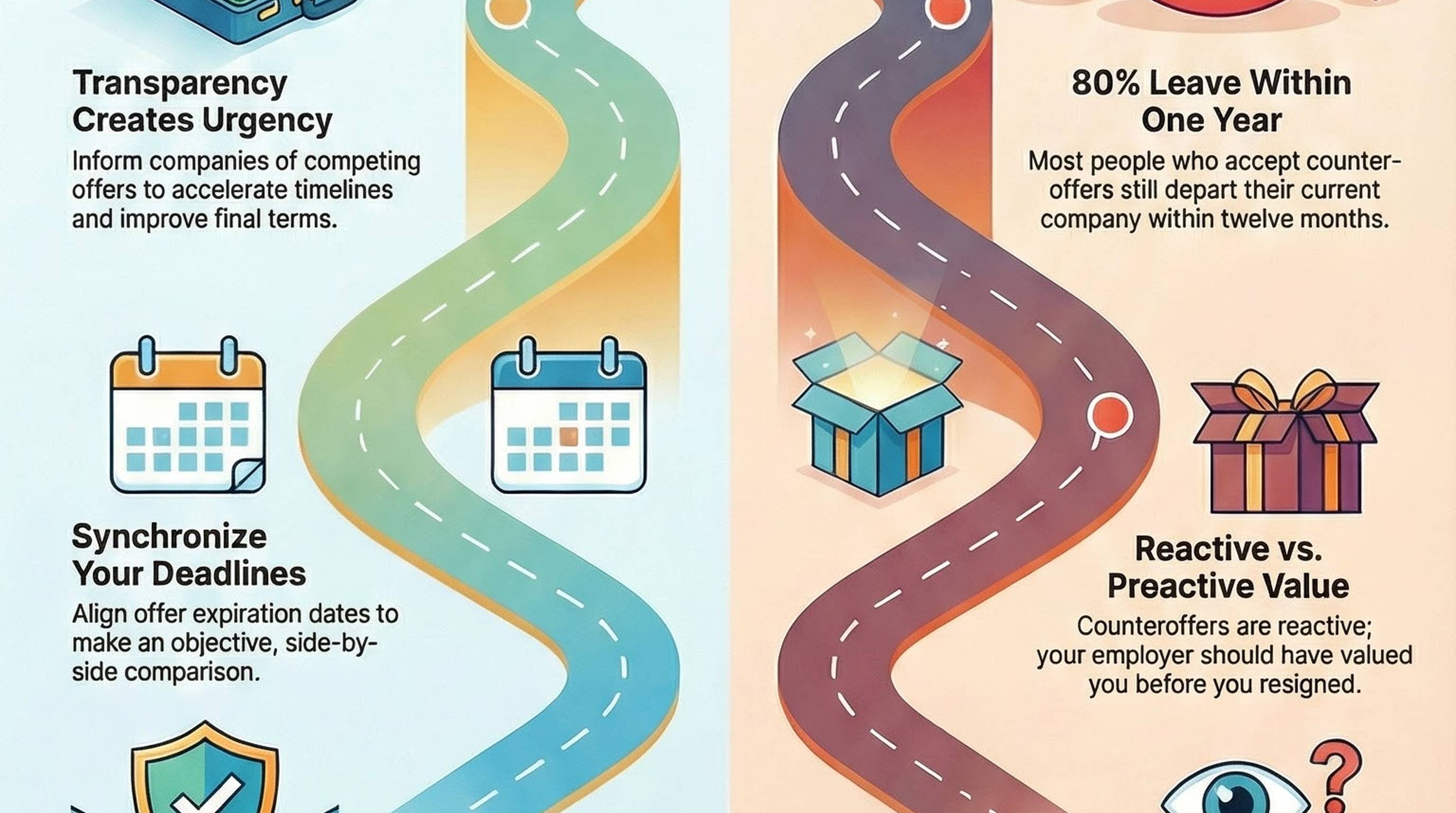
- Create Urgency through Transparency: Inform companies that you have competing offers. This isn't "playing games"; it's providing market context that encourages them to put their best offer forward immediately.
- Synchronize Timelines: Your mission is to get all offers on the table at once. If Offer A gives you 48 hours, tell Offer B you need a decision sooner because you are at the final stage elsewhere.
- Deliver with Collaboration, Not Confrontation: Use the specific phrasing: "I want to be transparent — I’m fortunate to have another offer I’m also considering. Your company is my preference, but I want to make sure the compensation reflects that commitment."
- Coach’s Tip: Deliver this line with a tone of partnership. You aren't threatening to leave; you’re inviting them to make the choice easy for you.
The Don'ts of Negotiation
- Never Fabricate Offers: The professional world is smaller than you think. If you lie about a competing offer and get caught, you don't just lose the job—you destroy your reputation.
- Avoid Aggressive Ultimatums: Leverage is a scalpel, not a sledgehammer. Avoid "pay me X or I’m gone" tactics that sour the relationship before you even onboard.
Why the Counteroffer is a Trap in Disguise
It’s a classic move: You resign, and suddenly your current boss discovers the budget they "didn't have" three months ago. They offer you a 15% raise and a title change to stay. It feels like a win, but experienced recruiters will tell you a different story: most people who accept counteroffers still end up leaving within a year.
If you find yourself tempted by a counteroffer, run your situation through the Counteroffer Evaluator to see if the risks outweigh the rewards. Generally, counteroffers fail for three tactical reasons:
- Unchanged Underlying Issues: A raise doesn't fix a toxic culture, a lack of growth, or a bad manager. Those frustrations will resurface within weeks.
- Questioned Loyalty: You’ve shown you’re willing to walk. When the next round of layoffs or promotions comes, you will be viewed as the flight risk.
- Reactive vs. Proactive Recognition: This is the most damning point. If they valued your contribution, why did it take a resignation for them to pay you what you’re worth?
The "Moment of Truth" Checklist
Before you say "yes" to staying, answer these questions honestly:
- Has the underlying reason I wanted to leave been truly addressed, or just masked with money?
- Do I trust my manager's commitment to me for the next two years?
- Coach's Note: Would I have received this raise yesterday if I hadn't resigned? If the answer is no, they aren't investing in you; they are buying time to replace you.
- Am I staying for the right career move, or just because I’m afraid of the "new"?
Removing Emotion: The Offer Decision Matrix
Choosing your next role is the biggest financial and lifestyle decision of your year. Stop relying on "gut feelings." You need a weighted scoring system to make an objective choice. If the math feels daunting, the Offer Comparison Analyzer can automate this process for you.
The Sample Matrix
Use the weights below as a professional baseline. Coach’s Pro-Tip: While many fixate on compensation, "Manager Quality" and "Growth Potential" are often better indicators of long-term wealth because they lead to your next 20% raise.
| Factor | Weight (%) | Offer A (Score 1-10) | Offer B (Score 1-10) | Weighted Total A | Weighted Total B |
|---|---|---|---|---|---|
| Total Compensation | 25% | ||||
| Growth Potential | 20% | ||||
| Culture Fit | 20% | ||||
| Work-Life Balance | 15% | ||||
| Location/Flexibility | 10% | ||||
| Manager Quality | 10% | ||||
| TOTAL | 100% |
How to Execute:
- Assign Weights: Ensure your total equals 100%.
- Score the Offers: Rate each factor from 1 (poor) to 10 (excellent).
- Calculate the Data: Multiply the score by the weight (e.g., a Score of 8 on a 25% weight = 2.0). Sum the totals to see the objective winner.
The Art of the Graceful Decline
Your reputation is your most valuable asset in any industry. In this game, today’s "no" could easily be tomorrow’s "yes." You may find yourself reporting to that hiring manager at a different company three years from now. Never burn a bridge when you can build a gate.
When you’ve made your choice, use the Graceful Decline Drafter or adapt the following template:
"Thank you so much for the opportunity and the team's time. After careful consideration, I've decided to [accept another offer/stay in my current role]. I have tremendous respect for [Company Name] and hope we can stay connected."
💥 Engagement Zone
🎬 Real Story: The $50,000 Loyalty Trap Mark resigned from Company A for a $20k raise at Company B. Company A suddenly offered a $30k counteroffer to keep him. Mark stayed. Six months later, his manager still hadn't forgiven the "disloyalty," passed him over for a promotion, and Mark was the first to be let go in a "restructuring." He lost the new opportunity and his old security—a $50,000 mistake because he fell for the counteroffer trap.
😂 Humor Touch A counteroffer is like a partner who only notices how great you are when they see you packing a suitcase. They aren't suddenly in love with your "unique talents"; they're just terrified of having to do the recruiting "chores" themselves. If they didn't appreciate you when the suitcase was in the closet, a few extra bucks won't fix the relationship.
🎮 Gamification: The "Loyalty Test" Quiz Be brutally honest. If your current boss offered you a 20% raise tomorrow—without you having to resign first—would you still want to leave?
- Yes: The problem isn't the money; it's the culture, the work, or the management. LEAVE.
- No: You're simply underpaid. You can try to negotiate, but be aware that most people who stay under these conditions still leave within a year.
📊 Self-Assessment: The Offer Decision Matrix (Mini) Rate your primary offer from 1-10 on these four "Success Pillars":
- Total Compensation: Is it fair market value? [ ]
- Manager Quality: Do I genuinely trust and respect them? [ ]
- Growth Potential: Where will this role put me in 24 months? [ ]
- Culture/Balance: Will this role sustain me or drain me? [ ]
Scoring:
- 4-25: Proceed with caution. You might be trading one set of problems for another.
- 26-34: Solid Career Move. This is a logical step forward.
- 35-40: The "Hell Yes" Zone. This is a trajectory-changing opportunity.
AI Tools for a Smarter Negotiation
Strategic career moves in the modern era require modern tools. Integrate these four applications into your process to maintain your edge:
- Offer Comparison Analyzer: Transforms the Decision Matrix into an automated, data-driven report.
- Competing Offer Script: Provides the exact "transparency" language to use with recruiters.
- Counteroffer Evaluator: Runs a risk-assessment on staying at your current firm.
- Graceful Decline Drafter: Crafts professional, relationship-saving messages for the offers you leave behind.
Conclusion & Key Takeaways
Success in negotiation is about taking control of your career trajectory rather than being a passenger to your emotions. By synchronizing your offers, seeing through the counteroffer trap, and letting the data guide your final decision, you ensure your next move is a step up, not just a step sideways.
Key Takeaways:
- Synchronize timelines: Maximize leverage by getting all offers on the table simultaneously.
- Beware the counteroffer trap: Most people who accept one end up leaving within a year regardless.
- Use data, not feelings: Let the Decision Matrix remove your internal bias.
- Always leave on excellent terms: Your reputation is worth more than any single signing bonus.
Accessibility — Image descriptions
| File | Alt text |
|---|---|
GHFE-M07-L04-ENG-multiple-offer-strategy-infographic-landscape.png | Infographic for “Navigating the Final Play: How to Master Multiple Offers and Avoid the Counteroffer Trap”: visual summary of navigating final play multiple (landscape layout, GHFE course). |
GHFE-M07-L04-ENG-multiple-offer-strategy-infographic-portrait.png | Infographic for “Navigating the Final Play: How to Master Multiple Offers and Avoid the Counteroffer Trap”: visual summary of navigating final play multiple (portrait layout, GHFE course). |
GHFE-M07-L04-ENG-multiple-offer-strategy-video-thumbnail-landscape.png | Video thumbnail for “Navigating the Final Play: How to Master Multiple Offers and Avoid the Counteroffer Trap”: preview image for the lesson video (landscape format). |
GHFE-M07-L04-ENG-multiple-offer-strategy-video-thumbnail-portrait.png | Video thumbnail for “Navigating the Final Play: How to Master Multiple Offers and Avoid the Counteroffer Trap”: preview image for the lesson video (portrait format). |