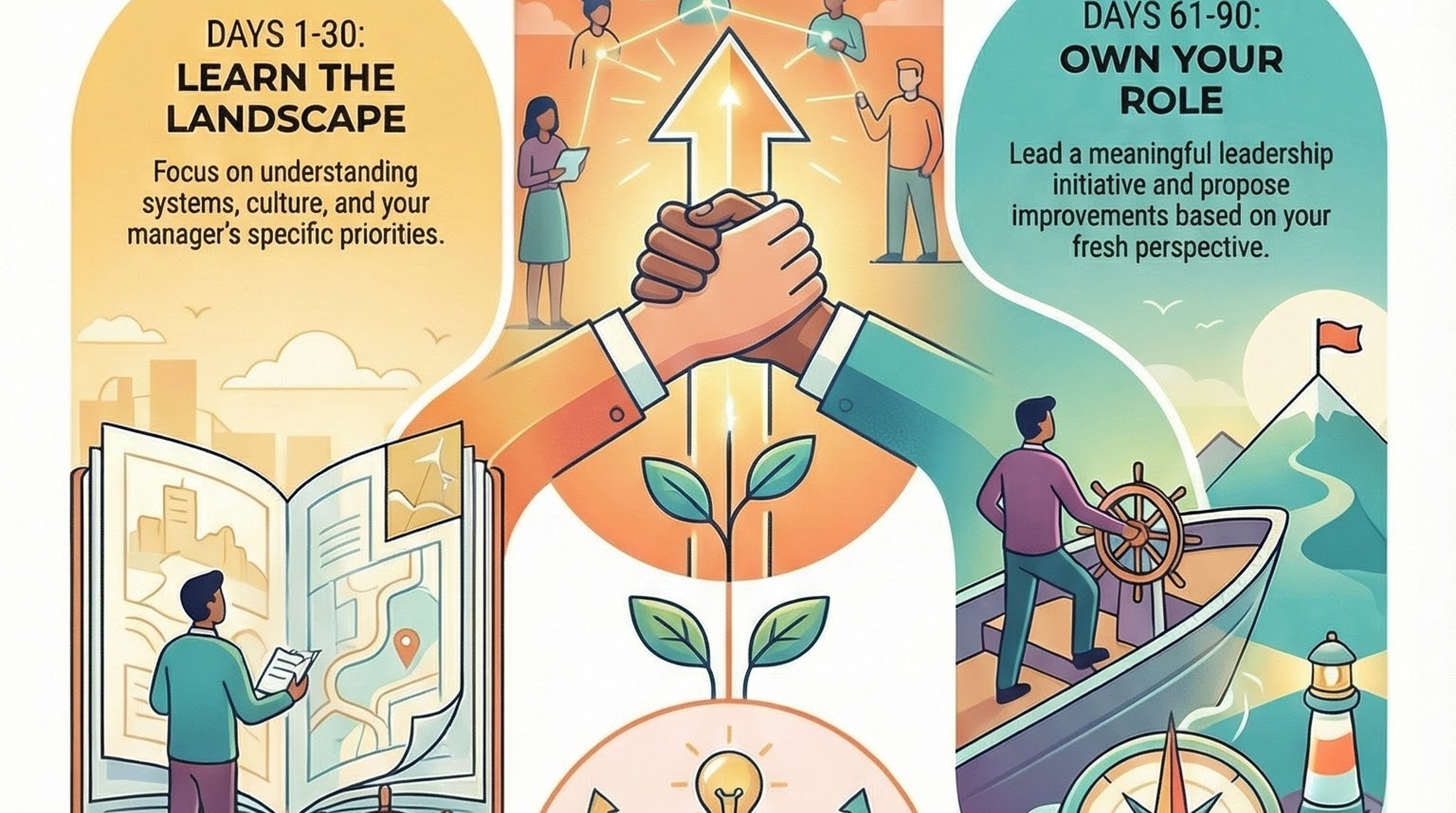
Master Your First 90 Days: The Strategic Blueprint for New Hire Success
Outcome: By the end of this lesson, you will be able to engineer your first 90 days of success using the Learn-Contribute-Own plan.
1. Introduction: Beyond the Job Offer
Congratulations—you got the job. But here is the reality: getting hired is the easy part. The stakes are high, and your first 90 days are a trial by fire. This window determines whether you are perceived as a high-potential "top hire" or a strategic "question mark."
The difference isn't talent; it’s strategy. While most employees "wing it" and hope for the best, top performers arrive with a specific strategic document. Your 30-60-90 day plan is not just a schedule; it is a professional tool designed to accelerate your integration, establish credibility, and secure early wins through intentional action. In this arena, professionalism is demonstrated through preparation.
2. Phase 1 (Days 1-30): The Power of Observation (LEARN)
In the first month, your primary objective is to understand. This is the LEARN phase. Your only job is to absorb the organizational landscape.
Essential Focus Areas:
- Systems and Processes: Master the tools and workflows that keep the department functioning.
- Culture and Politics: Observe how decisions are actually made, who holds the influence, and the unspoken rules of the office.
- Manager Priorities: Align your efforts with what your manager actually cares about and decode their specific communication style.
- Stakeholder Mapping: Identify the key players who make or influence decisions and begin building those critical relationships.
The Signature Move: Within your first week, share your 30-60-90 day plan with your manager. This is a signature move of top performers that immediately signals your initiative and alignment.
During this period, ask more questions than you answer. The questions you pose in your first month reveal more about your intelligence than the answers you give in month six. To maximize this phase, maintain a Learning Journal. Document technical details, cultural nuances, and decision-making patterns. This is your raw data for future improvements.
3. Phase 2 (Days 31-60): Establishing Value (CONTRIBUTE)
Once you have mapped the landscape, you must transition from learning to contributing. The focus of month two is delivering on small projects to build a reputation for competence.
The most effective way to build credibility is through "Quick Wins." These are improvements that are high-visibility but low-risk.
Tactical Examples of Quick Wins:
- Streamlining a Report: Take a clunky, manual process and automate or simplify it.
- Fixing a Broken Process: Identify a minor bottleneck that everyone complains about and resolve it.
- Organizing a Team Resource: Centralize tribal knowledge or documentation that is currently scattered.
As you deliver these wins, expand your internal network beyond your immediate team.
The Foundation of Credibility: Your reputation is built on reliability and follow-through. By consistently delivering on small promises, you prove you are both proactive and competent.
4. Phase 3 (Days 61-90): Stepping into Leadership (OWN)
In the final phase, you move into full ownership. You are no longer an observer; you are an active driver of results.
This is the time to utilize your fresh perspective. This perspective is a temporary superpower. It allows you to see inefficiencies that veterans have become blind to. You must propose meaningful improvements and lead initiatives now, because once you become "part of the system," your ability to see these flaws will fade.
Key Requirements for Phase 3:
- Lead an Initiative: Take full responsibility for a specific project or process overhaul.
- Request Formal Feedback: Schedule a dedicated session with your manager to ensure you are exceeding expectations.
- Set Future Goals: Define your objectives for the subsequent quarter to maintain your momentum.
5. Critical Pitfalls: What to Avoid in Your First 90 Days
To protect your professional reputation, avoid these common mistakes:
- ❌ Trying to change everything in week one: Respect the existing culture before suggesting overhauls.
- ❌ Criticizing the past: Never disparage how things were done before your arrival; it alienates your new colleagues.
- ❌ Being invisible: Failing to speak up in meetings prevents leadership from recognizing your value.
- ❌ Over-promising and under-delivering: Reliability is your currency; do not go bankrupt in your first quarter.
- Neglecting relationships for tasks: Your network determines the information you receive and how quickly you advance. Never prioritize a checklist over a person.
💥 Engagement Zone
🎬 Real Story: The "ROI Guy" Kevin started as a Director of Operations. Instead of "waiting for orders," he showed up on Day 3 with a printed 30-60-90 day plan. His boss was so impressed she shared it with the VP. By Day 45, Kevin had identified a $12k/month overspend in redundant software licenses—a "Quick Win" that effectively paid for his entire annual salary in just 10 months. He wasn't just "the new guy"; he was the "ROI Guy."
😂 Humor Touch Starting a new job is like being the new character in a long-running TV show. Everyone else knows the plot, the inside jokes, and who stole whose yogurt from the fridge in 2019. If you try to rewrite the script in Season 1, Episode 1, the "fans" (your coworkers) will hate you. Spend Month 1 just learning the characters' names and where the good coffee is hidden.
🎮 Gamification: The "Day 1" Survival Kit Which of these do you have ready before you walk in the door?
- A drafted 30-60-90 Day Plan (+10 XP)
- A list of 5 "Smart Questions" to ask your manager (+5 XP)
- Your 30-second "Elevator Pitch" for team introductions (+5 XP)
Total Score:
- 0-10: Rookie. You're winging it and hoping for the best.
- 15-20: Strategic Pro. You're already leading the pack.
📊 Self-Assessment: The 90-Day Mindset Check Rate yourself on a scale of 1-5 for each statement:
- I am more focused on listening and observing than "fixing" things right now. [ ]
- I have identified the 3 "Gatekeepers" of information in my department. [ ]
- I know exactly what my manager considers a "win" for this specific month. [ ]
- I am keeping a "Learning Journal" of every new term, acronym, and process. [ ]
Scoring:
- 4-10: Danger Zone. You're at risk of being "The Invisible New Hire."
- 11-15: Solid Start. You're building a foundation of competence.
- 16-20: High-Potential Star. You're on track for a "Top Tier" first review.
6. Accelerating the Plan with AI Tools
Modern technology can significantly streamline the execution of this blueprint. By utilizing specialized AI applications, you can customize your approach and professionalize your communication.
- 30-60-90 Plan Generator: Creates a structured, role-specific roadmap based on the goals in Worksheet Exercise 1.
- Quick Win Identifier: Use this to filter potential projects against the visibility and risk criteria found in Worksheet Exercise 2.
- Stakeholder Mapping AI: Assists in identifying key influencers to populate your Worksheet Exercise 3 (Key Stakeholder Map).
- Manager Communication Template: Provides professional frameworks for your week-one plan presentation and subsequent feedback requests.
7. Conclusion: Your 90-Day Roadmap Summary
To ensure a successful transition, internalize these key takeaways:
- Have a plan: Professionalism is demonstrated through preparation.
- Follow the sequence: Learn first, then contribute, then own.
- Quick wins build credibility: Find and execute them early.
- Relationships > tasks: Who you know determines what you can accomplish.
- Fresh perspective is your superpower: Use it before it fades.
Your Immediate Action Items:
- Draft your plan today: Complete the strategic worksheet before your first day.
- Identify three quick wins: Select three high-visibility, low-risk improvements to target in your first 30–60 days.
- Commit to the week-one meeting: Prepare to share your 90-day vision with your manager immediately.
By the end of your first 90 days, your goal is for your manager to see you as an indispensable "great hire." This won't happen because of one spectacular event, but because you were consistently excellent and strategically aligned from day one.
Accessibility — Image descriptions
| File | Alt text |
|---|---|
GHFE-M08-L01-ENG-30-60-90-day-plan-infographic-landscape.png | Infographic for “Master Your First 90 Days: The Strategic Blueprint for New Hire Success”: visual summary of first 90 days new job (landscape layout, GHFE course). |
GHFE-M08-L01-ENG-30-60-90-day-plan-infographic-portrait.png | Infographic for “Master Your First 90 Days: The Strategic Blueprint for New Hire Success”: visual summary of first 90 days new job (portrait layout, GHFE course). |
GHFE-M08-L01-ENG-30-60-90-day-plan-video-thumbnail-landscape.png | Video thumbnail for “Master Your First 90 Days: The Strategic Blueprint for New Hire Success”: preview image for the lesson video (landscape format). |
GHFE-M08-L01-ENG-30-60-90-day-plan-video-thumbnail-portrait.png | Video thumbnail for “Master Your First 90 Days: The Strategic Blueprint for New Hire Success”: preview image for the lesson video (portrait format). |