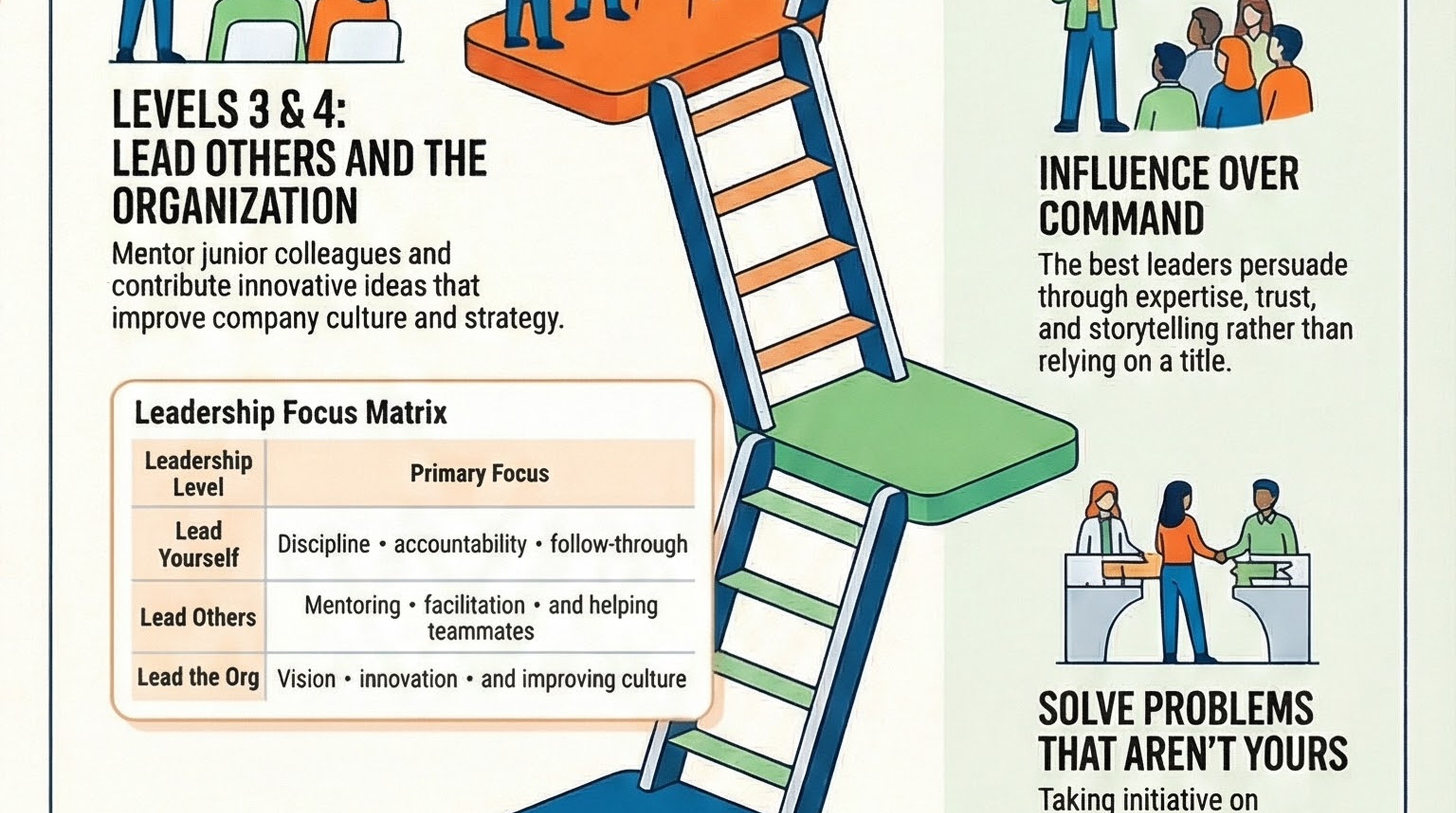
Leading Without the Title: How to Advance Your Career at Every Level
Outcome: By the end of this lesson, you will be able to build leadership influence at any level using the 4-Level Leadership Ladder.
Introduction: The Leadership Myth
"I’m not in a leadership position." As a consultant, I hear this phrase constantly, and it is a dangerous fallacy. Waiting for a formal title before you begin to lead is a strategy for career stagnation. In high-performance organizations, leadership is not a destination on an organizational chart—it is a set of behaviors available to you right now.
To accelerate your trajectory, you must internalize a fundamental truth: "The people who get promoted into leadership roles are the ones who were already leading before anyone gave them permission." If you are waiting for a promotion to act like a leader, you have already missed the window of opportunity. Leadership is about shifting your focus from authority to impact.
The Leadership Ladder: Four Levels of Impact
To command the respect of your peers and the attention of your superiors, you must master the four distinct levels of the Leadership Ladder. Each level serves as a prerequisite for the next, building the credibility necessary for rapid advancement.
Level 1: Lead Yourself
The foundation of all leadership is discipline and accountability. This sounds elementary, yet it is a rare competitive advantage in the modern workplace. Many professionals fail to show up on time or keep their commitments consistently. To master Level 1, you must manage your energy and emotions with such consistency that your reliability becomes an undisputed fact.
Level 2: Lead Your Work
Leadership at this level requires taking total ownership that extends beyond your job description. It means setting uncompromising quality standards for your output and exercising initiative. If you see a broken process, fix it. If you notice an ignored opportunity, raise it and propose a solution. Do not wait for a task to be assigned; own the outcome.
Level 3: Lead Others
You do not need direct reports to develop the people around you. High-potential individuals lead by mentoring junior colleagues, facilitating team discussions, and helping struggling teammates cross the finish line. When you contribute to the success of others, you demonstrate that you are ready for the formal responsibility of management.
Level 4: Lead the Org
This is the level that triggers executive visibility. By contributing ideas that improve the organization's culture, efficiency, or long-term strategy, you catch the attention of senior leaders. Level 4 leadership proves you are thinking like an owner, not just an employee.
Mastering Influence Without Authority
In modern, matrixed organizations, the ability to persuade is far more valuable than the power to command. To move projects forward and align stakeholders, you must cultivate influence through three core pillars: Expertise, Relationships, and Trust.
True influence is built by combining:
- Data and Storytelling: Using objective information framed within a compelling narrative to drive buy-in.
- Genuine Concern: Prioritizing the team’s collective success over your personal gain.
To navigate complex political landscapes, I recommend creating an Influence Map. This strategic tool allows you to plot your path to alignment by identifying four critical factors:
- Person I Need to Influence: The specific stakeholder.
- What I Need: The desired outcome or resource.
- My Approach: The tailored narrative or data you will use.
- Trust Level (1-5): Your current standing with that individual.
Strategic Initiative: Solving Problems That Aren't "Yours"
The fastest way to gain visibility is through cross-boundary initiative. This means looking beyond your immediate silo to tackle friction points that affect multiple teams. High-impact leaders follow a simple mantra: Lead before you’re asked.
To implement this strategic mindset:
- Identify a gap in a process that everyone complains about but no one fixes.
- Volunteer for "stretch" projects that force you to operate outside your comfort zone.
- Never bring a problem to a leader without also bringing a proposed solution.
Practical Implementation: AI Tools and Action Steps
Leveraging modern technology can streamline your development. Utilize these AI applications to sharpen your leadership edge:
- Leadership Self-Assessment: Use this to brutally evaluate your current strengths and identify blind spots in your accountability.
- Influence Strategy Builder: Use this to script your approach for high-stakes meetings with key stakeholders.
- Leadership Mentor Identifier: Use this to find the internal or external guides who can navigate you through organizational politics.
- Initiative Brainstormer: Use this to identify "ignored problems" within your department that are ripe for a leadership intervention.
To begin your advancement immediately, complete the following Leadership Action Plan by identifying one specific action you will take this week at each level:
| Level | My Action | By When |
|---|---|---|
| 1. Lead Yourself | [Specific action] | [Date] |
| 2. Lead Your Work | [Specific action] | [Date] |
| 3. Lead Others | [Specific action] | [Date] |
| 4. Lead the Org | [Specific action] | [Date] |
💥 Engagement Zone
🎬 Real Story: David, a Junior Analyst, noticed that the monthly reporting process was a nightmare for three different departments. Without being asked, he created a standardized template and a 5-minute Loom video explaining it. The "unassigned" project saved 20 man-hours a month. When a Lead position opened up 3 months later, the VP specifically asked for "the guy who fixed the reporting mess."
😂 Humor Touch: Waiting for a leadership title to start leading is like waiting to be a marathon winner before you start running—you're just standing at the starting line in very expensive shoes, wondering why no one is giving you a medal.
🎮 Gamification: The "Invisible Manager" Mission: Identify one "broken" thing in your office/workflow that everyone complains about. Fix it, or propose a 3-step solution to your boss by Friday. Completion earns you the "Problem Solver" badge.
📊 Self-Assessment: Rate your "Leadership Readiness" (1-5):
- I do exactly what's in my job description and nothing more.
- I wait for my manager to tell me how to improve things.
- I occasionally help a teammate when they're stuck.
- I lead projects within my own silo without being asked.
- I actively solve cross-departmental problems and mentor others.
Conclusion: Your Path to Advancement
Advancement is the natural byproduct of consistent leadership behavior. As you move forward, keep these four principles as your guide:
- Lead before you’re asked. Initiative is the primary driver of visibility.
- Solve problems that aren’t yours. Expanding your scope increases your organizational value.
- Influence is greater than authority. Lasting impact comes from persuasion, not power.
- Self-leadership is the foundation. You cannot lead a team until you can lead yourself.
Leadership is a choice you make every day. Stop waiting for the title and start acting like the leader the organization needs.
You don't need anyone's permission.
Accessibility — Image descriptions
| File | Alt text |
|---|---|
GHFE-M09-L03-ENG-leading-without-title-infographic-landscape.png | Infographic for “Leading Without the Title: How to Advance Your Career at Every Level”: visual summary of leading without title advance (landscape layout, GHFE course). |
GHFE-M09-L03-ENG-leading-without-title-infographic-portrait.png | Infographic for “Leading Without the Title: How to Advance Your Career at Every Level”: visual summary of leading without title advance (portrait layout, GHFE course). |
GHFE-M09-L03-ENG-leading-without-title-video-thumbnail-landscape.png | Video thumbnail for “Leading Without the Title: How to Advance Your Career at Every Level”: preview image for the lesson video (landscape format). |
GHFE-M09-L03-ENG-leading-without-title-video-thumbnail-portrait.png | Video thumbnail for “Leading Without the Title: How to Advance Your Career at Every Level”: preview image for the lesson video (portrait format). |