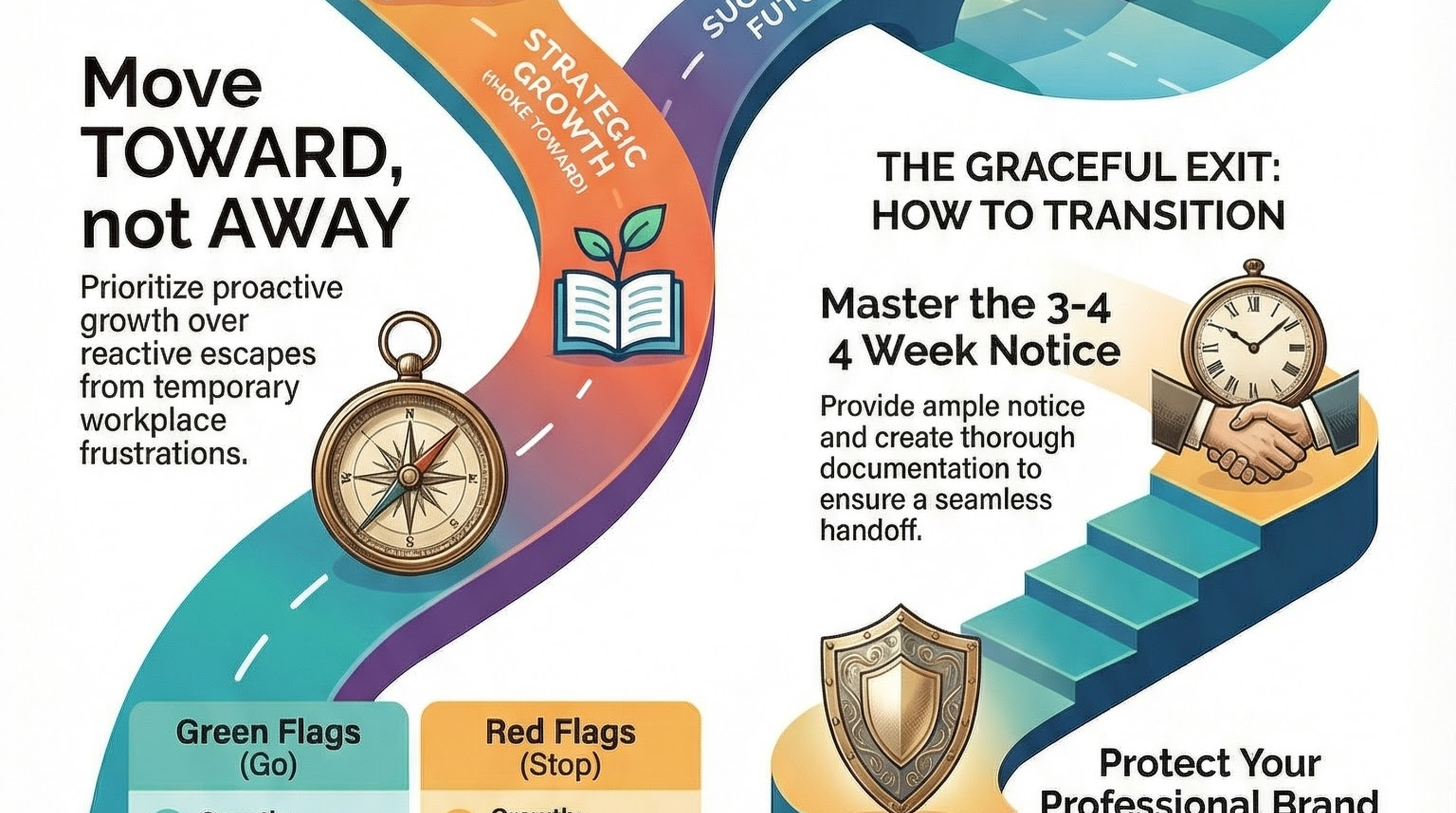
Smart Career Moves: How to Transition with Strategic Intent
Outcome: By the end of this lesson, you will be able to identify when to make your next move using the Green/Red Flag Framework.
The Reality of Modern Career Paths
In my experience advising professionals across every industry, I’ve seen a fundamental shift in the topography of success. The traditional "job for life" is a relic. Today, the data is clear: the average professional will change jobs every two to three years, totaling ten to fifteen different roles over the course of a career.
Because transitions are a mathematical certainty, the question is no longer whether you will move, but how you will move. In the high-stakes game of professional development, every move functions as either an acceleration or a detour. The differentiating factor is intentionality. As I often tell my clients, reactive career moves are expensive—they cost you time, momentum, and equity. A strategic move, however, is a calculated advancement. This guide is designed to help you navigate these pivots with the sophistication of a seasoned strategist, ensuring every change serves your long-term vision.
The Decision Framework: Moving Toward, Not Away
The most vital principle of career management is this: Move toward an opportunity, never away from a frustration. Proactive moves are fueled by growth; reactive moves are often just escapes from temporary discomfort. If you leave because you are annoyed, you are likely to carry that same reactivity into a new role that may not actually be better.
Before you update your resume, evaluate your current situation against these strategic indicators:
Green Flags (Time to Move)
- Learning Plateaus: You have squeezed every drop of knowledge out of your current role and are no longer acquiring new technical or leadership skills.
- Stagnant Pathing: There is no clear, viable trajectory to reach your next milestone within the current organizational chart.
- Mission Accomplished: You have successfully delivered the specific impact, projects, or results you were hired to achieve.
- Superior Alignment: An external opportunity presents a significantly better match for your long-term vision than your current role ever could.
Red Flags (Pause and Reflect)
- Temporary Frustrations: You are reacting to a "bad week," a difficult quarter, or a single project setback rather than a systemic organizational failure.
- Premature Departure: You haven't been in the role long enough to demonstrate tangible impact. Leaving before you can claim a "win" weakens your professional narrative.
- Emotional Reactivity: Your desire to exit is driven by a recent conflict or ego bruise rather than an objective analysis of your "Career GPS."
- Unexamined Internal Options: You are looking for the exit before looking across the hall.
Strategic Evaluation: Looking Before You Leap
Before committing to an external transition, you must conduct a rigorous side-by-side diagnostic. Do not guess; evaluate. Use the following criteria to determine if a potential move actually provides the ROI required to justify the risk of leaving.
| Factor | Current Role Diagnostic | Potential Move Diagnostic |
|---|---|---|
| Learning & Growth | Have I reached a point of diminishing returns on skill acquisition? | What specific new technical or leadership skills will I acquire in the first 12 months? |
| Compensation Trajectory | Is my current ceiling lower than the market average for my impact level? | Does the total rewards package reflect a true advancement in my lifetime earning power? |
| Culture & Team | Does the environment still foster my best work, or has it become toxic? | Does the prospective team dynamic and leadership style align with how I produce results? |
| Career Path Alignment | Is this role a dead end, or is it a stepping stone to my 5-year vision? | Does this new role serve as a high-speed bridge to my ultimate "Career GPS" destination? |
| Location/Flexibility | Does my current work model still support my non-negotiable lifestyle needs? | Will the new requirements (travel/office/remote) enhance or detract from my performance? |
The Power of the Internal Move
In my practice, I frequently find that the highest-ROI move is the one you make without leaving the building. An internal move is often the smartest first step because it allows you to leverage your existing internal capital—the trust, reputation, and network you have already built. By moving to a different department or taking on a new function, you can reset your learning curve and title while maintaining your tenure and benefits. Before looking externally, use tools like an Internal Move Explorer to identify growth paths that might be sitting just ten desks away.
The Art of the Graceful Exit
How you leave an organization is a permanent part of your professional brand. The industry is smaller than you think, and your reputation is a portable asset that follows you for decades. To ensure your departure strengthens rather than depletes your network, follow these steps:
- Provide Proper Notice: Offer a minimum of two weeks; however, for senior roles, three to four weeks is the professional gold standard to ensure a seamless hand-off.
- Document for Success: Create transition documentation so thorough and organized that your successor—and your manager—are genuinely impressed. This is your final "work product" at the company; make it excellent.
- Personalize Your Gratitude: Don't rely on a mass "farewell" email. Take the time to personally thank your manager, teammates, and mentors for specific ways they helped you grow.
- Enforce a "No-Badmouthing" Policy: Never speak negatively about your previous employer—not in interviews, not on social media, and not at happy hour. Discretion is the hallmark of a high-level professional.
- Nurture the Network: Before you leave, connect with every relevant colleague on LinkedIn. Transitioning from a coworker to a "warm contact" requires intentionality; set a reminder to check in with key mentors three months after your move.
Leveraging AI Tools for Your Transition
In the modern era, you shouldn't navigate a career pivot manually. Use targeted AI applications to streamline the logistics so you can focus on the strategy:
- Career Move Advisor: Use this for objective decision support to see if a potential move aligns with the data in your Career GPS.
- Transition Planner: A logistical powerhouse to help you organize the hand-over of your current responsibilities without dropping the ball.
- Resignation Communication: AI can help you draft professional, poised, and graceful messaging that hits the right tone for your departure announcement.
- Internal Move Explorer: A diagnostic tool to help you uncover lateral or upward opportunities within your current organization that you might have overlooked.
💥 Engagement Zone
🎬 Real Story: James, a Project Manager, was frustrated with his boss and quit in a huff for a job that paid $5k more. Six months later, he realized the new company was in a death spiral and his "new" boss was even worse. Because he left on bad terms, he couldn't go back. He spent 4 months unemployed before finding a stable role. Total loss: $30k in lost wages and a massive hit to his mental health.
😂 Humor Touch: Leaving a job because of a "bad week" is like moving houses because you didn't like the way the mailman looked at you—it's a lot of heavy lifting for a problem that might just follow you to the next zip code.
🎮 Gamification: The "Exit Audit": List 3 "Green Flags" (Reasons to move) and 3 "Red Flags" (Reasons to stay) for your current role. If you have more Reds than Greens, stay put for 90 days and focus on building one "Signature Win" before you leave.
📊 Self-Assessment: Rate your "Transition Readiness" (1-5):
- I'm ready to quit today because I'm annoyed.
- I've started looking at job boards but haven't updated my resume.
- I know why I want to leave, but I haven't checked internal options.
- I have a clear "Toward" goal and my wins are documented.
- I have a full transition plan, a 2-week hand-off doc ready, and my "Career GPS" is set.
Conclusion: Your Career Insurance Policy
Strategic career growth is not a matter of luck or timing; it is a lifelong management system. By prioritizing proactive moves over reactive escapes, and by protecting your reputation as fiercely as your skill set, you turn your career into a resilient asset.
As we look toward the holistic systems of career management, remember that your network and your brand are your ultimate insurance policy against market volatility. Stay focused on your "Career GPS," and never let a temporary frustration dictate your long-term trajectory.
Final Action Item Checklist
- Audit your current role: Run the Green Flag/Red Flag checklist to determine if you have truly demonstrated enough impact to justify a move.
- Consult your Career GPS: Map any potential move against your long-term vision to ensure it is an acceleration, not a detour.
- Update your external branding: Refresh your LinkedIn profile and resume to reflect your most recent wins before you need them.
- Secure your network: Connect with your current team on LinkedIn and ensure your transition documentation is ready to leave a lasting, positive impression.
Accessibility — Image descriptions
| File | Alt text |
|---|---|
GHFE-M09-L04-ENG-strategic-transitions-infographic-landscape.png | Infographic for “Smart Career Moves: How to Transition with Strategic Intent”: visual summary of smart career moves transition (landscape layout, GHFE course). |
GHFE-M09-L04-ENG-strategic-transitions-infographic-portrait.png | Infographic for “Smart Career Moves: How to Transition with Strategic Intent”: visual summary of smart career moves transition (portrait layout, GHFE course). |
GHFE-M09-L04-ENG-strategic-transitions-video-thumbnail-landscape.png | Video thumbnail for “Smart Career Moves: How to Transition with Strategic Intent”: preview image for the lesson video (landscape format). |
GHFE-M09-L04-ENG-strategic-transitions-video-thumbnail-portrait.png | Video thumbnail for “Smart Career Moves: How to Transition with Strategic Intent”: preview image for the lesson video (portrait format). |