Future-Proof: Navigating Industry Change in the Age of AI
Outcome: By the end of this lesson, you will be able to build long-term career resilience using the Career Resilience Model.
1. Introduction: The Choice of Readiness
Every year, the headlines deliver the same ominous warning: technology is coming for your job. While it is mathematically certain that automation and Artificial Intelligence will eliminate millions of roles, these forecasts routinely ignore the counter-narrative—that technology simultaneously creates millions of new opportunities.
As a workforce futurist, I look at the horizon and see a thirty-to-fifty-year career span ahead for today’s professionals. In that time, you will navigate industries that haven't even been invented yet. The question isn't whether your sector will face disruption; it will. The real question is whether you will be ready. Industry change is an inevitability, but professional readiness is a deliberate choice. The professionals who thrive in 2050 won’t be those who resisted change, but the "hybrid professionals" who positioned themselves at the volatile intersection of technological advancement and human expertise.
2. The Career Resilience Model: Four Pillars for Thriving
To move beyond the fragile concept of "job security," you must build a foundation of career resilience. This model consists of four strategic layers designed to turn industry shifts into personal leverage.
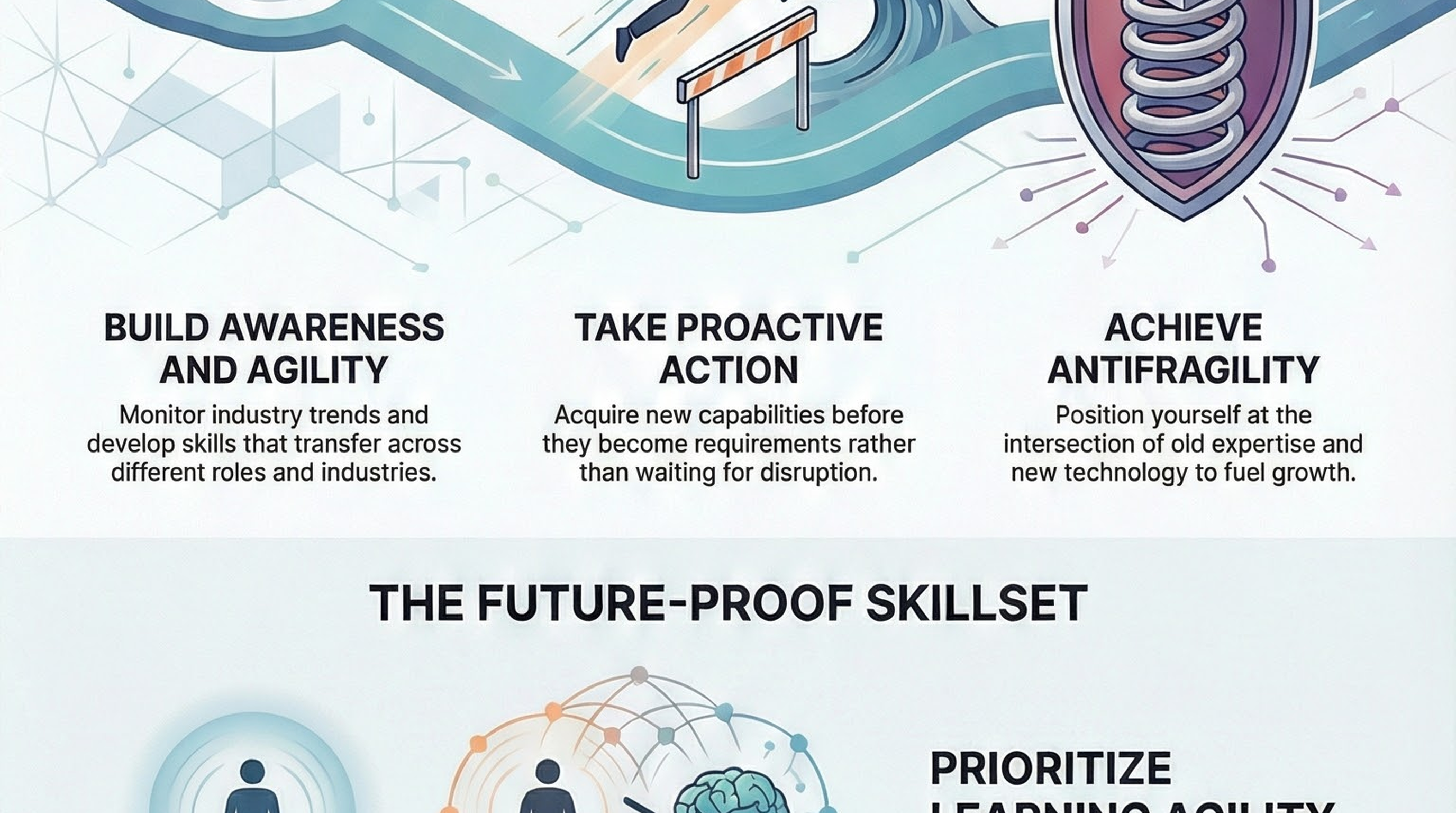
- Awareness: You must maintain a constant scan of the horizon. This goes beyond reading basic news; it requires monitoring where investment capital is flowing and following the thought leaders who are signaling the next market shift.
- Practical Application: Set aside time weekly to analyze which technologies are receiving major venture funding in your sector, as these are the primary indicators of future disruption.
- Agility: True agility is rooted in mastery of transferable skills—your "career insurance." These competencies, such as communication, problem-solving, and project management, travel with you across any role or industry.
- Practical Application: Intentionally lead a cross-functional project that requires high-level negotiation and data literacy, ensuring your value isn't tied to a single software or process.
- Action: Proactivity is the antidote to obsolescence. You must acquire capabilities before they become mandatory requirements. The best time to learn AI wasn’t last year—it was the year before. The second best time is today.
- Practical Application: If you notice AI-driven research tools appearing in adjacent fields, begin an AI literacy path now rather than waiting for your employer to mandate it.
- Antifragility: Most people aim to be resilient (surviving stress). You should aim to be antifragile—actually improving because of the stressor. This is the "sweet spot" where you combine "old expertise" (deep industry knowledge) with "new capability" (AI literacy).
- Practical Application: Use an industry downturn to pivot into a role that requires a hybrid of your legacy industry experience and new automation skills, making you more valuable than a person who only has one or the other.
3. The Human-AI Synergy: Your New Competitive Advantage
The prevailing myth is that AI will replace the professional. The reality is far more pointed: AI will not replace you, but a person using AI will replace a person who doesn't. Your objective is to achieve a state where Human + AI > Human alone. By leveraging AI for data-heavy tasks like research and analysis, you free yourself to focus on the elements that remain uniquely human.
| Skill Category | Why It Matters | Key Examples |
|---|---|---|
| Human Skills | The foundational elements AI cannot replicate; the core of your value. | Empathy, leadership, creativity, judgment |
| AI Literacy | AI transforms every role and is the new baseline for entry. | Prompt engineering, AI tool usage, data literacy |
| Adaptability | The pace of change is accelerating; learning is the meta-skill. | Learning agility, resilience, flexibility |
| Digital Fluency | Technology is the foundation of the modern workforce. | Data analysis, digital communication, automation |
4. Practical Tech: AI Tools for Career Navigation
To implement the Awareness and Action phases of the Resilience Model, leverage these specialized tools to stay ahead of the curve:
- Industry Trend Analyzer (Awareness): Scans market signals and investment flows to identify looming shifts in your specific sector before they reach the mainstream.
- Career Disruption Simulator (Awareness): Allows you to visualize potential industry "stress tests," helping you prepare for various scenarios and identify which skills might become obsolete.
- Transferable Skills Identifier (Action): Maps your current expertise—like communication and problem-solving—to emerging roles, effectively calculating your "career insurance" value.
- AI Literacy Learning Path (Action): Moves you from a state of passive awareness to active implementation, providing a structured route to close your digital fluency gaps.
5. Taking Action: From Insight to Implementation
Resilience is not a feeling; it is a set of practices. Use the following checklist to transition from a traditional career path to a future-proof one:
- Identify three trends currently reshaping your specific industry (e.g., automation, globalization, shifts in investment capital) and map their potential impact.
- Assess your current level of AI literacy and digital fluency on a scale of 1-5 to identify where your knowledge needs an immediate upgrade.
- Identify your core transferable skills, specifically focusing on communication and problem-solving, which serve as your "career insurance."
- Map out two adjacent industries where your current skill set could be applied if your primary industry faces a major downturn.
6. Conclusion: The Sustainable Advantage
In an era of constant flux, your adaptability is your most valuable asset. It is the meta-skill that makes all other skills learnable. As we look toward the industries of 2050, remember that the only sustainable competitive advantage is your ability to learn, adapt, and grow at the speed of change.
💥 Engagement Zone
🎬 Real Story: Sarah, a 15-year paralegal, saw AI drafting contracts and initially feared for her job. Instead of panic, she learned to audit and "fine-tune" AI outputs. Within 6 months, her billable efficiency tripled, leading to a $25k "Innovation Bonus" and a new role as Legal Tech Strategy Lead.
😂 Humor Touch: Worrying about AI taking your job without learning to use it is like being afraid of cars while insisting on riding a horse to work. Sure, the horse is "classic," but the car has heated seats and gets you there before lunch.
🎮 Gamification: The 2-Minute Pivot Challenge: Look at your top 3 daily tasks. If a robot did 50% of them tomorrow, what higher-level "human only" task would you fill that time with? Write it down in 120 seconds.
📊 Self-Assessment: The Adaptability Quotient (AQ) Check:
-
- I've tried at least one new AI tool in my field this month. (1-5)
-
- I can list 3 skills I have that a robot definitely can't do (yet). (1-5)
-
- I spend at least 1 hour a week "scanning the horizon" for industry shifts. (1-5)
- Score 12-15: Future-Proof Legend. 8-11: Emerging Hybrid. Below 8: Time to upgrade the OS.
Key Takeaways:
- Change is the constant: Embrace it as the primary vehicle for your professional growth.
- Synergy is the goal: Aim for the "Human + AI" sweet spot to remain irreplaceable.
- Transferable skills are insurance: Mastery of communication and judgment provides the mobility needed to navigate any shift.
- Adaptability is the foundation: It is the skill that ensures you will never be left behind.
The timeline for readiness has moved up. Start building your Career Resilience Toolkit today to turn industry disruption into your greatest professional advantage.
Accessibility — Image descriptions
| File | Alt text |
|---|---|
GHFE-M10-L03-ENG-future-proofing-infographic-landscape.png | Infographic for “Future-Proof: Navigating Industry Change in the Age of AI”: visual summary of future proof navigating industry (landscape layout, GHFE course). |
GHFE-M10-L03-ENG-future-proofing-infographic-portrait.png | Infographic for “Future-Proof: Navigating Industry Change in the Age of AI”: visual summary of future proof navigating industry (portrait layout, GHFE course). |
GHFE-M10-L03-ENG-future-proofing-video-thumbnail-landscape.png | Video thumbnail for “Future-Proof: Navigating Industry Change in the Age of AI”: preview image for the lesson video (landscape format). |
GHFE-M10-L03-ENG-future-proofing-video-thumbnail-portrait.png | Video thumbnail for “Future-Proof: Navigating Industry Change in the Age of AI”: preview image for the lesson video (portrait format). |