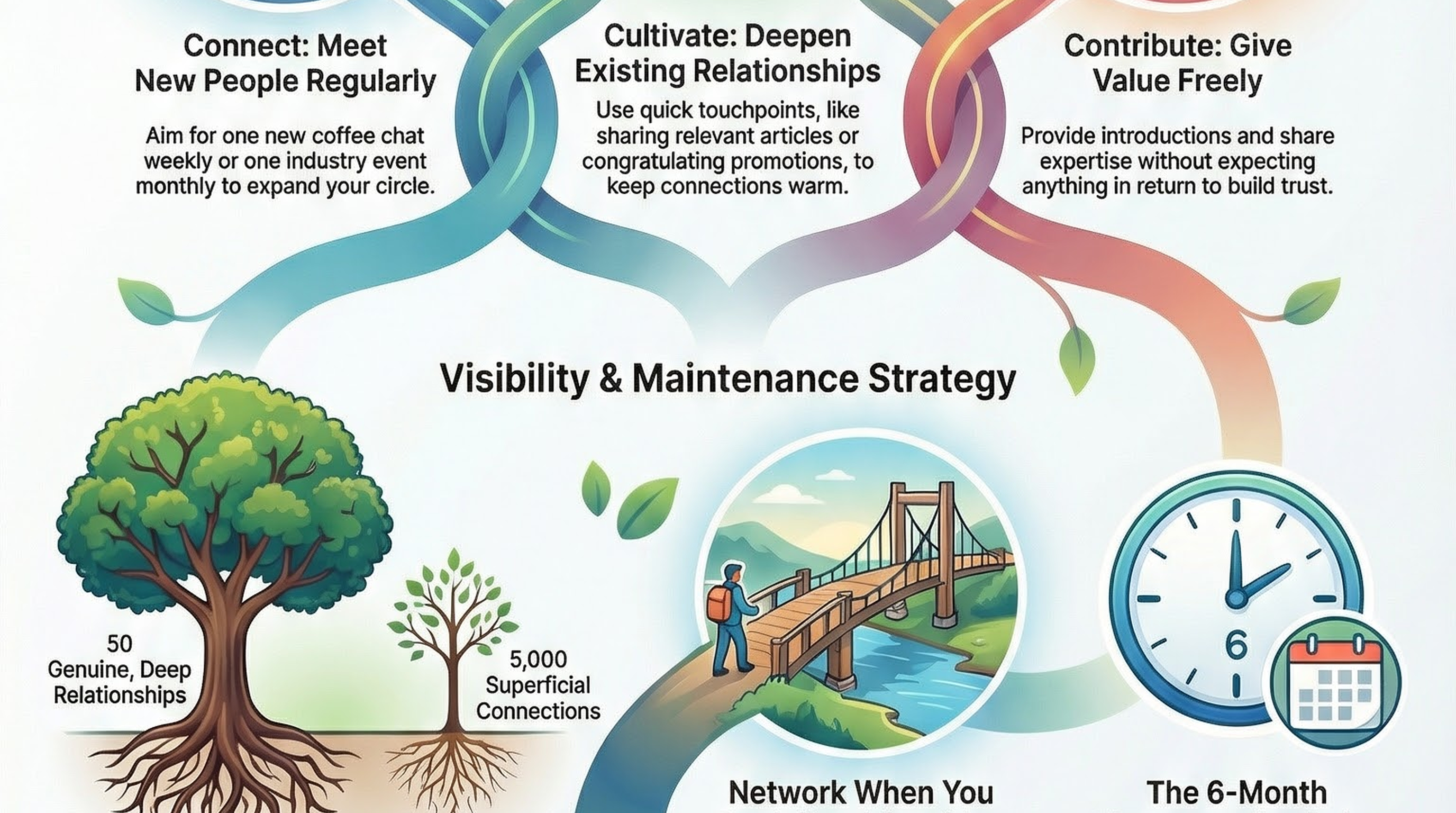
Networking for Life: Why Your Professional Network Should Be a Living Ecosystem (Not a Transaction)
Outcome: By the end of this lesson, you will be able to sustain your professional network for life using the 3 C's Framework.
We have all received it: that dreaded LinkedIn message from a colleague you haven’t spoken to in three years. It usually starts with a forced "Hope you’re doing well!" before immediately pivoting to the real point: "I saw an opening at your company and was wondering if you could put in a referral for me?"
It feels awkward because it is. Transaction-based networking is a recipe for professional loneliness, and frankly, people can smell the desperation. When you only reach out because you need a life jacket, you’ve already missed the point. Your professional network is not a tool to be pulled out of a shed during an emergency; it is your career’s immune system. To keep it healthy, you must treat it as a living, breathing ecosystem that requires continuous cultivation.
The 3 C’s Framework for Sustainable Networking
To move away from "emergency networking," you need a system that integrates into your daily life. The 3 C’s framework transforms networking from a chore into a high-yield professional habit.
- Connect: Continually expand your circle before you need a favor. Aim for one new coffee chat per week and one industry event per month. Whether it is joining a new online community or asking for an introductory meeting, the goal is to keep the "intake" of your ecosystem fresh.
- Cultivate: Deepen your existing relationships through low-friction touchpoints. It takes exactly two minutes to send a LinkedIn message congratulating a peer on a promotion or sharing an article relevant to a conversation you had months ago. These small actions keep a relationship "warm" so that your bridge is built long before you need to cross it.
- Contribute: Adopt the philosophy that givers build the strongest networks. Instead of asking "What can they do for me?", ask "How can I add value?" This means making introductions, sharing job opportunities you aren't pursuing, or offering your specific expertise to help a peer solve a problem. People are naturally inclined to help those who have helped them.
Building Visibility: From Presence to Authority
Your network can only serve as a "career safety net" if people actually remember you exist. Visibility is about maintaining top-of-mind awareness so that when an opportunity arises in your field, your name is the first one that surfaces.
This isn’t about shameless self-promotion; it’s about genuine knowledge sharing:
- Share Insights, Not Just News: Don't just reshuffle content. Share a brief takeaway from a project you completed or a lesson learned from a recent industry shift.
- Engage with Intention: Regularly comment on posts from your peers. Celebrating a colleague’s achievement or adding a thoughtful perspective to a discussion builds authority without the need for a stage.
- Create Value at Scale: By sharing your expertise publicly on platforms like LinkedIn, you are effectively "networking while you sleep," educating your connections on what you do best.
Leveraging AI for Smarter Networking
Technology should never replace human sincerity, but it is an incredible tool for reducing the "friction of starting." Use AI to handle the administrative heavy lifting of networking so you can focus on the relationship.
| AI Application | Strategic Edge |
|---|---|
| Reconnection Message Writer | Overcomes the "blank page" syndrome by drafting low-pressure, no-agenda scripts to revive dormant connections. |
| LinkedIn Content Strategy | Maps out a consistent knowledge-sharing schedule, ensuring you remain visible to your network without burning out. |
| Networking Event Prep | Summarizes participant backgrounds and industry trends so you can enter conversations with high-value questions. |
| Network Value Mapper | Audits your current connections to identify where you can provide more value or where your ecosystem needs more diversity. |
Putting it into Practice: Your Strategic Action Plan
Before you can grow your network, you must understand its current state.
The Strategic Network Audit
Take 15 minutes to categorize your current connections. This helps you identify where your ecosystem is thriving and where it is stagnant:
- Close Professional Contacts: Your inner circle. Are you providing them enough value?
- Dormant Connections: People you haven't spoken to in six months or more. These are your highest-priority targets for reconnection.
- New People: Key individuals in your industry you want to meet.
- Industry Leaders: Thinkers and movers you should follow to stay ahead of the curve.
The Monthly Networking Cadence
Networking works best when it is a recurring appointment, not a one-time event.
- Week 1: Schedule and hold one coffee chat (virtual or in-person).
- Week 2: Focus on visibility—engage with five posts and share one piece of your own expertise.
- Week 3: Attend one industry event or participate deeply in a professional community discussion.
- Week 4: Send out three "no-agenda" reconnection messages to your dormant contacts.
💥 Engagement Zone
🎬 Real Story: Kevin was a Software Architect who hated "networking." He stayed at his company for 8 years and only talked to his immediate team. When the company folded overnight, Kevin realized he had zero external contacts. It took him 6 months of "desperation messaging" to find a new role, and most people ignored him because they hadn't heard from him in nearly a decade.
😂 Humor Touch: Reaching out to a contact only when you need a job is like only calling your parents when you need money—eventually, they're going to stop picking up the phone and start telling everyone you're "busy with your own thing."
🎮 Gamification: The "No-Agenda" Blitz: Open LinkedIn right now. Find 3 people you actually like but haven't talked to in 6+ months. Send them this: "Hey [Name], just saw something that reminded me of our time at [Company/Project]. Hope you're doing awesome!" Stop. Don't ask for a thing. You just "watered" your ecosystem.
📊 Self-Assessment: Rate your "Network Health" (1-5):
- I only talk to people I currently work with.
- I reach out to old colleagues only when I'm looking for a job.
- I have a few "work besties" I keep in touch with.
- I have at least one "no-agenda" coffee chat a month.
- I have a 3-C system (Connect, Cultivate, Contribute) and a "Top-of-Mind" visibility strategy.
Strategic Pillars and the "Six-Month" Challenge
To master lifelong career management, keep these four pillars at the forefront of your strategy:
- Build the bridge before you need it. The worst time to network is when you are desperate for a job.
- Prioritize Quality over Quantity. Fifty genuine, deep relationships will move your career further than 5,000 superficial connections.
- Lead with Value. Always seek to contribute first; the most resilient networks are built by givers.
- Stay Top-of-Mind. Consistent visibility ensures your network works for you even when you aren't looking.
The Six-Month Challenge: Right now, identify three people in your network you haven't spoken to in at least six months. Send them a message today. Do not ask for anything. Do not include an "agenda." Simply check in, mention something you remembered about them, and wish them well.
The strongest asset in your career is not your resume—it’s the group of people who will vouch for you. Keep your ecosystem alive.
Accessibility — Image descriptions
| File | Alt text |
|---|---|
GHFE-M10-L02-ENG-networking-for-life-infographic-landscape.png | Infographic for “Networking for Life: Why Your Professional Network Should Be a Living Ecosystem (Not a Transaction)”: visual summary of networking life professional network (landscape layout, GHFE course). |
GHFE-M10-L02-ENG-networking-for-life-infographic-portrait.png | Infographic for “Networking for Life: Why Your Professional Network Should Be a Living Ecosystem (Not a Transaction)”: visual summary of networking life professional network (portrait layout, GHFE course). |
GHFE-M10-L02-ENG-networking-for-life-video-thumbnail-landscape.png | Video thumbnail for “Networking for Life: Why Your Professional Network Should Be a Living Ecosystem (Not a Transaction)”: preview image for the lesson video (landscape format). |
GHFE-M10-L02-ENG-networking-for-life-video-thumbnail-portrait.png | Video thumbnail for “Networking for Life: Why Your Professional Network Should Be a Living Ecosystem (Not a Transaction)”: preview image for the lesson video (portrait format). |