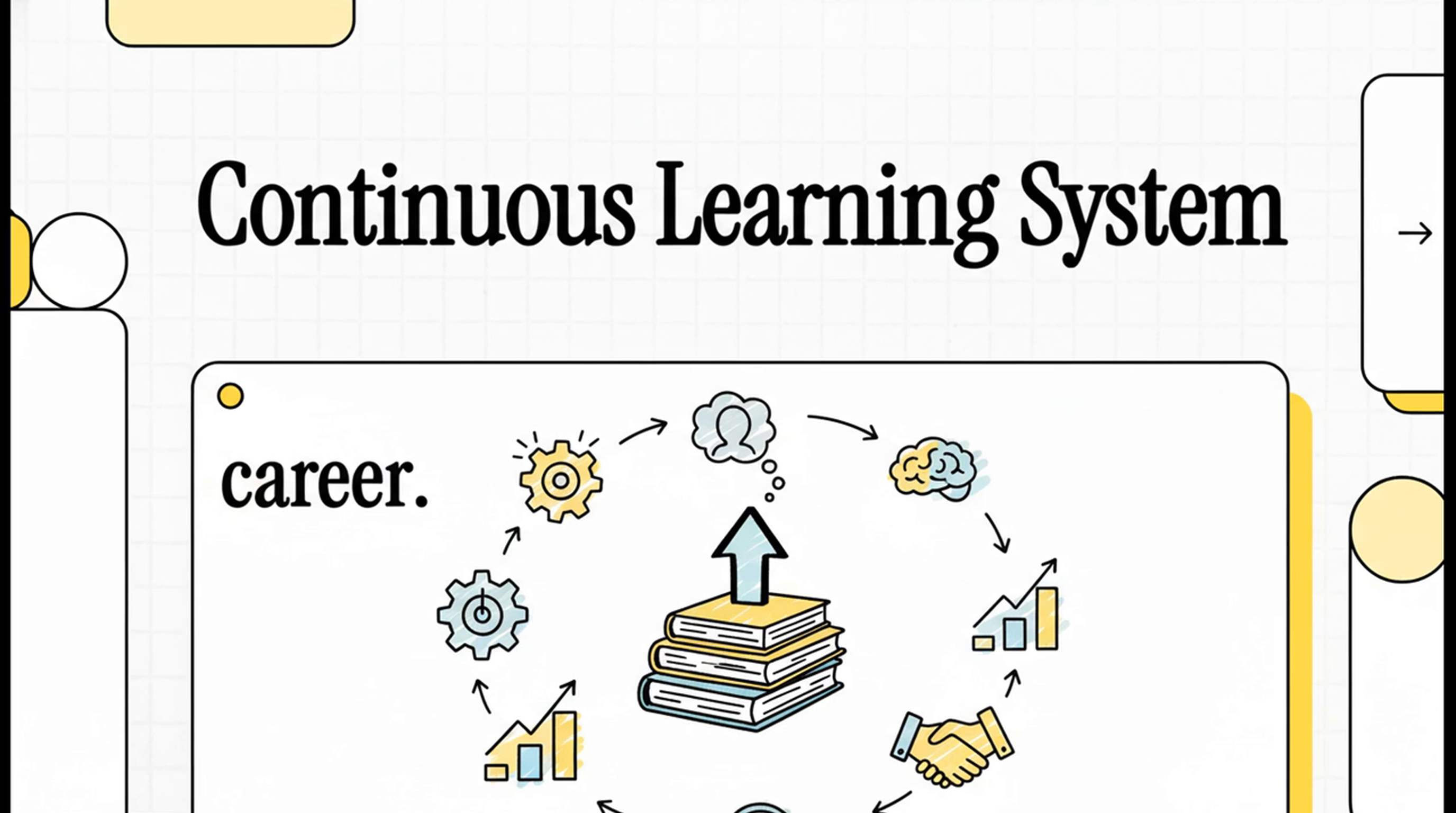
The New Career Survival Guide: Building a Lifelong Learning Stack in the Age of AI
Outcome: By the end of this lesson, you will be able to maintain professional relevance using the 4-Layer Learning Stack.
Introduction: The Shifting Professional Landscape
Your expertise is a depreciating asset. The skills that secured your current position are already losing their market value. We are operating in an era where the "half-life" of professional skills is shrinking at an unprecedented rate; what made you a top performer five years ago is likely approaching obsolescence today.
According to the World Economic Forum, roughly 40% of core professional skills are expected to change within the next five years. This isn’t a distant forecast—it is a wake-up call. Continuous learning is no longer a "nice-to-have" or an optional extra; it is the absolute price of admission for a successful career. To thrive in this landscape, you must become a perpetual student, developing the agility to adapt faster than the market shifts.
Strategic Skill Selection: Building Your "Learning Stack"
Not all learning yields the same return on investment. As a strategist, your goal is to be surgical about where you direct your energy. You must build a "Learning Stack" composed of four distinct layers:
- Layer 1: Core Skills – These represent your primary domain and deep expertise. This is your professional bread and butter—the specialized knowledge that makes you an expert in your specific role.
- Layer 2: Adjacent Skills – These are complementary capabilities that act as multipliers for your core expertise. When you combine Core and Adjacent skills, you create a "Multiplier Effect" where 1+1=3. For example, a marketer who masters data analytics is exponentially more valuable than one who doesn't, as they can quantify the ROI of their creative output.
- Layer 3: Emerging Skills – These are the capabilities required to future-proof your career. In today’s market, AI literacy and data fluency are no longer niche requirements; they are essential survival tools for every field.
- Layer 4: Meta-Skills – This is the foundation of your entire stack. It includes critical thinking, adaptability, and the ability to "learn how to learn." These are the foundational tools that make the acquisition of every other skill possible.
Consistency Over Intensity: The Power of Daily Habits
Most professionals treat learning as a rare, high-intensity "event"—a three-day conference or a monthly seminar. This is a mistake. True mastery is built through consistency, not occasional intensity.
30 minutes daily > 8-hour seminar monthly.
Consistency wins because it integrates growth into your professional DNA. To make this work, you must select your preferred Learning Modality—whether that is Reading, Video, Practice, or Teaching—and find the hidden windows in your schedule. Use your commute, your lunch break, or a dedicated block before your first meeting.
AI as Your Learning Accelerator
Artificial Intelligence is your most powerful partner in the learning process, provided you use it correctly. You must use AI to accelerate your learning, not substitute for it.
Warning: Do not "outsource the thinking" to AI. If you ask a tool to do the work for you rather than helping you understand it, you prevent the formation of the neural pathways required for true mastery.
Instead, utilize AI across these four applications:
- Strategic Skill Advisor: Identify which skills are most relevant to your specific career trajectory.
- Personalized Learning Path: Create a structured curriculum tailored to your specific goals and current knowledge level.
- Concept Teacher: Ask AI to break down complex ideas or challenge your thinking to ensure you aren't falling into cognitive biases.
- Skill Assessment: Use AI to generate practice problems and test your retention through active recall.
The Ultimate Learning Hack: Teach to Learn
The "Golden Rule of Mastery" is simple: If you want to truly understand a concept, explain it to someone else. Teaching is the most powerful learning technique because it forces you to organize your thoughts and, crucially, identifies gaps in your logic. When you struggle to explain a point clearly to a peer or colleague, you have found exactly where your own understanding is weak. Moving from passive consumption to active teaching is how you move from "knowing" to "mastering."
Action Plan: From Insights to Implementation
Stop viewing your career as a static state and start viewing it as a continuous build. Follow this three-step checklist to implement your learning system:
- Audit Your Stack: Use the four-layer framework (Core, Adjacent, Emerging, Meta) to categorize your current abilities. Identify the single most strategic gap that will provide the highest multiplier for your career right now.
- Schedule Your Window: Do not leave your growth to chance. Formally block a 30-minute window on your daily calendar. Decide on your primary modality (e.g., "30 minutes of practice using data tools" or "20 minutes of reading and 10 minutes of teaching a peer").
- Commit to a 90-Day Plan: Define your resources (books, courses, mentors) and your weekly time commitment. Most importantly, set a clear milestone for each month—such as completing a certification, building a portfolio project, or conducting a "teach-back" session with your team.
Conclusion: Becoming a Perpetual Student
The professionals who thrive in the age of AI are those who refuse to stand still. Your career is not defined by what you knew yesterday, but by how fast you can learn today. By treating learning as a daily habit and strategically building a stack of complementary skills, you ensure your relevance in any market. The best time to start was five years ago; the second best time is now. Schedule your first 30-minute session today.
💥 Engagement Zone
🎬 Real Story: Tom, a Graphic Designer, saw AI tools coming and spent 30 minutes every morning for 6 months learning how to use them for "concept sketching." When his agency did layoffs, Tom was the only designer kept because he could do the work of three people in half the time. He actually got a raise while his peers were job hunting.
😂 Humor Touch: Refusing to learn new skills in this market is like trying to keep your horse and buggy because "cars are just a fad"—you might look very classic and dignified, but everyone else is already at the finish line while you're still looking for a bale of hay.
🎮 Gamification: The "30-Day Skill Sprint": Choose one "Adjacent Skill" (e.g., Data Viz, Public Speaking, Prompt Engineering). Commit to 15 minutes a day for 30 days. Mark a big 'X' on your calendar for every day you complete. 30 'X's = Level Up.
📊 Self-Assessment: Rate your "Learning Agility" (1-5):
- I haven't learned a new professional skill since I graduated.
- I attend the mandatory training my company provides.
- I occasionally watch a YouTube video or read an article about my industry.
- I have a 30-minute daily learning habit and a "Learning Stack" list.
- I have a 90-day learning roadmap and I've "taught" a new concept to a peer this month.
Key Takeaways Summary
| Principle | Actionable Insight |
|---|---|
| Learning is a habit, not an event | Consistency wins over occasional intensity; aim for 30 minutes daily. |
| Be strategic about what you learn | Not all skills are equal; prioritize your stack from Core to Meta-skills. |
| AI is your learning accelerator | Use tools to accelerate and structure your path, not as a substitute for effort. |
| Teach to learn | Explain concepts to others to transition from understanding to mastery. |
Accessibility — Image descriptions
| File | Alt text |
|---|---|
GHFE-M10-L01-ENG-lifelong-learning-infographic-landscape.png | Infographic for “The New Career Survival Guide: Building a Lifelong Learning Stack in the Age of AI”: visual summary of career survival lifelong learning (landscape layout, GHFE course). |
GHFE-M10-L01-ENG-lifelong-learning-infographic-portrait.png | Infographic for “The New Career Survival Guide: Building a Lifelong Learning Stack in the Age of AI”: visual summary of career survival lifelong learning (portrait layout, GHFE course). |
GHFE-M10-L01-ENG-lifelong-learning-video-thumbnail-landscape.png | Video thumbnail for “The New Career Survival Guide: Building a Lifelong Learning Stack in the Age of AI”: preview image for the lesson video (landscape format). |
GHFE-M10-L01-ENG-lifelong-learning-video-thumbnail-portrait.png | Video thumbnail for “The New Career Survival Guide: Building a Lifelong Learning Stack in the Age of AI”: preview image for the lesson video (portrait format). |