Should You Stay or Should You Go? A Data-Driven Framework for Your Next Career Move
Outcome: By the end of this lesson, you will be able to determine if a career move is necessary using the data-driven Stay/Go Matrix.
1. Introduction: The Decision Before the Search
Should you actually be looking for a new job right now? It is a question most professionals fail to ask until they are already halfway out the door.
We have all seen the cycle: a frustrating meeting or a missed promotion triggers a midnight "rage-applying" session, fueled by temporary adrenaline. On the other end of the spectrum is "financial inertia"—staying in a stagnant, soul-crushing role for years because the thought of starting over feels too heavy.
Both approaches are reactive, emotional, and—above all—expensive. Emotional career moves carry high financial and temporal costs. You might jump into a role that is even worse than the one you left, or waste years of potential earnings in a role where your skills are depreciating.
The most important career move you will ever make happens before you update your resume. You must move from emotional reactions to data-driven assessments. Not everyone who is unhappy needs a new job; some need an internal pivot or a difficult conversation. This framework is designed to help you determine if you should double down on your current path or build an escape route.
2. The Stay/Go Decision Matrix: 8 Dimensions of Career Health
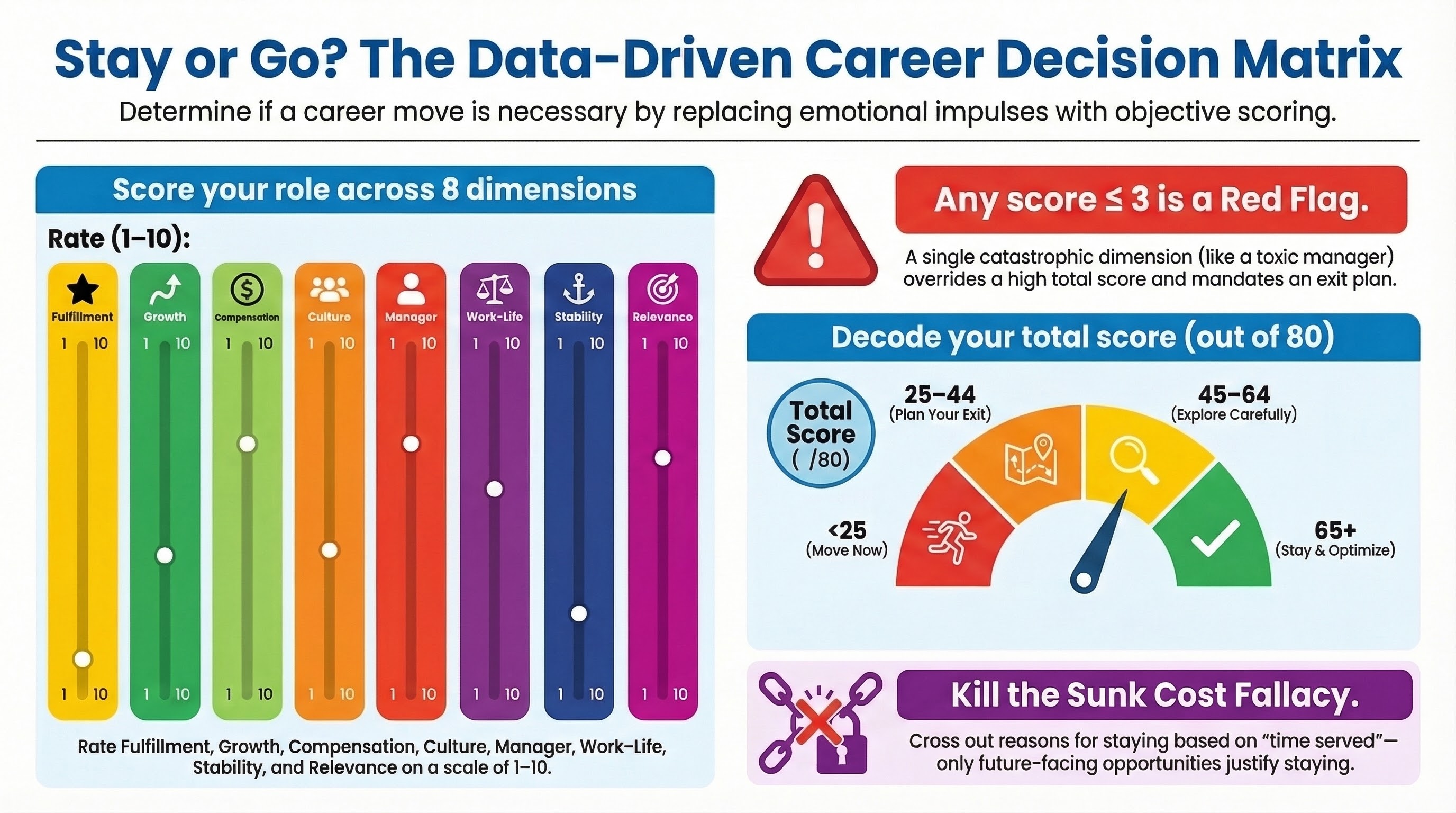
To achieve strategic clarity, you must evaluate your role as it exists today. Score each dimension on a scale of 1 to 10 based on your current reality, not a fantasy of what you hope it could become.
- Fulfillment: Does the work itself feel personally meaningful? Do you genuinely care about the outcome of your projects?
- Growth Trajectory: Are you actively learning new skills, and is there a clear, documented path to your next professional level?
- Compensation: Are you being paid at or above the current market rate for your experience and contribution?
- Culture & Values: Do you have genuine respect for your colleagues, and do the company’s daily actions align with its stated values?
- Manager Relationship: Does your supervisor advocate for your growth, provide autonomy, and support you—or are they a constant source of stress?
- Work-Life Integration: Does the role accommodate the life you’ve designed? Consider your commute, total hours, flexibility, and energy levels when you get home.
- Stability & Security: Is the organization financially healthy, and is your specific role safe from restructuring or layoffs?
- Industry Relevance: Are you building skills that the broader market values, or are you becoming hyper-specialized in an obsolete area?
3. Decoding Your Score: What the Numbers Actually Mean
Calculate your total score (out of a possible 80) and use the table below to determine your strategic posture.
| Score Range | Interpretation | Recommended Action |
|---|---|---|
| 65–80 | Stay & Optimize | You are in a strong position. Do not blow it up. Identify the 1–2 low-scoring areas and address them through internal negotiation. |
| 45–64 | Explore Carefully | Real problems exist, but they may be fixable. Start networking and researching market options quietly without panicking. |
| 25–44 | Plan Your Exit | Multiple dimensions are failing. Begin a structured, proactive search while maintaining performance to protect your reputation. |
| 8–24 | Move Now | This role is actively damaging your career, health, or finances. Prioritize a strategic exit immediately. |
Warning: The "Anything Below 3" Override A single catastrophic dimension can invalidate a high total score. If you have any dimension scored at a 3 or below, it is a non-negotiable red flag. A toxic manager (Score: 2) can poison a high-paying, prestigious role. A collapsing company (Stability Score: 1) means you are on borrowed time regardless of fulfillment. If you see a 3 or lower, begin your exit plan regardless of your total.
4. Exercise: The Career Happiness Timeline
To understand your future, you must audit your past. This exercise identifies the conditions you uniquely require to thrive—what we call your "Career DNA."
Instructions: List every significant role you have held. Assign each a happiness score (1–10) based on how you felt during the majority of your tenure. Plot these on a chronological timeline and look for:
- Peaks: What was happening during your happiest periods? Identify the specific drivers (e.g., high autonomy, a specific mission, or a collaborative team).
- Valleys: What went wrong? Separate the work itself from the environment or external circumstances.
- Patterns: Look for cycles. Do you get restless after three years? Do you thrive in startups but struggle in corporate structures? Recognizing these is data, not a character flaw.
- Trend Lines: Is your satisfaction moving up, down, or flat? A downward trend suggests a systemic issue that a simple job change won't fix—it requires a shift in your fundamental strategy.
5. The Sunk Cost Audit: Stop Investing in the Past
The "sunk cost fallacy" is the primary reason professionals stay in the wrong jobs. You cannot recover the time or effort you have already spent; you can only decide where to invest your future.
Common traps include:
- "I've been here eight years—I can't just throw that away."
- "I worked so hard to get promoted; walking away would waste all of that."
- "My pension vests in two more years—I just need to hang on."
The Audit Process:
- List every reason you are currently staying in your role.
- Categorize each as PAST (time spent, promotions earned, historical effort) or FUTURE (strategic growth, upcoming opportunities).
- Cross out the "Past" reasons. They are gone. They are on your resume, but they cannot be "saved" by staying.
- Evaluate the remaining Future reasons. If they are primarily fear-based (e.g., "I might not find something better"), recognize that fear is not a strategy. It is an anchor.
6. Leveraging AI as a Neutral Coaching Partner
AI is a powerful tool for challenging your assumptions and identifying blind spots. Use it as a coaching partner to ensure your assessment is objective.
Strategic Use Cases:
- Market Reality Check: Research your actual market value. If the AI shows you are significantly underpaid, your "Compensation" score must reflect that data.
- The Blind Spot Detector: Input your matrix scores and ask the AI to play "Devil's Advocate" by challenging your rationalizations for low scores.
- The Industry Relevance Scanner: Check if your skills are appreciating or depreciating. Remember: Comfort in a shrinking skill set is a trap.
- The Career Pattern Analyzer: Provide your happiness timeline data to the AI to help define your "Career DNA"—the specific conditions that must exist for you to be successful.
The Consultant's Golden Rule: Mirror, Not Oracle
- Accuracy Warning: AI data can lag behind real-time market shifts. Always cross-reference AI-generated salary or industry data with at least two human or verified sources.
- Brutal Honesty: Vague inputs produce vague outputs. Be specific about your frustrations and goals.
- Privacy First: Never share your full name or exact employer. Use general descriptions (e.g., "A director-level role at a Fortune 500 manufacturing firm").
- Ownership: Use AI to reflect your thoughts, but never let it make the final Stay/Go decision. You own the outcome.
💥 Engagement Zone
🎬 Real Story: Sarah, 40, was one bad review away from quitting her job at a mid-sized tech firm. She spent a week "rage-applying" to anything with a "Quick Apply" button, nearly accepting a $20k pay cut just to escape. Using the Stay/Go Matrix, she realized her "Fulfillment" and "Compensation" scores were actually high (8/10), but her "Manager Relationship" was a catastrophic 2. Instead of leaving the company, she used the data to negotiate an internal transfer to a different department. She stayed, got a 15% raise, and is now thriving under a leader who actually advocates for her.
😂 Humor Touch: Rage-applying is the career equivalent of drunk-texting an ex. It feels like a brilliant idea for exactly ten seconds, right up until you realize you’ve committed to something you’re definitely going to regret for the next eighteen months. Step away from the "Apply" button and look at the data first.
🎮 Gamification: The 2-Minute Red-Flag Check. Scan your Matrix. Do you have a "3 or Below" in any category? If yes, that's your Red Flag. Write it on a sticky note and put it on your mirror. This is the problem we are going to solve first. No more "maybe it's not that bad." It’s that bad. Now, let’s fix it.
📊 Self-Assessment: The Clarity Meter. How do you feel about your Stay/Go decision right now?
- "I'm still 100% emotional and just want to run away."
- "I've started the Matrix, but I'm still trying to talk myself out of the truth."
- "I have the scores, but the path forward still feels foggy."
- "The data is clear, but I'm still feeling a little nervous about the next step."
- "I have total data-driven clarity on whether I'm staying or going." Current Score: [ ]
7. Conclusion: Clarity is Power
The goal of this framework is to replace impulse with intentionality. Whether the data dictates that you "Stay and Optimize" or "Plan Your Exit," the value lies in owning that decision. When you choose to leave based on data, you are no longer running away from a problem; you are moving toward a goal.
Action Item Checklist
- Complete the Stay/Go Decision Matrix. (Score current reality, not fantasy.)
- Perform the Red Flag Check. (Identify any score of 3 or below.)
- Plot your Career Happiness Timeline. (Identify your "Career DNA.")
- Conduct the Sunk Cost Audit. (Cross out the past.)
- Write your Final Decision Statement. (One paragraph: Based on the data, what is your move and why?)
- Conditional Task (Stay): If your decision is to stay, identify 1–2 dimensions to improve and write an internal negotiation plan.
- Conditional Task (Go): If your decision is to leave, proceed to Lesson 1.2 to design your search strategy.
Accessibility — Image descriptions
| File | Alt text |
|---|---|
GHFE-M01-L01-ENG-stay-or-go-matrix-infographic-landscape.png | Infographic for “Should You Stay or Should You Go? A Data-Driven Framework for Your Next Career Move”: visual summary of stay or go decision (landscape layout, GHFE course). |
GHFE-M01-L01-ENG-stay-or-go-matrix-infographic-portrait.png | Infographic for “Should You Stay or Should You Go? A Data-Driven Framework for Your Next Career Move”: visual summary of stay or go decision (portrait layout, GHFE course). |
GHFE-M01-L01-ENG-stay-or-go-matrix-video-thumbnail-landscape.png | Video thumbnail for “Should You Stay or Should You Go? A Data-Driven Framework for Your Next Career Move”: preview image for the lesson video (landscape format). |
GHFE-M01-L01-ENG-stay-or-go-matrix-video-thumbnail-portrait.png | Video thumbnail for “Should You Stay or Should You Go? A Data-Driven Framework for Your Next Career Move”: preview image for the lesson video (portrait format). |